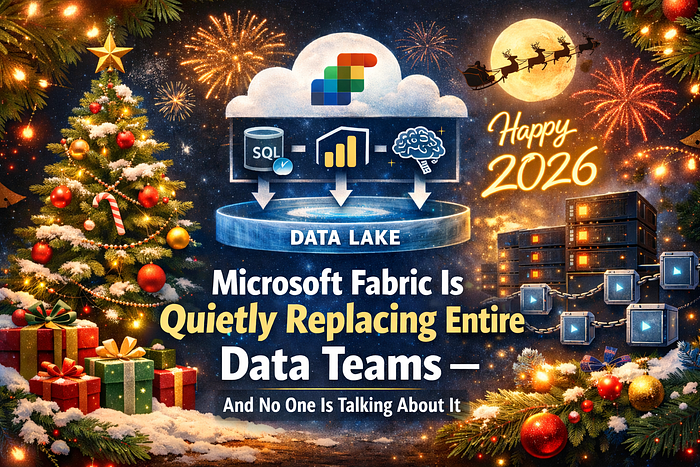
Microsoft Fabric is reshaping modern data teams by unifying data engineering, analytics, BI, and AI into one platform. Learn why traditional data roles are being quietly replaced — and how to stay relevant.
The Shift No One Is Announcing
There will be no announcement saying "Your data team is obsolete." No dramatic headlines. No public blame.
Instead, something far more effective is happening.
Microsoft Fabric is eliminating the need for fragmented data teams by design.
Not by firing people — but by removing the complexity that once justified entire roles.
And most organizations don't even realize it yet.
What Data Teams Used to Look Like
Until very recently, a "modern data stack" required multiple specialized teams:
- Data Engineers for ingestion, pipelines, Spark, storage
- Analytics Engineers for transformations and business logic
- BI Developers for semantic models and dashboards
- Platform Engineers for security, orchestration, and infrastructure
- ML Engineers for notebooks, features, and deployment
Each role existed for one reason: The tools were disconnected.
Different systems. Different ownership. Different failure points.
Coordination itself became a full-time job.
What Microsoft Fabric Changes (At the Core)
Microsoft Fabric is not another tool. It is a full operating system for analytics.
It unifies:
- Data ingestion
- Lakehouse storage
- Data engineering
- SQL warehousing
- Semantic modeling
- Power BI visualization
- AI and notebooks
All of it sits on one storage layer, one security model, and one governance surface.
No handoffs. No duplication. No fragile glue code.
This single design decision removes the organizational need for large, role-based data teams.
The Architecture (Why This Is So Disruptive)
Traditional data stacks look like a pile of boxes connected by hope.
Fabric replaces that with one surface and multiple experiences.
[ Data Sources ]
       |
       v
[ OneLake (Single Storage) ]
       |
       +--> Data Engineering (Spark / Pipelines)
       |
       +--> SQL Warehousing
       |
       +--> Semantic Model
       |
       +--> Power BI
       |
       +--> AI / Notebooks
Same data. Same permissions. Same governance.
Different personas — not different teams.
That distinction is everything.
The Quiet Benchmark: Team Size vs Output
Let's talk realistically.
Traditional Mid-Size Organization
- 2 Data Engineers
- 1 Analytics Engineer
- 1 BI Developer
- 1 Platform Engineer
Total: 5 specialists
Fabric-First Organization
- 1–2 hybrid analytics professionals
Total: 1–2 people
Output?
Often higher with Fabric.
Why?
- No data duplication
- No semantic mismatch
- No deployment bottlenecks
- No cross-team dependency delays
This isn't theory. This is already happening inside enterprises that adopted Fabric early.
The Real Disruption: Role Compression
Microsoft Fabric does not remove work.
It compresses responsibilities.
The new high-value data professional:
- Understands data modeling and business metrics
- Writes SQL and DAX
- Designs pipelines and tells stories
- Thinks end-to-end, not task-by-task
People who only know one narrow layer are becoming expensive risks.
That's why no one wants to talk about it.
A Simple Example: From Raw Data to Insight
Below is a minimal example of how Fabric-style workflows collapse complexity.
from pyspark.sql import functions as F
sales_df = spark.read.table("onelake.raw_sales")
cleaned_df = (
    sales_df
    .filter(F.col("amount") > 0)
    .withColumn("order_date", F.to_date("order_timestamp"))
    .groupBy("order_date", "region")
    .agg(F.sum("amount").alias("total_sales"))
)
cleaned_df.write.mode("overwrite").saveAsTable("analytics.daily_sales")
That same table can now be:
- Queried directly with SQL
- Modeled in Power BI
- Used by AI notebooks
No exports. No copies. No synchronization jobs.
This is how teams disappear — quietly.
Why Executives Love Fabric (And Teams Feel Uncomfortable)
Executives see:
- Lower total cost
- Faster delivery cycles
- Fewer vendors
- Clear ownership
Data teams feel:
- Blurred responsibilities
- Fewer specialized roles
- Higher expectations per person
Fabric aligns perfectly with leadership incentives — not with traditional team structures.
The Skills That Will Survive
Here is the uncomfortable truth:
Tools do not protect careers. Decision-making does.
To stay relevant in a Fabric-first world, you must:
- Think in business outcomes, not pipelines
- Design semantic models, not just tables
- Understand metrics, not just schemas
- Communicate insight, not dashboards
Fabric rewards systems thinkers, not tool operators.
What No One Wants to Say Out Loud
Microsoft Fabric will not eliminate data jobs.
It will expose low-leverage ones.
The future data professional will be fewer in number, broader in scope, and closer to the business than ever before.
And the companies that adopt this early?
They will outperform — quietly.
Final Thought
This is not just about Microsoft Fabric.
It is about a larger shift: Complexity is being absorbed by platforms, and value is moving to thinking.
If you still define yourself by tools, you are already behind