
I don't believe becoming a software engineer is the future anymore. Unless you literally can't imagine yourself doing anything else…
It turns out spending a month with the guys who are refurbishing your place teaches you just as much about career choices and consequences as it does about tiling, flooring and insulating walls. But I can't say it all came as a big surprise. While much of the world looked at us — and lots of folks still do — software engineers with envy, thinking we're the "lucky bastards" who struck oil, for a good while now I suspected many of the jobs that countless parents discourage their kids from taking on, pay just as well, if not better. I now have proof.
In the early 2000s, we had a saying in Romania: "you throw a rock in the air, and it's bound to hit a university graduate on the head as it falls". Everyone but yours truly went to university. My classmates were already discussing half-way through high school where everyone would like to go, what courses they'd like to take. I said, I'm going to study in the UK. I was clearly lying, but it sounded fancy, and special, and they believed me. I think. In all honesty, though, I had no clue what the next step would be for me. My parents couldn't afford to send me to university, and I didn't quite feel the urge to go either. Nothing seemed up my alley. It was meant to be, I just didn't know it yet.
My classmates, however, the overwhelming majority of them, did finish university. Most of them never made use of their diplomas, but that's an entirely different conversation. In Romania, and much of Eastern Europe to be fair, a degree had very little or nothing to do with your job. Even if its actual value was less than a roll of toilet paper, the prestige of having a "university educated child" was priceless. It did not matter that the kid hated the courses, that they barely passed, parents would look down on other parents who didn't send their kid to higher education. Of course, this sentiment of false value got passed down to the offsprings as well, and people would measure their higher education "achievements" like some men measure their you-know-what.
Nobody wondered what happens when everyone works in the office, and nobody knows how to fix a broken pipe or replace a plasterboard.
It was all very binary. You either had a university degree and hopefully — more often than not they ended up working in factories for peanuts — you ended up working in a cushy job at a desk, and as such you were a white-collar "somebody", or you became a blue-collar "nobody".
With IT becoming the "new oil" obviously everyone started pushing their kids into software engineering. But you can't only blame the parents. Silicon Valley in the US, Silicon Docks in Ireland and the media shares plenty of the blame. When jobs are presented like "fun" with foosball tables, break rooms full of gaming consoles, beer on tap — not joking, looking at you HubSpot — endless snacks and Kombucha, you kinda' have to be an eejit not to want your kid to work there. So everyone and your 3rd cousin's 2nd cousin's twins did just that. And in fairness, we needed them all. At least for a while. But that while was short-lived. Shorter than many of us thought. Though on second thought, I wonder why we ever assumed we'd write code by hand for at least a century and a half. If I learned something in high school is that "anything that can be automated, shall be automated". I studied actual automation. It was fun. But I digress.
While everyone was scoring degrees upon degrees, trade got less and less attention. You needed a plumber? It started getting expensive. You needed a socket replaced? You paid a pretty penny. If you were handy, you could do it yourself, but that was your home insurance made void. God forbid needing major refurbishment in or outside the house. You can throw money at people, and you still wouldn't get it done because there is no one to do it. Your best shot is knowing someone who knows someone, and maybe they'll take the work on. If you happen to be close enough, if they happen to like the work you're giving them, if they've just had the vacation in the Bahamas, and they feel like having another one soon — hence money is welcome — they just might. Trades people have so much work, they'll more often than not reject your business. It's nothing personal, they simply can't take on all the jobs.
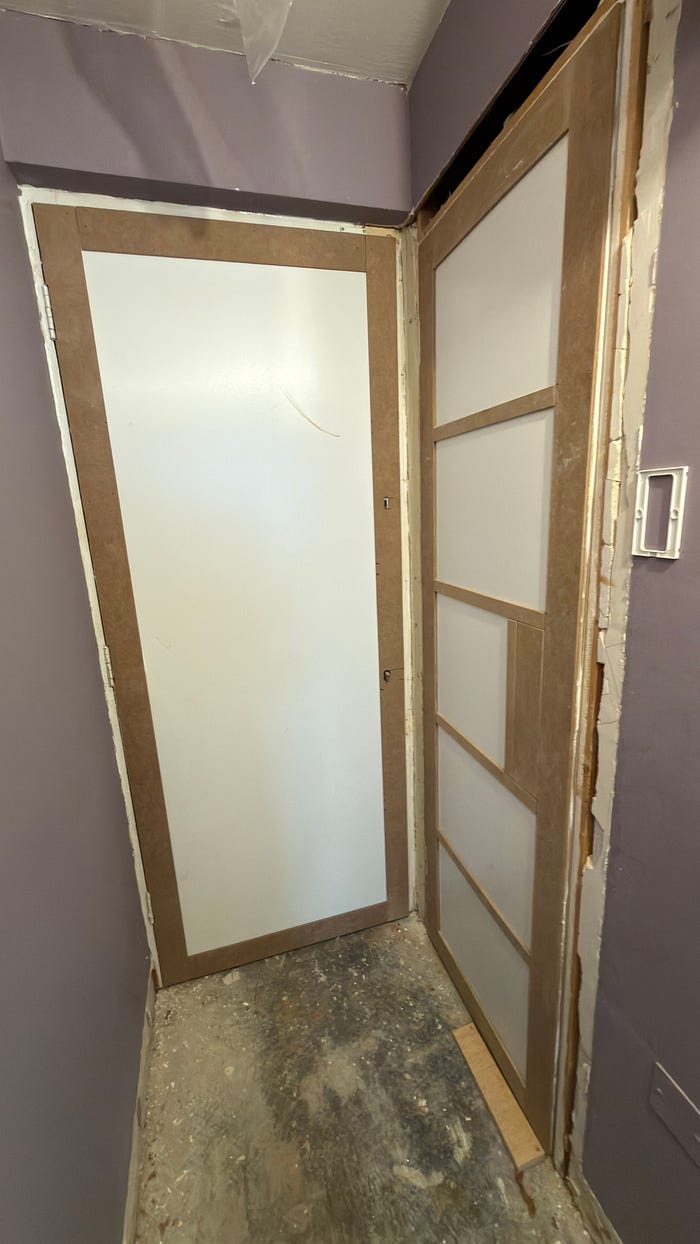

And the pay? When you get to go twice on vacation to some exotic location, you can bet it's pretty darn good. My friend did the math for me, and quickly concluded he makes two-to-three times as much as a staff software Engineer in Western Europe — specifically Ireland. That's nothing to sneeze at. It's tough work alright, but he loves it and the pay certainly helps! The funny part? This was never his dream job. His dad worked alongside my dad in construction. Having experienced first-hand as teenagers what it's like, neither of us felt the calling. I became a self-taught software engineer, he went to several schools only to end up refurbishing homes instead.
I have eleven diplomas, and I use none of them. I refurbish houses instead, and I love it! — one of the guys refurbishing my apartment.
That I managed to get him and his partner to take my apartment on was a sheer alignment of stars. He's doing so well, he specifically asked me not to advertise him, as he hates saying no to customers, but when you're booked for the next two years, the only answer you can give is "no". But he's not a unique example. The electrician, the plumber he works with are just as busy, and just as handsomely paid. The consensus is that you could literally double the professionals in this business overnight, and there would still be an acute shortage in available talent. That's pretty grim for all of us who need them. The skills aren't available, no matter how much you're paying, and we're already very-very much overpaying.
However, if you must, you must…
That said, I know that for some of us software engineering is something we truly enjoy. Don't think for a second that trade jobs are less complicated. Don't think that just because system design sounds fancier, it's any more complicated than figuring out the piping or the wiring in a home. You'd think laying floors is "simple LEGO". Not if you want it to flow nicely across the entire house.
But I get it. Building software is what makes you get up in the morning, and if that's the case, I'd be the last one to discourage you, though keep in mind that as it stands, software engineering is a very fast-moving space. The skills we need change from year to year, and was already true before AI entered the scene. Now, it's about as chaotic as laying the tracks for a Shinkansen while riding it. You'll need to really love your job to want to stay in it, and you've got to develop stamina to keep growing, as the job requirements might change every couple of months or so.
You will make it work because it's your passion, and you'll find ways to keep doing what you're passionate about. Otherwise, don't become a software engineer.
Of course, some of the perks of a software engineering job will remain. You get to work from anywhere — unless you work for one of them companies that hate remote work — you get to eat, drink beverages while working, have a game with your team-mates, in broad strokes have a "cushy job". But don't for a second think that you've hit the jackpot. Layoffs in tech are far more common than in trade jobs. You're also getting paid less than you think. Being in tech may sound glamorous, but financially speaking, you are nowhere near as secure as the person fixing your tap. And that should make you think, whether you've chosen software engineering for the right reasons.
Redistribution of skills
It's pretty obvious if you start spending some time with professionals whom we usually refer to as blue-collar, that at least for a while know — and increasingly so — we've deluded ourselves into thinking "white is better than blue". I particularly dislike when "office folks" talk disrespectfully about everyone else, as if the world ran on white-collar jobs alone. The truth is, the world runs on countless jobs and careers that our parents discouraged us from pursuing.
While we have developed a world where white-collar jobs are also incredibly important, and they do help make the world go 'round, something — and these two guys, most definitely —tells me that we ought to rethink the distribution. We must encourage the next generations to gain skills that don't have much or anything to do with an office, paperwork, or anything digital. Robots are not going to solve this. Not in the next 50 years anyway, and I, for one, would not trust a robot to refurbish my home, that's for sure. I'd probably end up getting electrocuted by my tap and with a window on the floor.
We need to make trade jobs cool again. Because honestly, watching these guys work, they really do cool stuff. And their work actually lasts a lot longer than mine. Makes you think, doesn't it?
Attila Vago — Software Engineer improving the world one line of code at a time. Cool nerd since forever, writer of codes, blogs and books. Author. Web accessibility advocate, LEGO fan, vinyl record collector. Loves craft beer! Read my Hello story here! Subscribe for more stories about LEGO, tech, coding and accessibility! For my less regular readers, I also write about random bits and writing.