Also, as a disclaimer from the start, profitability doesn't come over night.
But what I'm about to tell you will for sure help a lot.
With all of that being said let's dive straight in.
I will structure this article on specific step by step phases to make it easy to apply in your own journey.
First: Choose Your Market
First of all, we need to choose the market we want to trade in.
And this is where most people make their first mistake — they jump into whatever someone on YouTube told them to trade without thinking about what actually fits their situation.
Let me break down each market so you can make an informed choice:
Crypto
The Good:
- Low barrier to entry (you can start with $100)
- 24/7 market (trade whenever you want)
- High volatility = bigger potential gains
- Can trade spot (buying actual coins) or futures (leverage)
The Bad:
- High volatility = you can lose money FAST
- Extremely emotional market driven by news and hype
- Massive price swings can wipe you out if you're overleveraged
- Less regulated, more scams and rug pulls
My take: If you have a small account and can handle extreme volatility, crypto offers the highest risk/reward. But it's also the easiest place to blow your account if you don't know what you're doing.
Futures
The Good:
- Centralized exchanges (everyone sees the same price)
- Very liquid markets with tight spreads
- Transparent pricing and regulation
- Can trade indices (S&P 500, Nasdaq), commodities (gold, oil), currencies
- Lower risk of broker manipulation
The Bad:
- Higher capital requirement (need $2,000-$5,000+ to start properly)
- Main volume is during London and New York sessions
- Standard contracts can be big (though Micro contracts help)
- Fast-moving markets require full attention
My take: If you have the capital, Futures are the most professional and transparent market. The structure and regulation make it safer long-term, but you need to be disciplined.
Forex
The Good:
- 24/5 market with consistent volume across all sessions
- Can start with very small capital ($100-$500)
- Huge leverage available (though this is also dangerous)
- Trade major, minor, and exotic currency pairs
- Many different strategies work (scalping, swing trading, carry trades)
The Bad:
- Decentralized market (different brokers show different prices)
- Broker conflicts of interest (market makers can trade against you)
- Spreads can widen dramatically during news
- Overnight swap fees add up on longer trades
My take: Forex is accessible and flexible, but you need to choose your broker carefully. The decentralized nature means you have to trust your broker isn't screwing you over.
Options
The Good:
- Defined risk (you can only lose what you paid for the option)
- Can profit from direction, volatility, or time decay
- Many strategies (buying calls/puts, spreads, iron condors, etc.)
- Lower capital can control big positions
The Bad:
- Complex — lots of moving parts (Greeks, IV, theta decay)
- Time decay works against you if you're buying options
- Can be illiquid on certain strikes/expirations
- Requires deeper understanding of markets
My take: Options are powerful but complex. Not recommended for complete beginners. Learn stocks or futures first, then add options to your toolkit.
Second: Day Trading vs Swing Trading
Second of all you need to decide if you want this strategy to be for day trading or for long term (aka multiple days/weeks/months to hold a position before closing).
This decision matters more than people realize because it affects everything — your time commitment, risk management, and even your psychology.
Day Trading
Benefits:
- No overnight risk — You close all positions before the end of the session, so you don't worry about what happens while you sleep or over the weekend.
- More opportunities — Multiple trades per day means more chances to make money (or lose it).
- Active learning — You get immediate feedback on your decisions, which accelerates your learning curve.
Drawbacks:
- Time-intensive — You need to be at your screen during your chosen session(s). This isn't passive income.
- Higher stress — Fast decisions, constant monitoring, more emotional pressure.
- Commissions add up — More trades = more fees, which can eat into profits.
Session Selection is CRITICAL for day trading:
You can't just trade any time. You need to pick specific sessions where your chosen instrument has volume:
- London Session (3am-12pm EST) — Best for EUR, GBP pairs and European indices
- New York Session (8am-5pm EST) — Best for USD pairs, U.S. indices (ES, NQ), and gold
- Asian Session (7pm-4am EST) — Best for JPY, AUD, NZD pairs
Here's a real example of how this works:
You could trade EUR/USD during the London session (let's say 4am-6am EST) when it's most active, then switch to trading NQ (Nasdaq futures) during the New York session (10am-12pm EST). Both trades use the SAME entry concept, same risk management, same everything — you're just trading different instruments at different times when they're most active.
This way you get 4 hours of focused trading across the day's best opportunities without burning out.
Swing Trading / Position Trading
Benefits:
- Less time-intensive — Check charts once or twice a day, not every 5 minutes.
- Lower stress — You're not watching every tick. Set your levels and walk away.
- Bigger moves — Holding for days/weeks means you can capture larger price swings.
Drawbacks:
- Overnight/weekend risk — News, gaps, unexpected events can hit you while you're not watching.
- Requires patience — Not getting instant feedback can be psychologically harder for some people.
- Tied-up capital — Your money is locked in positions for longer periods.
My honest take: Most beginners think day trading is easier because you're "in and out quickly." That's backwards. Day trading is actually HARDER because it requires constant attention, fast decision-making, and emotional discipline in real-time. Swing trading gives you time to think.
If you have a full-time job, swing trading is probably more realistic. If you can dedicate 2–4 hours daily during specific sessions, day trading can work.
Third: Risk Management
(The Thing That Makes or Breaks You)
Third of all, we need to decide how we manage our risk, because that's the NO.1 thing that destroys your profitability chances.
Let me be crystal clear: you can have the best entry strategy in the world, but if your risk management sucks, you will lose money.
There are a lot of ways to go about it, but the foundation is understanding the relationship between your Risk-Reward Ratio (RR) and your Win Rate.
The Risk-Reward & Win Rate Table
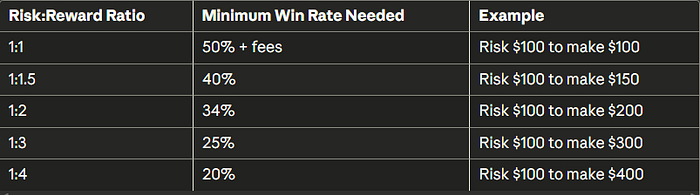
Here's the baseline of minimum win rate requirements for profitability at different RR ratios:
What this means:
If you're trading with a 1:2 RR, you only need to win 34% of your trades to break even (before fees). Anything above 34% win rate and you're profitable.
If you're trading with a 1:3 RR, you only need to win 25% of trades. That means you can lose 75% of your trades and still make money if you're disciplined.
Lower RR vs Higher RR (The Psychology Matters)
Lower Risk-Reward (1:1 to 1:1.5):
Pros:
- Easier on your mental state because you win more often
- Higher win rates (typically 50–70%)
- Builds confidence, especially for beginners
- Targets are closer, so trades close faster
Cons:
- You need to be right more often to stay profitable
- One bad losing streak can wipe out weeks of small wins
- More trades needed to build account significantly
Higher Risk-Reward (1:2.5 to 1:4):
Pros:
- Can be profitable with lower win rates (30–45%)
- One good win can cover multiple losses
- More forgiving of mistakes
- Better for long-term account growth
Cons:
- Psychologically harder — you'll lose more often
- Requires patience to let winners run
- Harder to stick to the plan when you're on a losing streak
My take: Most beginners should start with 1:2 RR. It's the sweet spot — not too aggressive, not too conservative. As you get more comfortable, you can experiment with higher RR ratios.
The 1% Rule (And When to Break It)
General guideline: Don't risk more than 1% of your account per trade.
If you have a $10,000 account, that's $100 risk per trade max. If you have a $5,000 account, that's $50 per trade.
Why? Because even with a solid strategy, you can easily hit 5–10 losing trades in a row. If you're risking 5% per trade, 10 losses in a row = 50% drawdown. That's devastating psychologically and mathematically (you need 100% gains just to get back to breakeven).
BUT — and this is important — if you have a really small account (under $1,000), the 1% rule can be too restrictive.
Here's the reality: if you have a $500 account and you're only risking 1% ($5 per trade), it's going to take forever to grow your account. In this case, you can go up to 5–7% risk per trade maximum, but understand that you're trading more aggressively and the risk of blowing the account is higher.
Once your account grows to $2,000+, drop back down to 1–2% risk.
Now for the final stage: The ENTRY model.
Well there are a lot of options and different things work for different people, but I am going to give you 3 quite popular strategies that I've seen online and also my personal strategy that I've also seen a influencer who I will link there , that talks about that way of entering trades in a similar way as me.
(IF YOU WANT ANY CLIPS OR ARTICLES IN REGARDS TO ANY OF THIS STRATEGIES LEAVE A COMMENT AND I'm GOING TO GIVE THEM TO YOU OR WRITE A FULL NEW ARTICLE ON THEM)
Popular Strategy #1: Support & Resistance + Candlestick Patterns
The Concept:
- Identify key support and resistance levels on higher timeframes (daily, 4H)
- Wait for price to come to these levels
- Look for rejection candlesticks (pin bars, engulfing candles)
- Enter in the direction of the rejection
Why it works: Support and resistance levels are where big players have orders sitting. When price hits these levels and rejects, it's often institutional money stepping in.
Best for: Swing trading and day trading with larger timeframes (15min+)
Popular Strategy #2: Moving Average Crossovers
The Concept:
- Use two moving averages (common ones: 20 EMA and 50 EMA)
- When the faster MA crosses above the slower MA = bullish signal
- When the faster MA crosses below the slower MA = bearish signal
- Enter on the crossover or on a pullback to the MA
Why it works: Moving averages smooth out noise and show the trend direction. Crossovers signal momentum shifts.
Best for: Swing trading and trend-following strategies
Popular Strategy #3: Breakout Strategy
The Concept:
- Identify consolidation patterns (ranges, triangles, flags)
- Wait for a clear breakout with volume
- Enter on the breakout or on a retest of the breakout level
- Set stop loss below the consolidation area
Why it works: Breakouts often lead to explosive moves as trapped traders get stopped out and new momentum enters.
Best for: Day trading volatile markets (crypto, indices during news)
My Personal Strategy:
The Concept: ICC — Indication/Correction/Continuation
You wait for a break of a High/Low for the end of a current trend the formation of a new one or for the continuation of a overall trend on the higher timeframe. It may sound hard to understand, but I will link a series of clips from a great trader to explain it.
Why it works: Because it's based on the most basic market analytics concepts: TRENDS.
Influencer who talks about similar concepts: Trades By Sci
Putting It All Together (The Complete System)
A profitable trading strategy isn't just one thing — it's a complete system:
- Market Selection — Choose what fits your capital and lifestyle
- Timeframe Decision — Day trading or swing trading based on time availability
- Risk Management — RR ratio and position sizing that matches your win rate
- Entry Model — A clear, repeatable way to identify trades
- Exit Rules — Know when to take profit and when to cut losses
- Journaling — Track everything so you can improve
The truth is: Most traders fail not because they don't know how to enter trades, but because they don't have a complete system. They pick random entries, change their risk per trade based on "feeling," and have no idea what their actual win rate or RR is.
If you want to be profitable:
- Pick ONE market
- Pick ONE timeframe
- Pick ONE entry strategy
- Stick to your risk management rules religiously
- Track at least 50–100 trades before changing anything
Consistency beats cleverness every single time.
Not financial advice. Trading is risky. Most traders lose money. But if you build a system and stick to it, you at least give yourself a fighting chance.
By the way, to be fully transparent, Ai was used in the drafting process of this article for reference of sources and correction in writing. I Just want to be transparent. Thanks for understanding.
Anyway, Wish everyone a great Day! Beme OUT.