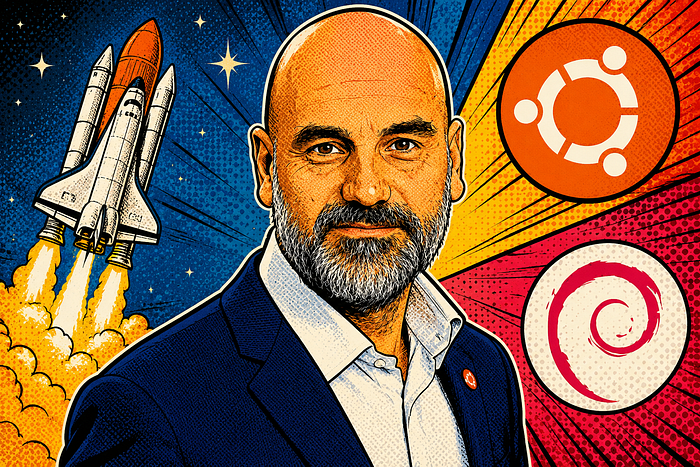
Shuttleworth sold his company for $575M, sailed to Antarctica, and invited 12 Debian developers to his London flat. Ubuntu shipped six months later.
Five hundred seventy-five million dollars. Twelve Debian developers.
Canonical employs 1,175 people. Red Hat charges thousands per server. SUSE, backed by EQT Private Equity, generates hundreds of millions in annual revenue.
Every major commercial Linux distribution is backed by a corporation with investors, quarterly earnings, and a board of directors.
Ubuntu started in a London flat with a dozen volunteers and a billionaire who paid for everything out of pocket.
Today, 60% of public cloud Linux instances run Ubuntu. According to the OpenStack User Survey, Ubuntu powers roughly half of all OpenStack deployments. Dell, HP, Asus, Framework, and Lenovo pre-install it.
Canonical, the company founded to back Ubuntu, generated $291 million in revenue in 2024, with 83% gross margins.
Ubuntu is the most popular third-party OS image on AWS, Google Cloud, and Azure. When developers spin up a cloud instance and choose a Linux distribution, Ubuntu is the most common pick.
All that happened with one visionary person: Mark Shuttleworth.
The Debian developers who made this possible were not employees. They were not paid.
Some of them would later argue that Shuttleworth took their work and built a billion-dollar brand on it without giving back enough. That argument has not gone away in twenty years.
I wrote a lot about Ubuntu recently because of the Ubuntu 26.04 LTS release. This is the story of Ubuntu and why it is a product rather than a distribution.
A Debian Developer Who Made Half a Billion Dollars
I remember the first time I installed Ubuntu. It was 2006. An orange CD arrived in the mail, no charge, no strings.
I had been fighting with Gentoo and Slackware for years, recompiling kernels and editing X11 configuration files by hand. I put the Ubuntu CD in, clicked through five screens, and had a working desktop. That had never happened to me on Linux before.
The man behind that CD had an unusual path to open source.
Mark Shuttleworth, born in 1973 in Welkom, South Africa, studied Finance and Information Systems at the University of Cape Town. While there, he helped install the university's first residential Internet connections.
He was also a Debian developer. According to project records, he uploaded the Apache HTTP Server into Debian's archives.
In 1995, at twenty-two, he founded Thawte Consulting, a digital certificate company. Thawte issued the cryptographic certificates that let websites prove their identity to browsers.
When you visited a bank's website in 1997 and saw the padlock icon, Thawte may have been the company that made that padlock possible. Within four years, Thawte became the second-largest certificate authority in the world. Nowadays, it is everywhere and easy to install. At that time, it was very challenging and very expensive.
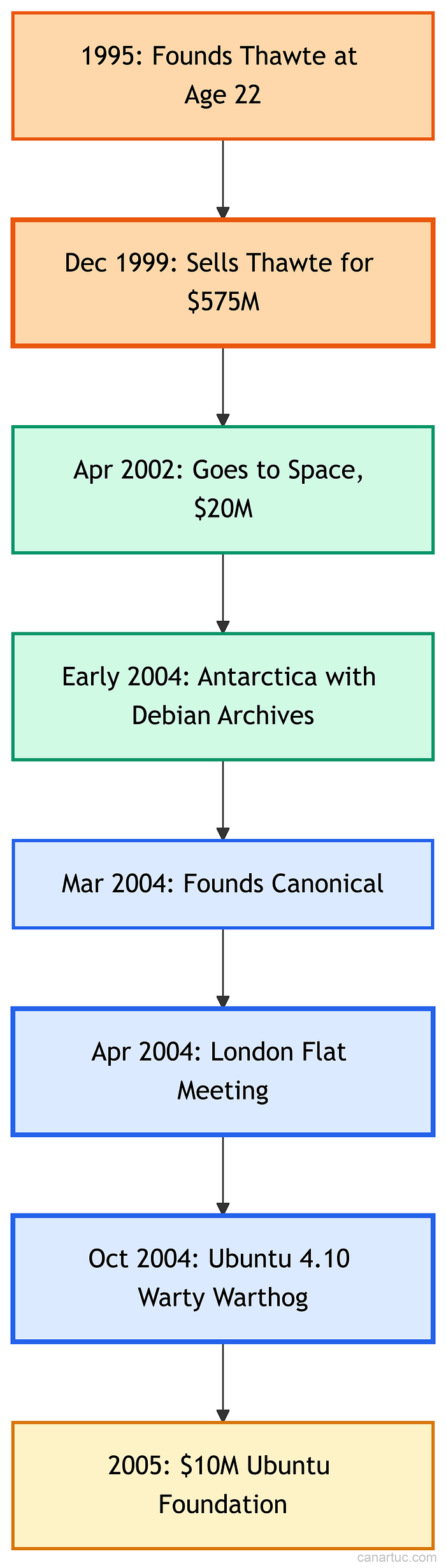
In December 1999, VeriSign bought Thawte for $575 million. Shuttleworth was twenty-six.
Antarctica, an Icebreaker, and Six Months of Mailing Lists
Before Ubuntu existed, Shuttleworth did something that would be absurd for any normal product launch.
In early 2004, he boarded the icebreaker Kapitan Khlebnikov and sailed to Antarctica. He brought six months of Debian mailing list archives to find the people he wanted to hire.
On the ship, surrounded by ice, he read through thousands of messages. He tracked who contributed what, who argued well, who fixed things quietly, and who had opinions worth respecting.
When he returned, he knew exactly who to call.
In March 2004, he formally founded Canonical Ltd. In April, he invited roughly a dozen Debian developers to his London flat. The meeting had one question: What would the ideal Linux operating system look like for regular people?
They had six months to build it.
Free CDs to Every Country on Earth
On October 20, 2004, Ubuntu 4.10 "Warty Warthog" shipped. Based on Debian, running the GNOME desktop, it came with Firefox, OpenOffice.org, and GIMP pre-installed.
Technically, Ubuntu 4.10 was Debian with a six-month polish cycle. Shuttleworth knew that. So he bet on reach instead.
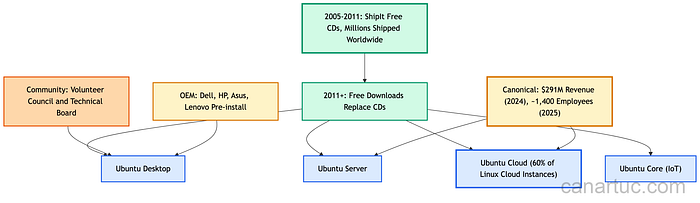
He launched ShipIt, a service that mailed free Ubuntu CDs to anyone who requested them, anywhere in the world… For free.
Most of the world was on dial-up in 2004, with Internet connections that ran through phone lines and topped out at 56 kilobits per second. Downloading a 700MB ISO on dial-up would take over 28 hours, assuming the connection never dropped. It usually did, even if the line was good, because your mother probably wanted to try calling her friend.
So Shuttleworth paid for the postage. Millions of CDs went out. Every country in the world received at least one.
The program ran until 2011, when broadband access had spread enough to make downloads practical.
A billionaire spent his personal fortune to mail physical copies of free software to strangers in every country that requested them. Between 2005 and 2011, ShipIt shipped more CDs than most commercial software companies sold. Shuttleworth covered manufacturing, packaging, and international postage for every single one.
'Ubuntu Takes and Does Not Give Back'
Shuttleworth gave himself the title "Self-Appointed Benevolent Dictator for Life," or SABDFL. It was tongue-in-cheek and also accurate.
Ubuntu was never a pure community project. From the beginning, Canonical funded development, employed core contributors, and made the strategic decisions. The community was governed through a volunteer Community Council and Technical Board, but Shuttleworth held the final say.
The arrangement created friction that persists today. Debian developers contributed the package management system, package archive, and base system that Ubuntu builds on. Ubuntu took those packages, added a six-month release cycle, polished the installer, and shipped.
Debian developers maintained packages for years. Canonical hired some of them and built a brand around the result.
Ubuntu consumed Debian's labor without contributing enough patches, fixes, and improvements back upstream. Some Debian developers called it parasitic. Others called it symbiotic.
Ubuntu brought Linux to people who would never have installed Debian.
In every team I have run over the past twenty years, this argument shows up in some form. One group builds the infrastructure. Another group builds the product on top of it.
The product team gets the credit while the infrastructure team gets the maintenance burden.
Shuttleworth's genius was in recognizing that Debian had built something extraordinary. His blind spot was underestimating how much the builders would resent someone else getting the glory.
In 2005, Shuttleworth put $10 million into the Ubuntu Foundation as a safety net: if Canonical ever went away, the Foundation could continue maintaining Ubuntu. Ten million dollars in escrow says, "I am not leaving."
If your team has lived this argument, clap, leave a comment, or share it. The people who build infrastructure rarely get the credit.
From Free CDs to $291 Million in Revenue
Ubuntu holds 33.9% market share among Linux distributions. Over 60% of public cloud Linux instances run Ubuntu.
The 2025 Stack Overflow developer survey shows that 27.8% of developers use Ubuntu for personal work and 27.7% for professional work. Over 28,900 companies run it in production.
Canonical's revenue hit $291 million in 2024, up from $251 million in 2023, with gross margins improving to 83% from 80%. Operating profit reached $15.5 million. The company grew its headcount from an average of 1,034 to 1,175 in 2024.
By late 2025, the headcount had reached roughly 1,400 across 80 countries, with two-thirds of the company in R&D. Zero venture capital. Shuttleworth still holds all shares.
An IPO is, according to Shuttleworth, "a matter of when, not if." In October 2025, he told The Register he would not take the company public "with our trousers around our ankles," citing market volatility.
He announced his departure as CEO in December 2009, with Jane Silber (COO since 2004) taking over in early 2010. He returned as CEO in July 2017.
The latest release, Ubuntu 26.04 LTS "Resolute Raccoon," shipped on April 23, 2026. Twenty-two years after the London flat meeting, Shuttleworth is still CEO.

4.7% and Linux's Unfinished Desktop
Ubuntu did not win the desktop. Linux holds 4.7% of the global desktop market share in 2025. That is up 70% from 2.76% in 2022, which is progress.
Windows 10 reached end of life in October 2025. Machines that cannot run Windows 11 are pushing some users toward Linux.
At this rate, Linux might hit 6% by late 2026. Still single digits after twenty years.
Shuttleworth's original goal was to make Linux so easy that anyone could switch from Windows. Ubuntu came closer than any distribution before or since.
Ubuntu got closer than any distribution before or since. But desktop adoption needs application compatibility, OEM partnerships, and a break from 20 years of Windows muscle memory. Ubuntu made real progress on all four (Dell, HP, Asus, Framework, and Lenovo now ship Ubuntu), but the desktop remains Linux's unfinished business.
The server and the cloud won instead. Most Ubuntu installations have no desktop environment. They run in racks at companies that would never put Linux on an employee's laptop.
The desktop was the plan. The datacenter turned out to matter more.
If your servers run Ubuntu, clap, comment, or share this. Someone should know the story behind the OS they deploy every day.
Space, Free CDs, and a $10 Million Safety Net
There are many ways to spend $575 million. Shuttleworth spent $20 million going to space. He spent years and tens of millions more funding an operating system he gave away for free.
He mailed CDs to strangers. He paid the salaries of developers who built software for everyone.
He titled himself "Benevolent Dictator for Life" and then proved the benevolent part by funding a $10 million foundation to protect the project from himself.
Ubuntu is an ancient African word meaning "humanity to others." The philosophy translates to something close to: "I am what I am because of who we all are."
A Debian developer from South Africa sold a security company for half a billion dollars, went to space, sailed to Antarctica with mailing list archives, invited twelve people to his flat, and built the most popular Linux distribution in history.
This is the story of Ubuntu, maybe not a startup fairy tale as of today, but a success story.
The Debian developers who made it possible are still maintaining packages. Some of them are still waiting for the credit.
A Product, Not a Distribution
Ubuntu is a product. A good product. Every release brings another controversial discussion, and that is the nature of it, because this is what companies do: product-market fit.
I Changed My Go-to Linux Distro for the First Time from Year 2006 Ubuntu 4.10 was my first go-to Linux distro, I have never changed to another distro besides some trials
If you think Ubuntu is a fully open source Linux distribution, you either have not looked closely or do not understand how products are managed.
Ubuntu 26.04 LTS Is Coming for the Developers macOS Stole in 2014 macOS kept the developer workstation for 10 years because the whole setup just worked. Ubuntu 26.04 LTS is the first…
I am not here to bury Ubuntu. Ubuntu did more to make Linux popular than any other project in history, until SteamOS came along and put Linux on a gaming handheld that millions of people actually bought.
Ubuntu 26.04 LTS Breaks Backward Compatibility on Purpose Ubuntu 26.04 LTS ships three changes that will break existing workflows on upgrade day
I appreciate what Canonical built. I used Ubuntu for close to two decades. I understood what they were trying to do, and I supported it with my time and my installs.
But I do not want to run a hybrid operating system where I have to research which parts are open and which parts are closed.
For desktop, if the line between what Apple does and what Canonical is trying to do gets blurry, I would rather pick Apple. At least Apple is clear about being closed.
35 Years of Linux Principles. Ubuntu Just Threw Them Away in One Snap. Ubuntu 26.04 LTS just shipped the fastest developer setup Linux has ever seen. It is hidden in a roadmap Canonical…
For the server, I have never used Ubuntu when there is already Debian.
If you are curious about Debian, which Canonical makes millions by building on top of, here is the story of Debian's founder:
A Dorm Room in 1993. The International Space Station Today. One Person the Industry Forgot. Deb and Ian. A 20-year-old's act of love is now the foundation on which billions of lines of code run. The relationship…