Six thousand pull requests. One year of free labor. One enterprise paywall.
A developer wakes up to a notification. His pull request merged overnight. Twenty-seven commits, weeks of evenings, finally in. He pours coffee. Opens the news feed. The same vendor, the same day, has announced the successor product. The tool he helped build is being replaced for enterprises. It is something he cannot touch.
He scrolls. The successor is closed. The license he trusted is still technically valid.
He opens a discussion thread on the project's repository. 6,000 pull requests have landed there in 12 months. Dozens of his fellow contributors have been doing what he has been doing: sprint after sprint of free engineering, against a roadmap they thought they shared.
He types the question that has been circling the FOSS community since the first big-company permissive-license release shipped:
"Now I am wondering, will closed product pick some of the code from open source product, or were we (i.e., us, free volunteer/enthusiast coders) essentially working for free on a code base that will only be used in enterprises?" [1]
Stripe Paid Their Engineer. Multiply by Six Thousand.
Gemini CLI is the command-line version of Google's Gemini AI, used by developers and power users at the terminal rather than in a web browser. It launched in June 2025. Apache 2.0 license. Public repository at google-gemini/gemini-cli. Open development model with the public roadmap on GitHub, community meetings, and a Discord. By May 2026, the project had 100,000-plus GitHub stars and more than 6,000 pull requests merged by outside contributors.
The integrations followed the stars.
Dynatrace shipped observability hooks for the agent…
Elastic wired up search and retrieval against the same codebase…
Figma pushed design context into the workflow…
Shopify and Stripe layered commerce primitives on top of all of it…
Five enterprise tools, all built against Gemini CLI's Apache 2.0 codebase, on the assumption that the codebase would stay Apache 2.0.
A developer at Stripe spends two weeks integrating a tool. That sprint costs Stripe roughly $10,000 in loaded salary. The cost to Google is zero, because Stripe paid it. Most pull requests take less effort than that, but with 6,000 of them in the codebase, the cumulative free labor reaches the tens of millions of dollars. That is the Series B funding round scale, paid by other companies and settled in commits.
The developer with the 27 merged commits has a name. Andrea Alberti. His pull request landed on May 19, 2026. The same day, Google announced the project's successor at Google I/O: a closed-source product called Antigravity CLI.
Alberti took it to the GitHub discussion thread and asked the question directly. Were the community contributors "essentially working for free on a code base that will only be used in enterprises?"
The product manager running the thread, Dmitry Lyalin, did not answer that question directly, but the Google Developers Blog post did… [2]
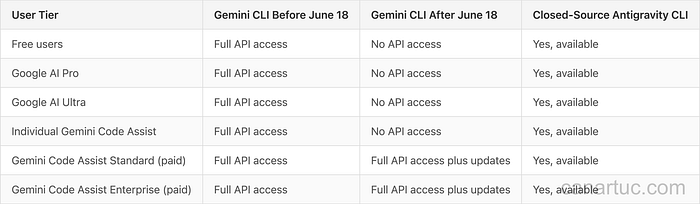
On June 18, 2026, free users, Google AI Pro subscribers, Google AI Ultra subscribers, and individual Gemini Code Assist users lose API access to the open-source command-line tool they helped build. Paid Gemini Code Assist Standard and Enterprise customers keep it, along with the model updates and security patches.
Apache 2.0 permits the move. The license made no other promise to the contributors.
I have watched this play out before. In every company I have worked at over the past 20 years, there has been a tension between what the lawyers will allow and what the engineers think is the deal. The lawyers are reading the license terms; the engineers are reading the README files, the roadmap, and the subtext of the maintainer's blog posts. The deal sits in the gap.
On June 18, the API Goes Dark for Four Tiers
The Google Developers Blog post is titled "An important update: Transitioning Gemini CLI to Antigravity CLI."
Antigravity CLI is "available to everyone." Free users, Google AI Pro, Google AI Ultra, and individual Gemini Code Assist users get pushed there. On June 18, 2026, those tiers lose API access to Gemini CLI. The repository and the Apache 2.0 license remain intact; API access for those tiers does not.
Paid Gemini Code Assist Standard and Enterprise customers keep Gemini CLI, including the model updates and security patches that come with it.
The open-source product becomes a permissive product for paying business customers, while the closed-source successor becomes the free product for everyone else.
Google's framing in the same post: "We can serve you best by pouring our energy into a single product built for today's multi-agent reality." Nothing in that sentence explains why the open-source product is being pulled from the developers who built it.
This Is Not the Redis Playbook
The first instinct is to file this next to Redis, HashiCorp, and Elastic. It does not fit there. Those were license flips with messy corporate aftermath. Redis went Server Side Public License (SSPL) in March 2024, then reversed to GNU Affero General Public License version 3 (AGPLv3) in May 2025 when Redis 8 shipped. Elastic went SSPL and Elastic License v2 (ELv2) in 2021, then added AGPLv3 as a third option in August 2024. HashiCorp went Business Source License (BSL) in August 2023, then sold to IBM for $6.4 billion in February 2025. The forks survived every reversal and every acquisition: Valkey forked Redis, OpenTofu forked Terraform, OpenSearch forked Elasticsearch. The community trust did not come back when the licenses did.
Google did none of that. The Gemini CLI Apache 2.0 license is intact. The repository will keep accepting commits, and anyone can fork or ship it.
Google cuts API access for everyone except paid business customers. The Gemini CLI client cannot function without Google's model, which lives on Google's servers. Those users can still fork the Apache 2.0 code, but the code does nothing without the model behind it. Google controls the API, not the license.
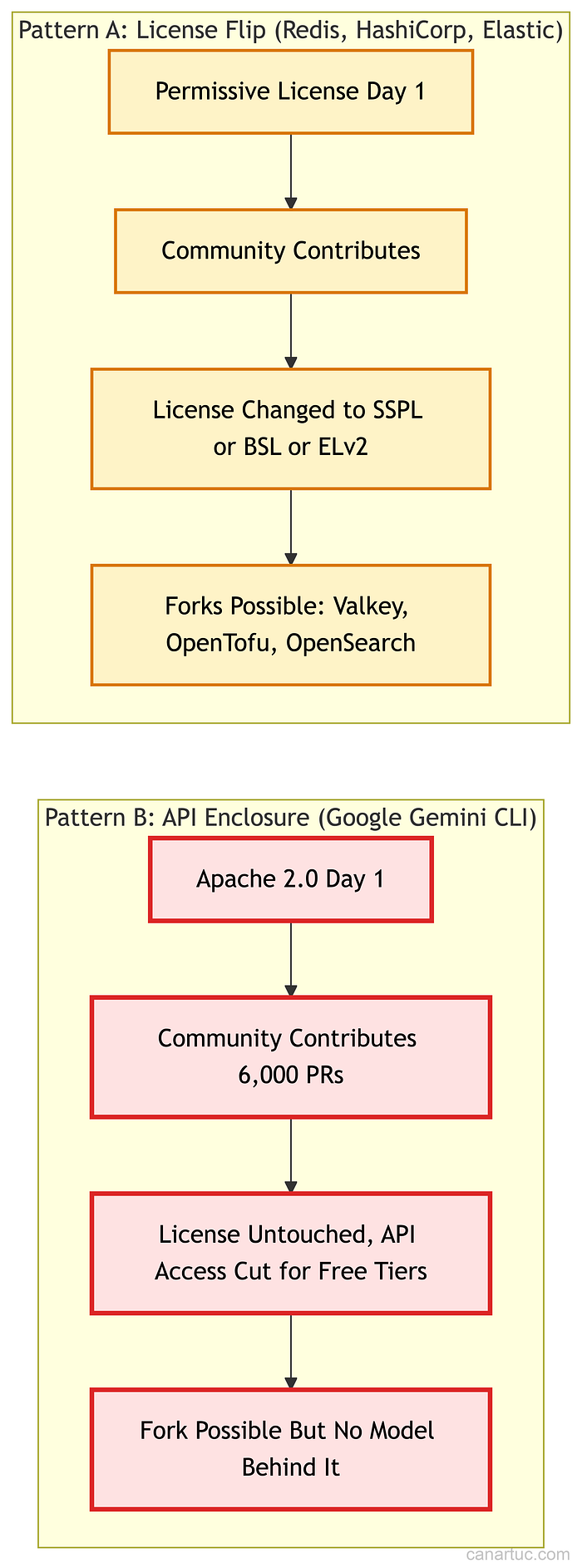
A fork of Gemini CLI without Google's model is a client without a server. The integrations from Dynatrace, Elastic, Figma, Shopify, and Stripe were built against Google's model API, not the codebase alone. A fork inherits the code, not the model.
This is the new mechanism, and it is cleaner than the old one. Redis paid in defections to Valkey and a year-long license U-turn. Google does not have to.
If this story matters to you, clap, comment, or share it. Open-source contributors deserve to know which patterns are now in play.
Three Questions Before Your Next Pull Request
Andrea Alberti asked the right question. If one company controls the API, you are contributing to their product. They do not owe you a say in where it goes.
The pattern is not just Google. Before contributing to any vendor open-source project, ask:
- Who controls the API that the open-source client talks to? If a single company controls it, the open-source license on the client is a partial protection at best.
- Is the model or backend service required for the tool to be useful? If yes, the licensing of that service is the actual contract.
- Does the project have a clear governance separation between code and runtime, or are both controlled by the same entity? Kubernetes has the Cloud Native Computing Foundation (CNCF). Linux has the Linux Foundation. Gemini CLI had Google.
I have watched engineering teams worldwide burn whole quarters integrating against vendor open-source tools without asking these questions. The integration looks free. The lock-in cost arrives in the next contract cycle, with interest only if you are lucky.
A Finished House with the Power Cut
Google now consolidates the client into a closed-source product (Antigravity CLI) for everyone who does not pay, while keeping the open-source one running for customers who pay.
The move is rational for Google. The community paid the cost in a year of pull requests. The next big company's open-source project, launching with a public roadmap and Discord, will attract fewer contributors who trust the deal.
On June 18, 2026, thousands of free-tier developers will run the same command they ran yesterday and watch their terminal print an authentication failure. The code is still on GitHub, but Google's API no longer answers.
Andrea Alberti's pull request will continue to work. His 27 commits are merged. The Apache 2.0 license guarantees that the code he wrote stays available. Google's model is under no obligation to answer his code. After June 18, his 27 commits will sit on GitHub like a finished house with the power cut. His evenings stay there, signed off in commits…
The API on the other end has stopped picking up.
If you contribute to a vendor open-source project, clap, comment, or share this. Check who controls the API before your next pull request.
[1] https://github.com/google-gemini/gemini-cli/discussions/27274
[2] https://developers.googleblog.com/an-important-update-transitioning-gemini-cli-to-antigravity-cli/
Your contribution matters! Here is the map of possible actions you can take: