Why I Built an Offline ESP32 Text-to-Speech System
Almost every text-to-speech (TTS) solution today relies on cloud services like Google, Amazon, or OpenAI. They sound great — but they come with hidden friction:
- Internet dependency
- Latency
- API costs
- Privacy concerns
For small embedded devices or remote deployments, these are deal breakers.
So when I discovered that the ESP32, paired with a brilliant lightweight library called Talkie, can generate voice completely offline, I knew I had to build a fully standalone talking device. No Wi-Fi. No cloud APIs. No waiting. Just direct, instant audio output.
In this post, I'll walk you through the offline ESP32 Text-to-Speech system — how it works, why it's surprisingly powerful, and how you can use it to make your electronics speak.
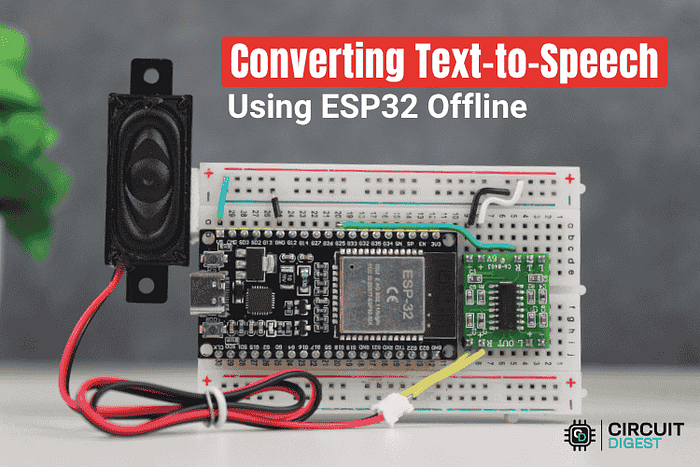
What This Project Does
This Esp32 text to speech offline system converts any text you type into the Arduino Serial Monitor into real voice output from a speaker.
No server. No MP3 files. No SD card. No internet.
The ESP32 — using its built-in DAC pins — generates the audio waveform on the fly using Linear Predictive Coding (LPC), the same technique used in early digital speech synthesizers.
All you need is:
- ESP32 Development Board
- PAM8403 Audio Amplifier
- 3–5W Speaker
- Jumper wires
- USB cable
This means anyone can turn an ESP32 into a talking device with under $5 of parts.
How the System Works (In Simple Terms)
Here's the magic behind the project:
1. ESP32 receives text from the Serial input
You type a sentence into the Serial Monitor. The ESP32 code reads it word by word.
2. Words are matched to pre-stored voice data
The Talkie library stores a vocabulary of LPC-encoded words (numbers, commands, common phrases).
If the ESP32 finds a match → it plays the voice data. If not → you can add new LPC entries.
3. ESP32 generates analog audio using DAC pin
The board outputs audio through GPIO25 or GPIO26, which can produce a real analog signal.
4. PAM8403 boosts the audio
The DAC alone can't drive a speaker. The amplifier ensures clear, loud audio output.
5. Speaker outputs speech instantly
The entire process is local and instantaneous.
This makes it perfect for real-time systems: alerts, sensors, robotics, kiosks, assistive devices, and more.
Why This Offline Approach Is a Big Deal
Cloud TTS systems are impressive — but they're not always practical. Offline LPC voice synthesis gives several advantages:
✔ 100% Offline Functionality
Works anywhere — rural areas, factories, underground labs, robotics competitions.
✔ Zero Latency
No waiting for API responses.
✔ Free & Unlimited
No per-character costs, no rate limits.
✔ Lightweight
LPC data is extremely small — you can add large vocabularies without SD cards.
✔ Reliable for Automation
Perfect for systems that must speak even if the network goes down.
Ideal Use Cases
Here are some creative ways to use an offline talking ESP32:
🔹 Industrial Automation
Let machines announce: "Warning: Overheating detected" "System initialised" "Motor running"
🔹 Smart Home Projects
Custom voice notifications without smart speakers.
🔹 Assistive Devices
Low-cost speaking tools for accessibility.
🔹 DIY Gadgets and Robots
Give personality to your robots or embedded projects.
🔹 Educational Tools
Speech-enhanced STEM projects for kids.
🔹 Offline Booths & Kiosks
Voice prompts without relying on Wi-Fi.
If you build products, prototypes, or IoT devices, the ESP32 offline TTS system is a powerful upgrade.
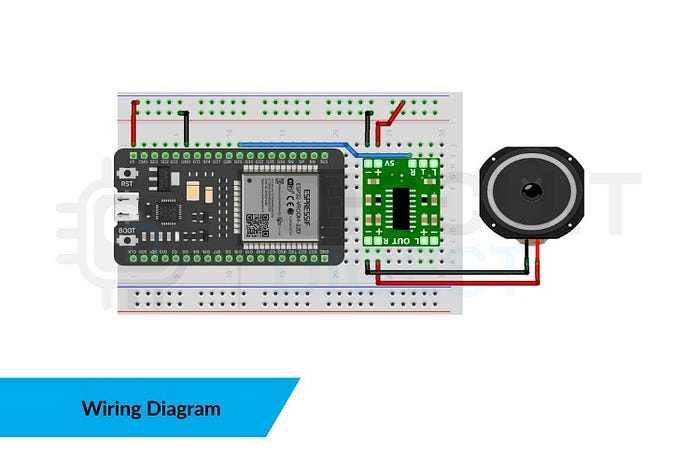
1. Wiring Diagram (Text Explanation)
- ESP32 GPIO25 → PAM8403 IN+
- ESP32 GND → PAM8403 IN− and GND
- PAM8403 OUT → Speaker
- PAM8403 VCC → 5V
- ESP32 5V → PAM8403 VCC (only if powering from USB)
2. Required Libraries
#include <Talkie.h>
#include <Vocab_US_Large.h>
3. Core Code Logic
You can include a short code snippet like:
Talkie voice;
void setup() {
  Serial.begin(115200);
  voice.say(spHELLO);
}
void loop() {
  if (Serial.available()) {
    String word = Serial.readStringUntil('\n');
    if (word == "hello") voice.say(spHELLO);
    else if (word == "one") voice.say(spONE);
    else if (word == "two") voice.say(spTWO);
  }
}
Wrapping Up
The ESP32 offline TTS system proves that impressive voice tech doesn't require cloud services or expensive hardware. With just a few components, you can bring speech capabilities to your embedded projects — fast, free, and offline.
Whether you're building a robot, a smart device, or a practical alert system, this project opens the door to a whole new level of interactivity.