There is a specific kind of silence that follows a $34 billion acquisition. It's not the silence of peace; it's the silence of a countdown.
Back in 2019, when IBM swiped its corporate credit card to buy Red Hat, the messaging was pitch-perfect. "Red Hat will remain independent," they said. "Red Hat will be a distinct unit," they promised. For a few years, we actually believed them. I remember sitting in a meeting with a client, defending the acquisition. I told them Red Hat was too valuable for IBM to "Blue-wash."
I was wrong. ⚠️
Fast forward to September 2025, and the mask didn't just slip — it was removed in a formal press release. IBM announced that Red Hat's back-office functions — HR, Finance, Legal — are being "integrated" into IBM. In corporate speak, that is the first stage of organ failure.
After 4 years of building, architecting, and swearing by the Shadowman, I've realized that the Red Hat I loved is being sold off for parts to fuel Big Blue's quarterly earnings. If you're still waiting for a sign to look at alternatives, this is it.
The "Betrayal" Timeline: How We Got Here
If you've been in the cloud game as long as I have, you know that the cloud was supposed to be simple, but we ended up with a mess of proprietary traps. Red Hat used to be the antidote to that. They were the "Open" in Open Source.
But look at the math since the acquisition:
- 2019: Red Hat revenue sits at $3.4 billion.
- 2025: Revenue hits $6.5 billion.
- 2026: Red Hat now drives nearly 45% of IBM's total software business.
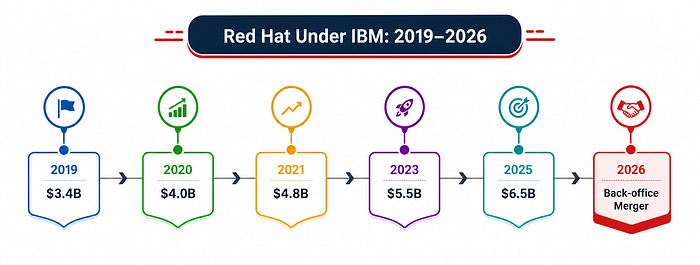
IBM didn't buy Red Hat to save Open Source; they bought it because their own software story was collapsing. Red Hat is now the growth engine for a company that has a historical reputation for "absorbing" culture until it disappears.
Remember Lotus Notes?
How about Rational Software or Informix? These weren't just acquisitions; they were disappearances.
When IBM says they are "streamlining" Red Hat's HR and Finance for "efficiency gains," what they are really saying is:
"We no longer need Red Hat to have its own identity. We just need its revenue."
The CentOS Catastrophe
I'll be honest with you — I made a massive mistake a few years ago. I migrated a medium-sized enterprise client entirely onto CentOS 8. I told them it was the "stable, free version of RHEL" and that it would be supported until 2029.
Then came December 2020.
IBM/Red Hat pulled the rug out and killed CentOS Linux in favor of CentOS Stream. Overnight, my "stable" recommendation became a rolling-release beta test for IBM's commercial products. I spent the next six months in "migration hell," moving that same client to Debian because I had lost their trust.
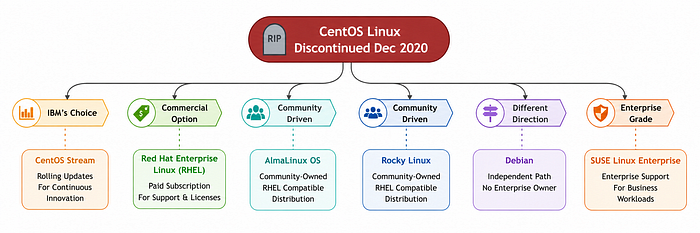
It was a painful lesson: In the corporate world, a "promise" is just a roadmap that hasn't been deleted yet. I've seen 500k cloud migrations go up in flames for many reasons, but "vendor betrayal" is the hardest one to recover from.
Why "Independence" is a Myth
Think of Red Hat's independence like a rented house.
- Step 1: You move in and the landlord (IBM) says you can paint the walls whatever color you want.
- Step 2: A year later, the landlord says they need to store some boxes in your garage (CentOS).
- Step 3: Then they tell you that they are taking over the kitchen management (HR and Finance) to "save costs."
At that point, do you still live in your own house? Or are you just a guest in theirs? 🏠
By the start of 2026, the people who defined Red Hat's culture — the HR teams that hired the "misfits," the legal teams that fought for open-source licenses — will all report to IBM. The engineering and sales teams are staying separate "for now."
"For now" is the most dangerous phrase in tech. It's the corporate equivalent of "We need to talk" in a relationship. 💔
The Fedora Trap: Stop Working for Free
I used to love Fedora. Even Linus Torvalds uses it! But my perspective has shifted. Today, the pipeline is a cold, calculated machine:
- Fedora: You (the community) do the free QA and bug testing.
- CentOS Stream: The features get polished.
- RHEL: IBM sells that polished product for $6.5 billion in annual revenue.
Every bug report you file in Fedora is a free contribution to IBM's profit margin. While I'm all for community contribution, it feels different when the parent company is actively restricting access to the source code (like they did in June 2023) to kill off competitors like AlmaLinux and Rocky Linux.
It's one thing to help a neighbor fix their car; it's another thing to fix a car for a billion-dollar dealership that then charges you for the tools.
My Exit Plan
I've stopped recommending the "All-Red" stack. The risk of the multi-cloud trap is real, but the "Single-Vendor Trap" is even worse when that vendor is IBM.
If you are an architect, it's time to diversify. Here is how I'm handling my current projects:
1. The "Rock-Solid" Migration (Rocky & Alma)
If you need binary compatibility with RHEL because your legacy apps demand it, AlmaLinux and Rocky Linux are the only way forward. They are community-driven and, most importantly, they aren't owned by a corporation with a $160B market cap that needs to "optimize" them.
2. The Total Divorce (Debian)
I'm moving more of my core infrastructure to Debian. It's the only major distro that has no "Big Tech" parent company. It's the "Great Cloud Divorce" in action — realizing that total public cloud reliance sucks when the underlying OS is being manipulated for stock prices.
3. The Enterprise Alternative (SUSE)
For clients who need a throat to choke (commercial support), SUSE has become the adult in the room. They've even launched "Liberty Linux" to support RHEL workloads without the IBM attachment.
Final Thoughts
It's okay to be sad about it. Red Hat changed the world. They proved that you could build a multi-billion dollar business on "free" software. But we have to stop pretending that the Red Hat of 2026 is the Red Hat of 2014.
IBM is doing what IBM does: they are optimizing. They are removing the "inefficiencies" of a unique culture to make the numbers look better on a Q1 earnings call.
My advice? Don't be the last person standing on a sinking ship because you like the color of the flag. Start testing your exit strategies today. Your infrastructure — and your sanity — will thank you.
What about you? Has your team started looking at Alma or Rocky? Or are you sticking with RHEL until the "For Now" finally expires? Let's talk about it in the comments. 👇