There are many articles about how to conduct 1:1s with your reports. Most share the same basic idea: this time belongs to the employee, not the manager.
I agree. Strongly.
My first manager at Google was frequently late to our 1:1s, and sometimes skipped them altogether without telling me. I remember waiting anxiously outside his office, hoping for advice, feedback, or help thinking through a challenge. After a while, I started feeling unimportant, like a kid whose parents forgot to pick them up after school.
That experience shaped how seriously I take 1:1s.
In my view, offering your employee a weekly session as a manager is a minimal service. It is one of the most basic ways I show my direct reports that they matter. It is where I try to add value for them, whether that means working through a problem together, coaching, guiding, sharing feedback, or simply offering mental support.
When you move into leading leaders, the 1:1 needs to do more than create space for the person in front of you.
Their clarity, blind spots, and judgment affect their team.
You are not just managing a person anymore, so the 1:1 becomes a place to understand and shape the health of the organization through the person leading it.
After shifting from leading individual contributors (ICs) to leading leaders, I was seeking a light yet useful structure for our weekly quality time. Not a rigid script, a thought-through template that grounds the conversation in an attempt to make room for the things managers and employees often avoid until they become urgent.
This is the current iteration of my 1:1 template (link), and why I chose those pieces in that order.
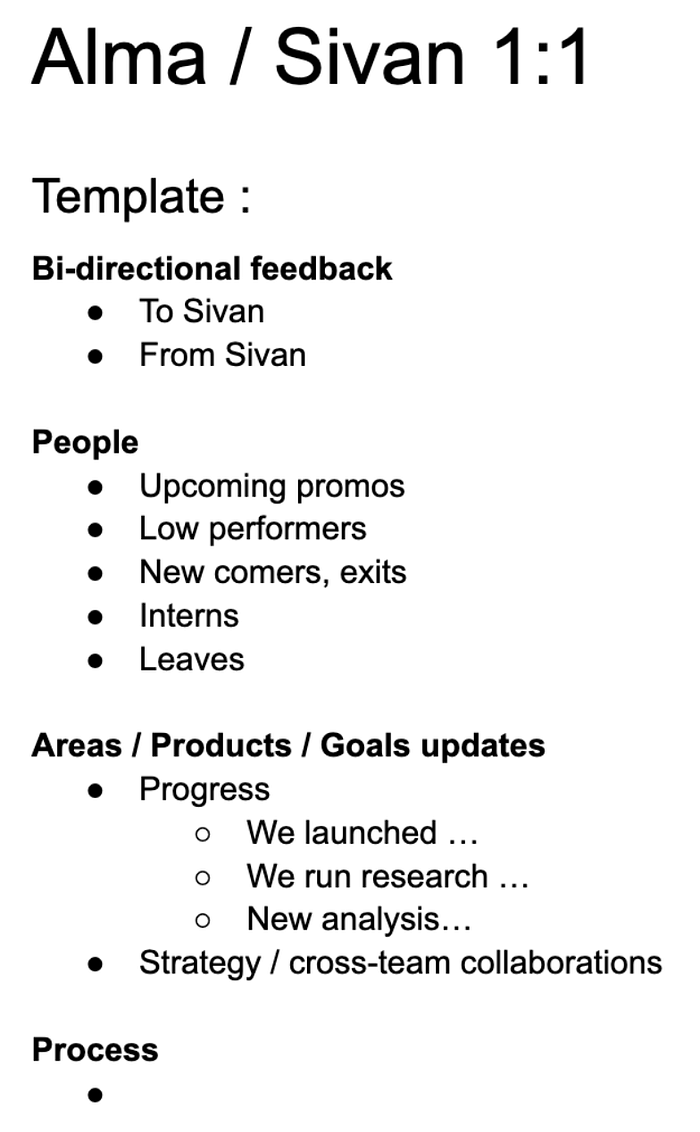
1. Bi-Directional Feedback
It starts with feedback.
Why?
- To remind me and my team to share feedback with each other.
- To normalize it, make it is part of the operating rhythm: frequent and timely. Don't wait for the performance review or for something to go really wrong to share that. It removes the "Can I give you some feedback?" dread
- To role model the importance of feedback and a growth mind set, by always welcoming feedback, listening, internalizing and acting on it.
It can be praise. It can be coaching. It can be a small observation. Feedback is a way to say "I see you" and "I care about you, that's why I take the time and risk to offer feedback".
Yesterday during my weekly session with a team member, I solicited feedback. Since I know many people struggle with the open ended question: "any feedback for me?" I broke it down:
- Over the last 2 weeks, what's one thing I did that you were happy with?
- What's one thing you wished I'd do differently
Starting with feedback sends a message: My job is not just about me evaluating you. It is also a service that should add value.
I Found My New Leadership Role Model in Dungeon Crawler Carl What Carl taught me about empathy, humility, and staying human in a system built to break you
2. The "People" Layer
Next: People.
I prioritized people ahead of work items to demonstrate and reinforce that people are the most important resource.
As a leader of leaders, it's not about knowing the status of every individual contributor. It's about understanding how and ensuring that the leader is thinking about their team.
Who is struggling? Growing? Joining? Leaving? This may include:
- Low performers
- High performers
- Newcomers
- People leaving
- Interns
- Cross-functional partners
- Team morale
- Hiring needs
I want to know how the leader is managing the edges of the organization.
3. Areas, Products, Project, and Goals
Those are normal work discussions. The goal here isn't to list every ticket moved to "Done." It's an opportunity to do things like: align on priorities and goals, give advice, work through a challenge, etc.
- What did we learn? What new analysis changed our thinking?
- What decisions are needed?
- What is blocked?
Needless to say that the manager can / should act on needed decisions and help unblock projects that are stuck outside of the 1:1.
4. Processes
We end with the "how." Is the way we are working actually working?
This is especially important when managing managers, because their local process becomes the operating environment for their team. This is where we debug the organizational machinery.
Why this works
This structure forces a shift from tactical to strategic. It encourages the leader to come prepared with thoughts and opinions on their people and domain.
The sheer act of the manager strategizing on what they want to discuss and share helps create clarity in their brain. Of course, occasionally you'll veer off the template, when urgent things come up.
Good 1:1s should feel useful, like you gained some clarity. Not all will be solved in that short conversation, but some resolution should be achieved. This template is designed to clear some fog.