
Happy April Fool's Day, to everyone who gets deceived with data!!
Welcome back to the blog! For those who are new here, I'm Ms. DataByte: your friendly neighborhood IT pro who spends way too much time decoding Python scripts and drinking way too much coffee. I started this blog because I believe data shouldn't be a mystery; it should be a conversation.
The idea for today's post actually hit me while I was staring at my Samsung S25 Ultra. I realized that we've all become digital detectives, convinced that every time we see a "creepy" ad, it's because Mark Zuckerberg is secretly eavesdropping on our 2 AM rants about how can the Balenciaga Yellow plastic bag be so costly? Especially when it looks like an ordinary trash bag.
It's the ultimate modern mystery: "Is my phone listening to me?"
Lately, this "the algorithm is a spy" theory has basically become the background noise of our lives. It's how we explain our shopping habits and our weirdly specific Instagram feeds. But as someone who lives in SQL and JSON files, I decided to have a little fun this April Fool's. I stopped guessing, pulled my own data logs, and went on a treasure hunt for the "wiretap."
Spoiler alert: The truth isn't a hidden microphone. It's actually something way more clever, a little bit "math-heavy," and honestly? Pretty fascinating.
They Know…
Okay, pop quiz time! How many of you, just this morning, were scrolling through Instagram and saw an ad for something so specific you almost threw your phone?
You didn't type it in. You barely thought about it. But there it was: that perfect calming sunscreen or a pair of noise-canceling headphones you had just mentioned your roommate.
This is the exact moment the "They are definitely listening" paranoia starts to itch. Because, really, how do they seem to know your deepest product desires? Well, grab your coffee, my friends, because that's exactly what I wanted to find out.
Let's look at the actual distribution of "Categories of Ads I See."
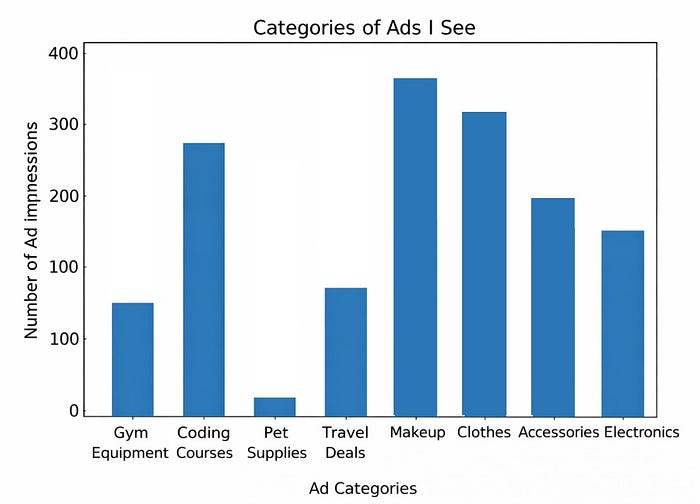
Now, looking at my own data, you can see Makeup, Clothes, and Coding Courses are dominating my feed. This isn't random; it's a carefully crafted mathematical mirror of exactly who the algorithm thinks I am. The reason it feels like a wiretap is that the system has analyzed hundreds of tiny, nearly invisible digital clues I've left behind. And some mystery passions have been calculated to keep me engaged and on my toes.
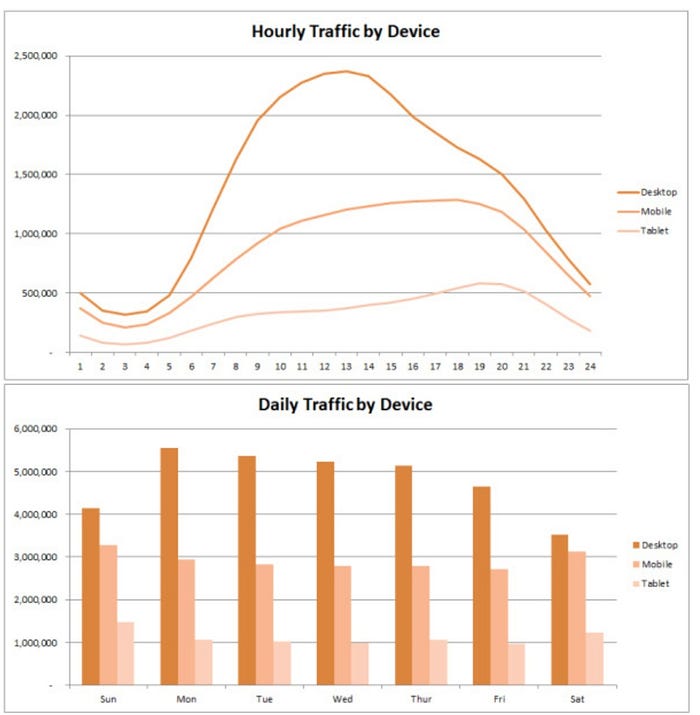
What is fascinating is that they know when and where to find you in the lost city of the Internet!
Take a look at my Traffic by Device patterns. My Desktop traffic peaks during the day; that's when I'm most productive and at work. But notice how the Mobile traffic stays steady and then starts to take over as the sun goes down? The algorithm knows exactly when I've closed my laptop and switched to my phone for some "mindless" scrolling.
By tracking these Hourly and Daily Traffic habits, the system learns my routine. It knows that Monday is my peak "Desktop research" day and Saturday is my "Mobile exploration" day. It's essentially passing a digital baton from one device to the other, ensuring that the ad you ignored on your big screen at 2 PM is exactly what you see on your small screen at 10 PM. So it's not just listening… it's just following you from the office to the bedroom.
They Know What You'll Buy Before You Do"
So, if there's no secret microphone recording our coffee-time gossip, how on earth did Instagram know I was looking for a new treadmill before I even told my flatmate?
It's not magic, and it's definitely not a spy movie plot. It's what I like to call the "Creepiness Funnel." Think of it as a digital breadcrumb trail that we leave behind every time we pick up our phones.
I searched 'treadmill once' and got treated like I'm training for the Olympics.
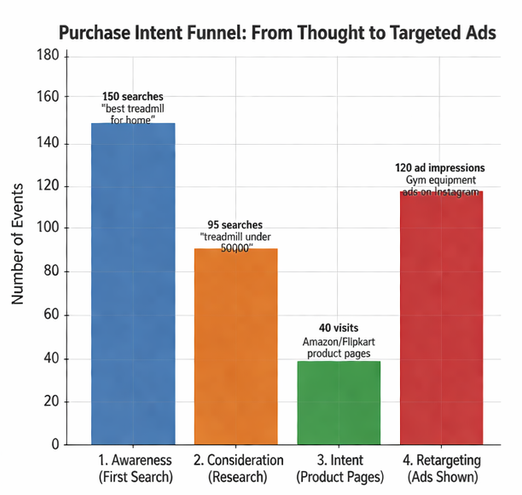
Take a look at my own Purchase Intent Funnel. The algorithm isn't eavesdropping; it's just really, really good at connecting the dots. It tracked 150 of my "just curious" searches for home gym gear and 95 clicks on budget-friendly treadmills. By the time I saw that "perfect" ad on Instagram, the math already showed a 68% conversion probability. It didn't need to hear me panting on a run; it just saw my search history and did the math!
They Know You Better And Your Friends
Ever notice how you'll be sitting with your friends discussing skincare, and suddenly you're all seeing the exact same ad for that Beauty of Joseon Rice + Probiotics sunscreen? You probably think, "Okay, now the phone is definitely listening to our skincare routine." But here's the fun part: Your privacy isn't just about you. It's a team sport! The Social Life Cycle chart shows how an "Event Intensity" spiked, the moment a friend started sharing hauls of Korean serums on WhatsApp group.
Because we hang out in the same spots in Pune and interact in the same digital circles, the algorithm basically goes, "Hey, if My bestie is obsessed with cooking recipes, there's a 99% chance she loves that too!" It's not a wiretap; it's just a Social Graph.
They Know what you Wanna See
Now, here's the part where we pull back the curtain on the "they don't sell my name" myth. Corporate giants love to say they "protect your privacy" because they don't give out your name to anyone.
Newsflash: They don't need your name, they have your Metadata.
While I was working on my laptop, I noticed something fascinating. If I hover over a video for a "Sandwich Recipe" for just 1.2 seconds, not even clicking, just pausing my "Scroll Velocity" … the system registers a tiny spark of interest. Ten minutes later, that exact same recipe is the second ad I see on my phone. They aren't listening to your words; they are measuring your curiosity in milliseconds!
Apparently, My HP laptop and my Samsung phone are in a better relationship than I am.
They Know When to Get to You
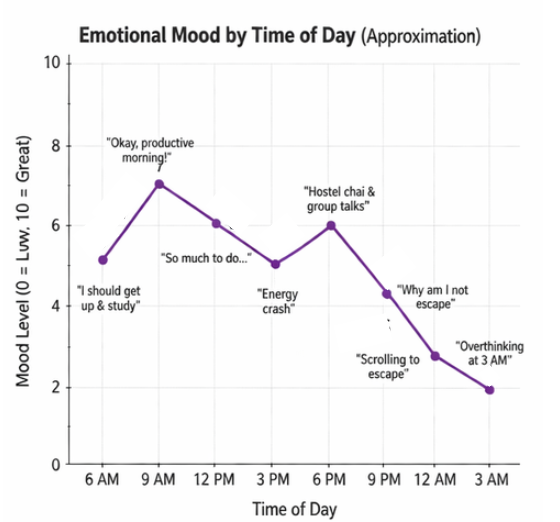
We all like to think we're the captains of our own digital ships, but my Emotional Mood by Time of Day chart is a total reality check. My mood usually peaks at 9 AM with that "Okay, productive morning!" energy, but it takes a serious nose-dive by 3 AM into "Overthinking at 3 AM" territory.
The tech giants have mapped this perfectly. They don't just see a user; they see a cycle. They know my battery percentage is at 8%, I'm in a "hostel coffee and group talks" vibe, and I'm "scrolling to escape." They don't need to hear me say I'm stressed to know that's the exact moment I'll click on a "Stress-Relief Skincare" ad or a "Late Night Momo Delivery" coupon. They aren't listening to your voice; they are watching your heartbeat through your data patterns.
They can Predict You, Your Personality Has Been Clustered
The data shows I'm not just one person named Ms.DataByte ; I'm actually a collection of K-Means Clusters. Depending on the hour and my activity, the algorithm treats me as a totally different personality. Check out my mood clusters below:
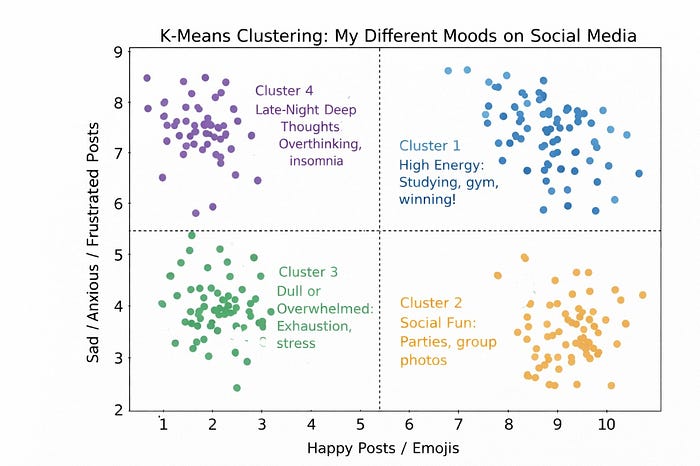
- Cluster 1 (Ambitious Tech Girl): This is me at 10 AM: high energy, corporate ready, and celebrating my SQL queries!
- Cluster 2 (Aesthetic Explorer): This is "Café Ms.DataByte," dreaming of sunsets and searching for the best bachelorette life and food.
- Cluster 3 (Exhausted Engineer): With all the office work, and the noisy neighbour, all this girl needs is some good food, good TV and good sleep.
- Cluster 4 (Late-Night Overthinker): Ah, the 2 AM "scrolling to escape" mode where I'm deep into random memes and "why am I not asleep" thoughts.
The algorithm knows that when I'm in "Cluster 4" mode, my resistance to buying that viral Beauty of Joseon serum is at an all-time low. It waits for my mood to shift before it strikes with the perfect "Add to Cart" suggestion!
But hey, we are humans… We are not just one person. Its more like 4–5 marketing personas fighting for control.
The Algorithm Isn't Listening, It's Being You
The truth is actually much more impressive (and a little bit cooler) than a secret microphone. A microphone can be muted, but a statistical model based on five years of your digital breadcrumbs? That's a masterpiece of engineering.
They don't eavesdrop on your conversations because, thanks to the data we happily provide, they've already simulated how our brains work! They aren't "stealing" your thoughts; they're just really good at the math of you.
So, Happy April Fool's Day! The real joke is on all of us for thinking we're still unpredictable mysteries. But hey, at least the algorithm knows exactly which sunscreen will give us that glow, right?
Stay curious, stay savvy, and don't forget to clear your cache today (it won't stop the math, but it'll make your browser feel brand new!).
— Ms. DataByte