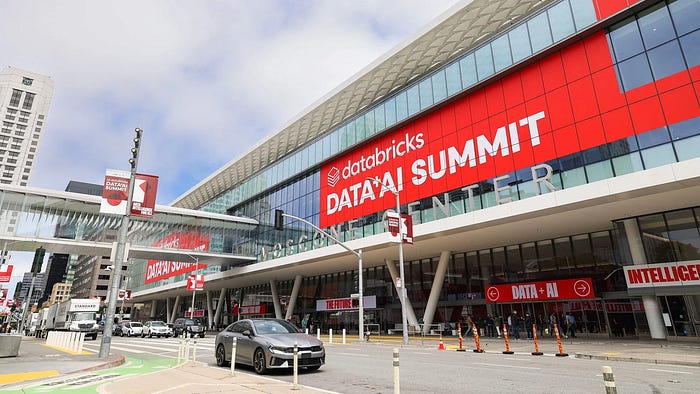
Here's a little secret for you. The next wave of AI success is going to be completely dependent on structured data. Maybe that's a no-brainer to you. Maybe I'm telling you that the next time you take a drink of water, that water will be wet.
But I believe that prediction, and the fact that it's kinda clear already, is the reason why you get a certain sense of calm when the CEOs of these massive data companies talk about the future of AI. They're confident, but thoughtful. Open-minded, but not susceptible to hyperbole, histrionics, and hand-waving.
They don't say things like all software developers will be replaced by AI (the deadline for which has since passed) or all tech employees should become baristas and bartenders (the dream is over, nerds) or don't worry, we've hammered out all the unintended consequences for letting users create their own AI porn (what could go wrong?).
Instead, the data CEOs say common sense things like ""Why would you move your system of record? You know, it's hard to move it.'"
Holy crap. I think I'm in love.
SaaS Goes Into the Woodchipper
Earlier this week, data giant Databricks "announced it reached a $5.4 billion revenue run rate, growing 65% year-over-year, of which more than $1.4 billion was from its AI products."
So a quarter of their revenue is now AI. That doesn't shock me, doesn't surprise me, doesn't concern me. That… is palatable hypergrowth, if such a thing exists. And I assume that a big chunk of the remaining 75 percent of the revenue is coming from SaaS, and the rest of it is stored Pirate Bay collections.
Now, I said that SaaS was dying a long time ago, in fact, I've called its imminent demise a couple times. Real readers know that when I say "SaaS is dying," I'm not saying that your favorite productivity number-cruncher will immediately disappear off the internets.
What I'm talking about is that the usefulness of the SaaS business model is waning, based on its intractable UX problem — "SaaS companies," for over a decade, have existed to throw crunched numbers back at sometimes-certified superusers to analyze. At the same time, AI is, theoretically anyway, offering executives and leaders actionable insights, options, and answers.
What I wrote were warnings, cautionary tales, a heads up on the iceberg. Stop marching along blindly with the traditional SaaS business model now to not get caught in the wood chipper later.
The reason I wade into histrionics is, well, because no one was listening — because useful advice like my previous sentence was getting drowned out by people who don't know how AI works very confidently telling business people that all you have to do is slap a chatbot on your SaaS and it'll be fine. The AI platforms, especially in the beginning, encouraged this foolishness because they wanted market penetration.
It was win-win, just… lose for the SaaS companies who went smiling into the buzzsaw with a fancy chatbot interface that allowed the same unnecessary SaaS superusers to still seem necessary, by typing sentences into their screens instead of ticking checkboxes and sliding sliders.
My guy Ali Ghodsi from Databricks is taking a different approach but saying essentially the same thing.
SaaS Superusers Are Getting Crushed
I mean, the CEO of Databricks has to take a different approach. He just raised $5 billion on top of his $5 billion AR. When you do that, you can't run around screaming "SaaS is dead, yo!" even if it is true.
So… just because I tend to get harsh sometimes, let me state here that I like Databricks, I kinda like the CEO, and I dug everything he said in this article, even though it appears, on its face, to be a counter to what I'm saying about AI and SaaS.
Until I read between the lines, which is what you all pay me for.
Then I realized he's just got a cooler head than everyone else because he is sitting in the catbird seat and knows how well-positioned data companies are for what's coming in AI.
He knows that he has to "distance Databricks from the SaaS label," but where we differ, I think, is that he is obligated to believe or at least give lip service to the notion that the SaaS companies will pull up from "it'll be fine" and realize that you can't just slap an LLM on a platform without completely reengineering how data is extracted, is loaded, and is transformed into the new system.
So while he says things like there's "so much talk about how AI is going to kill the SaaS business," we are eye-to-freaking-eye when I read passages like:
"…the threat to SaaS businesses, Ghodsi says, is that people no longer spend their careers becoming masters of a particular product: Salesforce specialists, or ServiceNow, or SAP. 'Millions of people around the world got trained on those user interfaces. And so that was the biggest moat that those businesses have,' Ghodsi warned."
In every article I've written about the end of SaaS for the last two years, this has been the crux of my argument. The SaaS model moat is evaporating at AI scale. Tech has a long and nasty history of creating then replacing its superusers. I know it. You know it. He knows it. He just also knows that a new superuser will be created once everyone realizes that proprietary data and actionable analytics are going to be the bridge to the next wave of "AI magic."
AI Is Motion, Data Is Experience
Look, I'm not trying to put Ali Ghodsi on a pedestal. What I do know is he is validating a path forward when the tech universe needs a path forward. And when every megacap is lopping off headcount like its the French Revolution and at the same time on a spending spree of 80s movie proportions, Ghodsi also says smart things like:
"Now is not a great time to go public… I just wanted to be really well capitalized [because it] protects us, gives us many, many years of runway."
Wait. The long game? Spoken like a true data nerd. I'm back in love.
AI is motion, while data is experience. That's why AI has been running around like a tween jacked up on sugar who just watched a Jackass marathon on MTV.
AI is magnitude, while data is direction. And after the chaos of the "chatbot and porn" stage of generative AI, we're all realizing that going really fast in the wrong direction isn't winning.
Or to put it in a more cautionary way, AI is fire, while data is fuel. It's going to take pragmatic, honest, see-through-the magic guidance as to when and how these SaaS-model companies move forward and survive the next five years.
You've got the chicken little dystopianists on one side, and the tweaked-out tweens on the other. Data is the mature, logical, boring middle, but if you want an honest assessment of where all the smart AI is going, look to those mature, logical, boring leaders pushing palatable hypergrowth.
If this resonated, please join my email list, a rebel alliance of professionals from all walks of life who want a unique and sometimes positive take on tech, business and the future of both.