Three weeks ago, my friend Sarah got the email.
"Due to our strategic pivot toward AI-driven operations…"
She worked in customer support at a Fortune 500 company. Seven years. Stellar reviews. Didn't matter. The AI was taking over, they said.
Except here's what they didn't tell her: The AI wasn't working. At all.
The Layoff Headlines Are Lying to You
Turn on any business news channel and you'll hear the same story: AI is eliminating jobs at breakneck speed. Salesforce cuts 4,000 positions — blame AI. Accenture eliminates 11,000 roles — blame AI. Klarna shrinks its workforce by 40% — you guessed it, AI's fault.
But here's what a new MIT study just revealed: 95% of companies investing in AI are getting exactly zero return on investment.
Let me say that again because it's important: These companies spent between $30 billion and $40 billion on AI initiatives, and 95% of them saw no measurable impact on profits.
Zero. Zilch. Nothing.
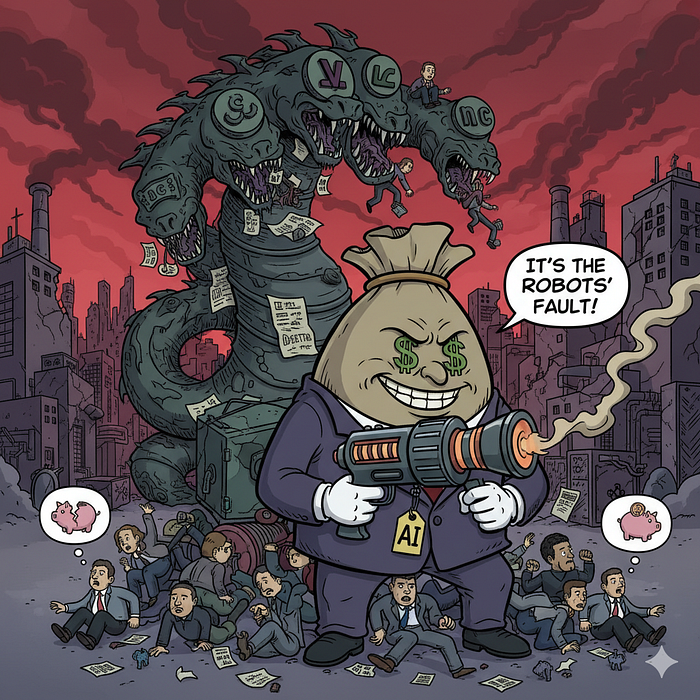
So if AI isn't actually working for most companies, why are they firing people and blaming it?
Welcome to the AI Excuse Economy
Fabian Stephany, assistant professor of AI and work at the Oxford Internet Institute, doesn't mince words: Companies are "scapegoating" AI to cover up old-fashioned cost-cutting.
The data backs him up completely.
According to research from the New York Federal Reserve, only 1% of service firms reported laying off workers due to AI in the past six months. That's down from 10% last year.
Yet somehow, we're seeing record layoffs. Over 180,000 tech workers cut loose in 2025 alone — averaging 489 jobs lost per day. Companies are rushing to attach "AI" to their press releases, but the math doesn't add up.
The Companies Getting Caught
Let's name names.
Salesforce slashed 4,000 customer support jobs in September, with CEO Marc Benioff claiming AI can do "50% of the work." But here's the kicker: Salesforce's own spokesperson later admitted they "redeployed hundreds of employees into other areas." Translation: We moved people around, not AI.
Klarna became the poster child for AI replacement after cutting 40% of its workforce. CEO Sebastian Siemiatkowski initially bragged about AI doing the work of 700 customer service agents. But in a recent damage-control post, he clarified: "We have made 0 layoffs due to AI." The cuts were due to "natural attrition" after they stopped hiring in 2023.
Wait — so the company everyone points to as proof AI kills jobs just admitted AI didn't kill those jobs?
Accenture announced it was "exiting" 11,000 employees who couldn't be "reskilled" on AI. Sounds futuristic, right? Except the company reported 7% revenue growth while making these cuts. They're profitable. They just decided they needed fewer humans.
And here's where it gets even messier: IBM and Klarna both reversed course on AI customer service after discovering the technology couldn't actually handle the complexity of human interactions. They spent millions. Cut thousands of jobs. Then had to start rehiring because the AI failed.
What the Data Actually Shows
Yale University's Budget Lab just dropped a bombshell report analyzing U.S. labor data from November 2022 to July 2025. Their finding? AI hasn't caused widespread job losses.
The researchers used something called a "dissimilarity index" to measure how much the job market has shifted since ChatGPT launched. They compared it to other major tech disruptions like computers and the internet.
Conclusion: The AI disruption everyone's freaking out about? It's not happening on a mass scale.
Meanwhile, that MIT study — "The GenAI Divide: State of AI in Business 2025" — paints an even more damning picture. After analyzing 300 public AI deployments and interviewing 52 executives, researchers found that:
- Only 5% of AI pilots extract measurable value
- Most tools "fail to contribute to profits due to brittle workflows and misalignment with operations"
- Companies waste money on AI for sales and marketing (low ROI) instead of back-office automation (high ROI)
- Internal AI builds succeed only 33% of the time vs. 67% for purchased solutions
Translation: Companies have no idea what they're doing with AI, but they're happy to use it as cover for layoffs they planned anyway.
Why Companies Love the AI Excuse
Think about it from a CEO's perspective.
Option A: Tell investors you're laying off 5,000 people because you overhired during the pandemic, miscalculated your growth projections, and need to boost quarterly earnings.
Option B: Tell investors you're "strategically realigning toward an AI-first future" and cutting 5,000 jobs as part of your "innovative digital transformation."
Which sounds better in a press release?
Professor Stephany nails it: "Companies can now position themselves at the frontier of AI technology to appear innovative and competitive, and simultaneously conceal the real reasons for layoffs."
It's brilliant PR. You look forward-thinking. You dodge the stigma of mass layoffs. And Wall Street eats it up because "AI" is the magic word that makes stock prices go up.
Jean-Christophe Bouglé, a founder who went viral on LinkedIn, put it bluntly: AI adoption in large corporations is happening at a "much slower pace" than claimed. Some companies are even rolling back AI projects due to cost and security concerns.
But they'll still blame AI when they cut headcount.
The Real Pandemic Connection
Here's what companies don't want to admit: Many of them significantly overhired during COVID-19.
When everyone went digital in 2020–2021, tech companies went on hiring sprees. Demand seemed infinite. Growth projections looked insane. VCs threw money at anything with a .com.
Now? Reality check.
Demand normalized. Investor patience evaporated. Interest rates went up. And suddenly all those extra employees hired during the boom years look like "inefficiencies."
So companies like Duolingo, Klarna, and dozens of others are doing what Stephany calls "market clearance" — firing people they never should have hired in the first place.
But saying "we screwed up our hiring forecasts in 2021" makes you look incompetent. Saying "we're embracing AI" makes you look like a visionary.
Same layoffs. Different spin.
The Entry-Level Massacre
Here's the darkest part of this story: Young workers are getting destroyed.
Dario Amodei, CEO of Anthropic (an AI company, ironically), told Axios that AI could eliminate half of all entry-level white-collar jobs. The data shows he's right — kind of.
Between October 2022 and July 2025, workers aged 22–25 in "highly exposed" fields saw a 13% relative decline in job opportunities. These aren't senior positions being cut. It's junior analysts, entry-level developers, assistant roles — the traditional starting points for careers.
Why? Because AI handles repetitive tasks reasonably well. And guess whose job is mostly repetitive tasks? Entry-level workers.
But here's the twist: Companies aren't actually replacing these roles with functional AI. They're just not filling the positions when people leave. "Soft attrition," as the MIT report calls it. No dramatic layoffs. Just a slow erosion of opportunities.
Young people entering the workforce face a brutal double whammy: Companies claim AI is doing the work, but the AI barely functions, so the workload just gets distributed to remaining (overworked) employees.
How to Protect Your Career in the Age of the AI Excuse
Alright, enough doom. Here's what you actually need to know.
First: Your job isn't being replaced by AI. It might be eliminated by cost-cutting that blames AI.
That's a crucial distinction. If you're in a role that seems "AI-replaceable," don't panic and don't buy into the hype. The technology is nowhere near as capable as the press releases claim.
Second: Document your wins. In this environment, being good at your job isn't enough. You need to be visibly valuable. Track metrics. Build relationships across departments. Make yourself costly to replace.
Third: Learn AI tools, but not because they'll replace you. Learn them because they're productivity multipliers. A worker who knows how to use AI tools to do their job faster is worth keeping. A worker who doesn't is just expensive.
Fourth: Watch the money, not the marketing. If your company announces "AI transformation" but isn't investing in training, infrastructure, or actual implementation — it's PR. Real AI initiatives involve months of pilot programs, workflow redesign, and employee training. If they skip straight to layoffs, it was never about AI.
Fifth: Know your worth outside your current company. The harsh reality is that loyalty means nothing anymore. Companies will dress up layoffs in whatever language makes shareholders happy. Your best protection is knowing you can land somewhere else.
The Bottom Line
Here's what's actually happening in October 2025:
Companies spent billions on AI and got almost nothing back. Investors are getting antsy. Cost-cutting needs to happen. But instead of admitting they overhired during a bubble or miscalculated market conditions, executives are pointing at AI and saying "the robots made us do it."
It's the perfect scapegoat. It sounds futuristic. It absolves leadership of bad decisions. And it positions the company as "innovative" instead of "incompetent."
Meanwhile, 180,000 people lost their jobs while CEOs collect bonuses for "strategic transformation."
The AI revolution isn't taking your job. But the AI excuse might.
The question is: Are you going to fall for it?
Have you experienced an "AI-driven" layoff at your company? Drop your story in the comments — let's expose the pattern together.