
Let's be honest, our lives depend more on websites than on almost any physical thing. We are totally locked in
If you're a software engineer, it's even worse. You're constantly drowning in newsletters, tech blogs, tracking job applications, and trying to keep up with tech trends, which basically forces you to be terminally online on X.
But my daily routine goes beyond the obvious apps like X, StackOverflow, and Reddit.
I have a few other websites that are a non-negotiable part of my daily workflow.
1. news.ycombinator.com
This one's a total no-brainer. If you're in tech, you're probably already on Hacker News.
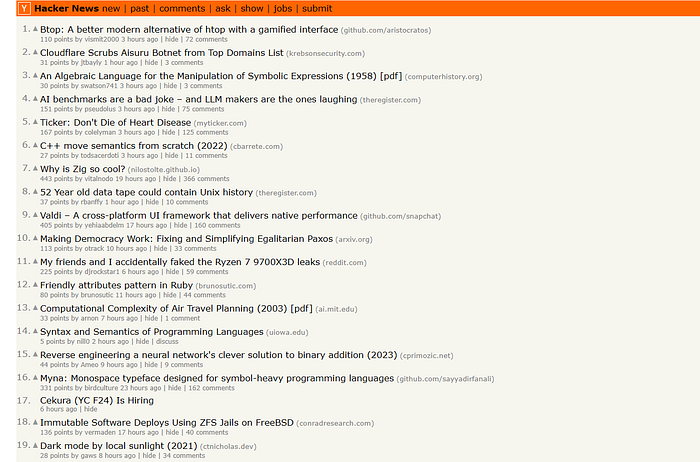
It's basically the best source for the latest tech news, startup drama, and… well, anything and everything tech.
You could learn a lot just by reading the titles. It's a definite must-read, must-bookmark platform. I skim the front page every time I get a free minute during my workday, catching up on breakthroughs, spectacular startup fails, or new security vulnerabilities.
The comments sections are pure gold for diverse opinions , it's pretty much Reddit, but for nerds.
2. Indiehackers.com
Indie Hackers is another community, but it's laser-focused on one thing: helping people build profitable online businesses.
The whole vibe is "building in public".
People are incredibly transparent, sharing their revenue numbers, their failures, and their strategies.
You get to learn, see, and hear from people who've actually made it. If you have that urgency to become an independent solo developer and launch your own SaaS, this place is a gold mine.
You get to read about successful entrepreneurs who literally started from 0.

3. InterviewBit.com
Let's be real, even in a comfortable 9–5, you always have to be ready for a layoff mail. The tech industry is… well, you know, in a bad, terrible state.
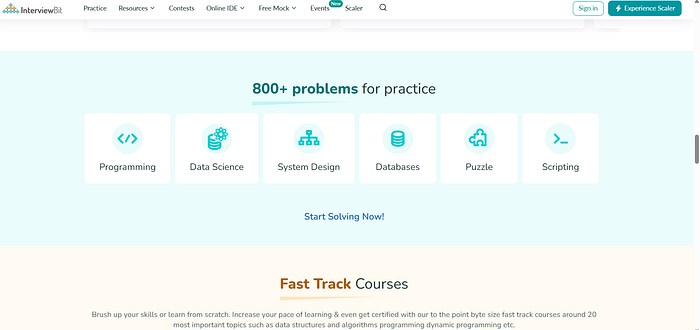
But I don't visit InterviewBit to panic-grind LeetCode-style. That's exhausting. I just casually spend an hour max to recall everything. So, if a recruiter from a FAANG company slides into my DMs (I hope that happens), I'm not starting from absolute zero. It's about staying ready, not just getting ready.
4. Algomaster.io
I spend my night times, 10PM–12AM, grinding LeetCode.
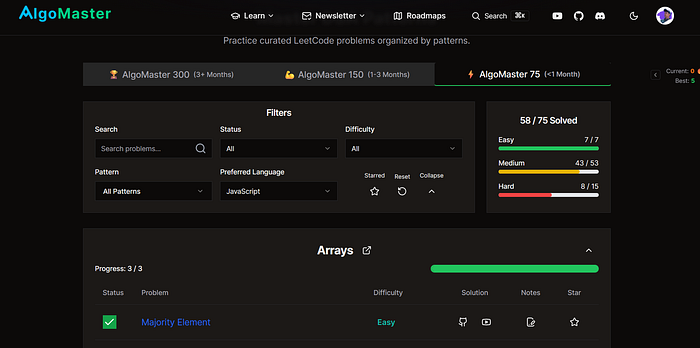
Watching YouTube videos for problems that I'm stuck on is old-fashioned. And just randomly grinding LeetCode is inefficient.
The guy behind Algomaster created a well-curated list of questions with a solid explanation for each. I don't want to solve 1000 random problems. I want to solve 100 good problems that actually build on each other.
Randomly picking 'Medium' problems on LeetCode feels like throwing darts in the dark. You get stuck, you Google it, you find a 20-minute YouTube video of someone explaining it with a hard-to-understand accent, and maybe you get it. It's a broken workflow.
But here you actually do the work, and if you get stuck, there is a good explanation that you can read and understand.
5. Hackernoon.com
This is where I find articles on "How I Reverse-Engineered a Proprietary API" or a hyper-detailed post-mortem on a microservice migration that went horribly, horribly wrong. It's highly technical website.

I usually land here from a link on Hacker News or Reddit. It's for the articles that actually have some meat on them, written by engineers who just spent 6 months fighting a problem.
6. Deep Research on Gemini, ChatGPT, etc.
My old workflow for learning something from scratch was:
- Search Google.
- Open 10 tabs of "medium.com" articles that are 80% fluff and 20% a vague, outdated code snippet.
- Go to YouTube, find a 40-minute video, and scrub through it at 2x speed, hoping to find the 30 seconds that actually matter.
- Finally, find some dense, unreadable official documentation.
Now, I just open Gemini or ChatGPT Deep Research feature. I treat it like a senior-level engineer I can bother 100 times in an hour. I'm not asking it to "write the code". I'm asking it to be my research assistant and my pair programmer and give me a detailed production-ready guide.
This is just a killer feature.

The AI generates a perfect, personalised tutorial in seconds. No fluff, no ads, no "smash that like button".
I have created more than 30–35 deep research tutorials; you can learn everything about a topic without wandering dozens of websites.
Of course, my list doesn't stop there. I've got a few other regulars, like:
- systemdesign.one
- hellointerview.com
- …and even just my GitHub feed.
These resources are how I keep a pulse on the tech market, and honestly, I've reached a place where I'd feel pretty lost without them.
They're my personal, self-curated university. It's the daily habit that compounds over a career.
Hope these websites will be useful to you as well, and I strongly believe you will thank me after knowing these websites.
Thanks for reading this blog.
See you at the top.