Thirteen years ago this month, amid a nervous breakdown, I closed the doors for the last time on the law firm I had spent nine years building.
I had no plan, and was scared to death.
Being a lawyer was my whole identity. I had been working towards a legal career since high school, and now I was leaving it all behind, with four young kids at home. The only thing I knew was I never wanted to practice law again.
The next few months would be tough. But, gradually, I would find new ways to earn money, and none of them involved getting a "real job".
I didn't find a get-rich-quick scheme. I never went viral. But, through lots of ups and downs, I managed to build a life that I loved that still provides me with all the money I need to live comfortably.
There were no hacks or cheat codes. I was never any good at networking, and I lack the stamina to hustle and grind my way through life.
Instead, I spent the next thirteen years trying to be my best self and learning to listen to my intuition. I ended up learning how to make a living from my way of living.
The first time I dared to believe that I could make money without getting the kind of soul-crushing job my in-laws were pressuring me to get was when I found a Reddit post from a new freelance content writer.
That post is now long gone; the internet isn't really forever, not for everything. But the poster mentioned that they were making as much money from freelance writing as they were as a barista.
That was the first time I saw anything on the web that gave me hope instead of hype.
What already works
I started to research copywriting and content writing, and had an epiphany. There was a lot of dreck on the internet. I was a competent writer already. It's hard to get through law school and not learn the basics of written communication.
I wasn't sure that anyone would want to hire me, and had no idea how to price my services, but I took the plunge.
I joined a bunch of online marketplaces and kept learning. Within two months of closing my firm, I had my first $1,000 month.
After I got tired of writing for pennies, I raised my prices and built my first website.
Early on, I decided to work with law firms because I already knew what they needed and I could speak their language.
Soon, I expanded my target market and began working with businesses operating in complex regulatory environments. That included professional service companies like doctors, lawyers, and financial planners, as well as B2B companies in sectors as diverse as energy and human resources.
I made a lot of mistakes, but I quickly built a stable business by doing what was already working for other freelancers and by leaning into the knowledge and skills I already had.
However, I would've quickly burned out if I hadn't also consistently experimented with different business models and offerings.
Experiment
About a year into my life as a freelancer, I read an article about Google's 20%-time rule. The idea was that engineers were encouraged to use 20% of their time in a week to experiment with new ideas. Much of Google's innovation in its first decade was directly related to 20%-time projects.
I began to dedicate every Friday morning to experimenting in my business.
I began writing under my name on different websites about topics I was passionate about, instead of just ghostwriting for clients.
I also tried new types of services. Most of these experiments didn't go anywhere, but two services, book sales descriptions for authors and video scripts for ads and explainer videos, became staples of my business.
Learn new skills
Another outgrowth of the experimentation was learning new skills. I saw that many of my clients needed press releases, and so I taught myself how to write them.
I was also getting sick of stock photographs and images, and taught myself illustration. Over the years, I developed a unique style that helped give me an easily recognizable visual identity and unexpectedly led to getting freelance illustration work.
Find creative outlets
Years into my journey as a happily unemployable freelancer, I started to get sick of only doing client work. By tuning into my intuition, I realized I needed to create stuff. I was an artist.
I started to write poetry, mostly haiku. Initially, I only wrote for my amusement. However, once I began sharing some of my work, strange things began to happen. People enjoyed my silly poems.
In 2016, I ended up publishing a book of pirate haiku for fun. The book itself never brought in much money, but it did lead two freelance clients to find me. A dentist and a wealth manager who were both obsessed with pirates read my book, saw that I was a freelance writer, and ended up hiring me to write for their companies.
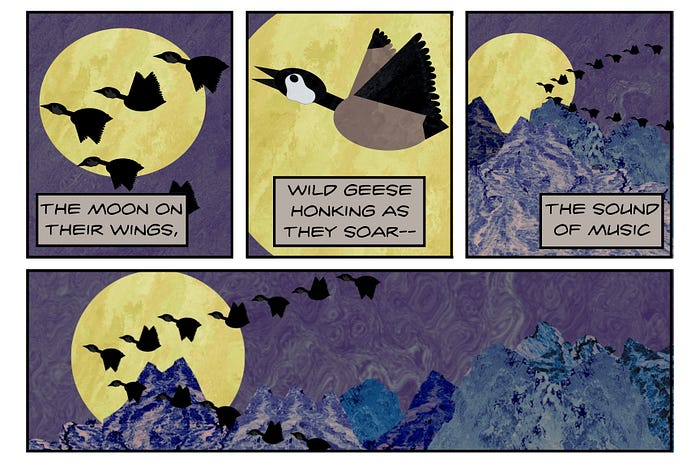
Today, my poetry comics are an important stream of income for me. However, I would still make them for free if nobody else was interested in them because they're so fun for me.
I have other creative outlets that I refuse to monetize. I make collage art in my notebooks to help me relax and to keep my creative juices flowing. I'm also learning macrophotography.
Having creative outlets helps me avoid burnout and reminds me that most things in life are not that serious.
Ignore spectators
While my wife and kids have been very supportive of my unconventional life choices, my in-laws and some of my friends have not.
I try to give them the benefit of the doubt and believe that they are just worried about me when they pester me about getting a real job or ask when I'm going to get tired of staying at home.
Mostly, I ignore them. They have no idea what they're talking about. Some of them are just jealous spectators. They lack the courage to try something out of the ordinary and can only jeer my efforts.
On the wall of my office, I have a framed comic from artist Gavin Aung Than that is an illustration of this Theodore Roosevelt quote:
It is not the critic who counts; not the man who points out how the strong man stumbles, or where the doer of deeds could have done them better. The credit belongs to the man who is actually in the arena, whose face is marred by dust and sweat and blood; who strives valiantly; who errs, who comes short again and again, because there is no effort without error and shortcoming; but who does actually strive to do the deeds; who knows great enthusiasms, the great devotions; who spends himself in a worthy cause; who at the best knows in the end the triumph of high achievement, and who at the worst, if he fails, at least fails while daring greatly, so that his place shall never be with those cold and timid souls who neither know victory nor defeat.
The comic tells the story of one man watching a mountain climber on TV and the story of the actual mountain climber doing the work, taking the risks.
If I had listened to all of the spectators, I would never have made it one year, let alone thirteen years.
Slow and steady really does win the race
I have never gone viral. I've never been a best seller, and I've never had an explosive period of growth.
My business has been built slowly by showing up each day to do the work. When I make a mistake or fail at something, I keep trying.
Over the past thirteen years, many of the friends and connections I've made along the way have quit or flamed out. The ones that are still in the game are the ones that never let themselves get too high or too low when they had successes and failures.
Adapt
The past couple of years have been especially hard on many of the writers and artists I know. AI has been cutting into people's incomes and crushing morale.
However, others are thriving.
The difference is how willing someone is to adapt.
I'm an AI skeptic. I write and draw my own work. I always have and I always will. But I also can't ignore AI, if I want to keep living a jobless life.
For me, that adaptation means leaning more into my humanity and finding new ways to connect with people independent of algorithms and screens.
Over the past thirteen years, I've learned that things will always change. If I want to keep doing work I love, I have to be open to new ways of sharing that work.
Build a life you love living
When I was building my law firm, the biggest mistake I made was thinking I would grind things out in the short term so I could enjoy a wonderful retirement later on.
Since the law firm closed, I've focused on building a life I love living right now.
I've built a business that allows me to do most of my work before noon each day. I don't work weekends. I take lots of hikes during the week, and I never go more than a few weeks without heading to the ocean.
I only work with people I enjoy.
I ensure that work fits into my life instead of trying to fit my life around work.
This has not been easy or simple.
We enjoy a lot of family time, but we aren't traveling all over the globe. We live a simple life with lots of laughter.
I'm a cancer survivor. Like you, I have no idea how much time I have on this planet. I refuse to make my life all about work. I've spent the past thirteen years living life and making a living from the way I live my life.
I've managed to string together several different income streams, none of them truly passive. But I've also never missed any of my children's events, and I get a good night's sleep every day.
I cannot imagine it any other way.
We are not wealthy. I may not ever fully retire. But as long as I love what I'm doing, why would I want to quit?
I've escaped having a "real job" for thirteen years so far. I think it might be permanent.

Jason McBride is a freelance copywriter, poet, illustrator, and essayist. He's also the author of the haiku comics collection "Wild Divinity." If you enjoyed this post, you will love his newsletter about using haiku to boost your creativity and mindfulness.