Before we start…
I am Jay Muthialu , an avid technologist, builder and experimenter of ideas. Many times I find understanding technology bit difficult and abstract, even for a technologist like myself, and I always wondered why is it that way? I guess it is the same with mathematics, economics and many other subjects. Though many of you may agree with this, I think there is a better way of narrating the story and I am going to take a stab at it and see if I am doing a better job. Feel free to add your comments, so I can improve.
The approach I am taking is two fold:
- Basics: Explain the concept in its bare bone, simplistic way, targeting non tech persons, product managers, business stake holders etc.
- Advanced: Deep dive with a demo and
prototypecode, targeting architects and engineers.
There will be no fluff or unnecessary jargon — just simple and straightforward.
What is hands-free technology?
It is a technology that executes an operation without any user interaction when the user is close to the target object. Very cool indeed!
Let me explain with Apple UWB based Car keys as an example. It unlocks the car when you move closer to the car with iPhone in your pocket or with Apple watch and locks when you move away. There is no need to pull your phone and tap it on lock — that is so old!!
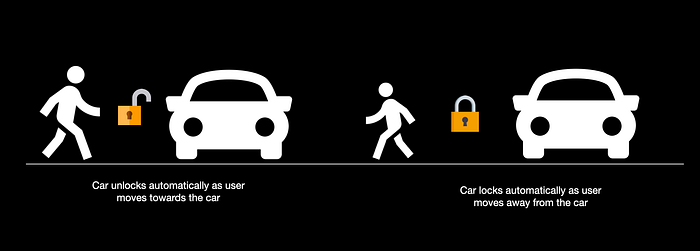
But, don't confuse this technology with NFC based Car keys, where you need to pull up your mobile phone and place it close to lock. With UWB, you just go near the car and it does the magic!
How does this work?
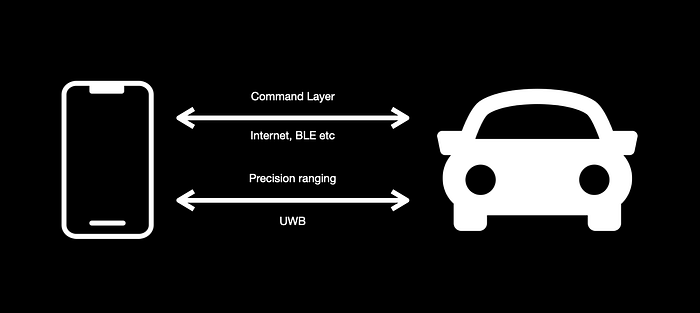
As you can see there are two things that needs to happen at a very basic level:
- Realtime calculation of precise distance between yourself and car
- Execute commands (lock or unlock) based on distance
Real time distance calculation, aka precision ranging, is the key component in hands-free technology that can lock or unlock based on how far you are from the car.
We need two technologies to get this working:
- Precision ranging capability
- Execute commands wirelessly
Let us start with precision ranging.
How do we calculate real time distance precisely?
Let us say we shine a light between two terminals A and B spaced 10 meters away. Imagine we start a timer at A exactly when the light is shone and stop the timer when it reaches B.
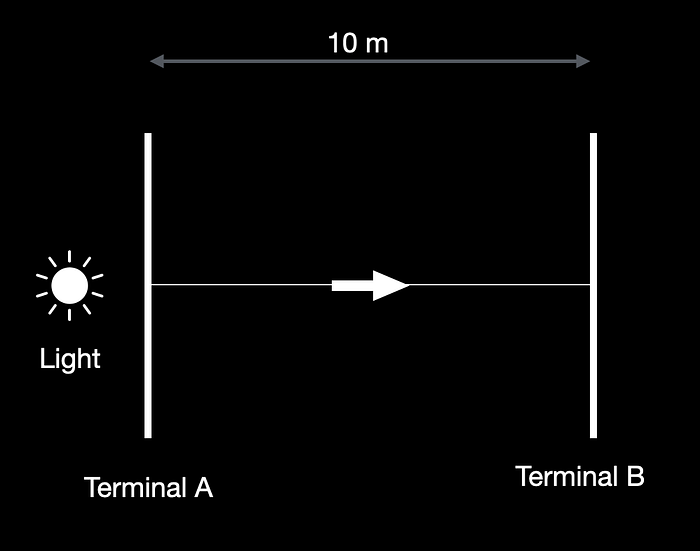
Let us say we can precisely calculate the time taken by light between A and B (elapsed time) and let this be 0.000000033333333 seconds. We know the speed of light is approximately 300,000,000 m/s. From this we can calculate distance between A and B as
distance = speed of light * elapsed time
distance = 300,000,000 * 0.000000033333333 = 10m
This scenario is good for illustration purposes only but will not work in real world. This is because when we shine a light, we are sending a continuous stream of photons with no specific start and end time. However if we replace the light source with one sharp pulse, then it has a definite start and end time - this is the key to precision ranging.
However it will still not be precise if the pulse is broad, as we cannot find exact start or end time. If the pulse is sharp, then we can determine a precise start and end time. The sharper the pulse, the better the accuracy.
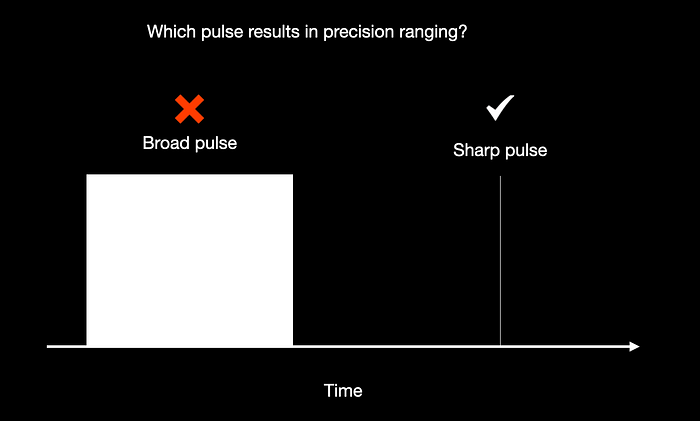
So what do we need to range precisely? In short, an ultra sharp pulse generator.
Welcome to UWB!
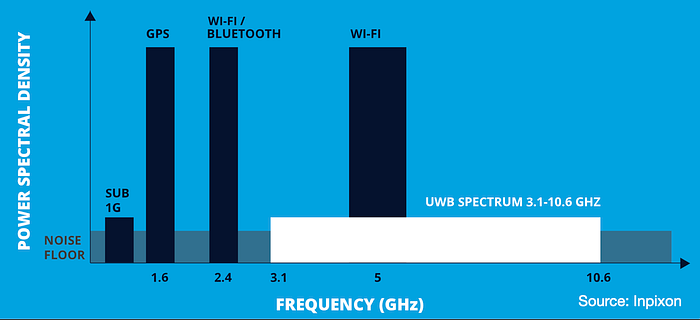
UWB stands for Ultra-wideband. This is a low power, wireless technology that uses radio frequencies between 3.1 GHz to 10.5 GHz. The technology has a large channel bandwidth of 500 MHz.
It sends a sharp sequence of pulses which lasts 2 nano seconds each, which is key to precision ranging.
See picture below, which shows UWB bandwidth compared with other radio technologies.
How does UWB calculate distance precisely?
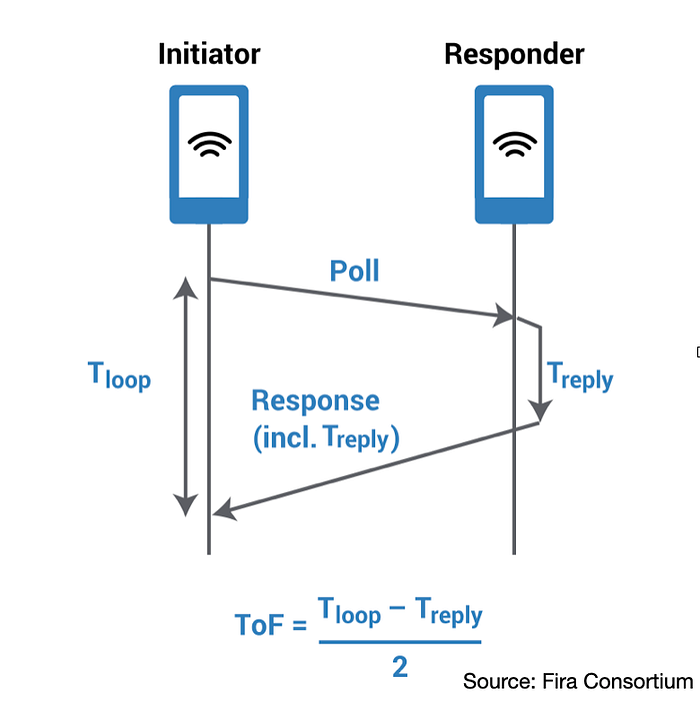
UWB does precision ranging by using Time of Flight (ToF). To understand how this works, let's take the car key example from earlier. When you get close to the car with your phone in your pocket, it starts ranging using ToF. The UWB tag in the car is the initiator, and your phone is the responder in this scenario. The initiator sends a pulse signal to the responder, and the responder replies with a response. The time taken for a round trip is then calculated by the UWB in the car, in a manner similar to which we described earlier and the distance is sent to the phone.
Putting it all together…
By now we have seen, how to precisely calculate the distance between objects, but still we still have not explained how the hands-free aspect of the technology works.
The distance calculated by the UWB tag in the car is sent to your phone and it determines if it should lock or unlock the car by sending appropriate commands. To do this, it uses a command layer which can use any existing wireless technologies, such as Internet or Bluetooth Low Energy (BLE).
Typically in the architecture of Car keys, BLE is used to the commands, as it can operate without internet — this is good as we wouldn't want to get locked out of our cars in the middle of no where. The BLE command execution is similar to the play command you issue to your bluetooth speaker.
And that's how UWB based hands-free technology works!
UWB Strengths
- Precision ranging (5 to 10 cm accuracy)
- Low power
- Secure communication
- Inexpensive and compact form factor
UWB Weakness
- Non Line Of Sight (NLOS): It does not work very well when there is no line of sight between the two UWB objects. Say if there is a wall or obstacle, the signals can get attenuated and may not deliver accurate ranging.
- Lack of widespread adoption: Apple introduced this in 2019 by adding UWB based U1 chips in iPhone 11 which made this technology popular, but still lacks widespread adoption.
How does UWB compare with other technologies?
- LIDAR
- Camera
- Wifi
- BLE
- RFID
- GPS
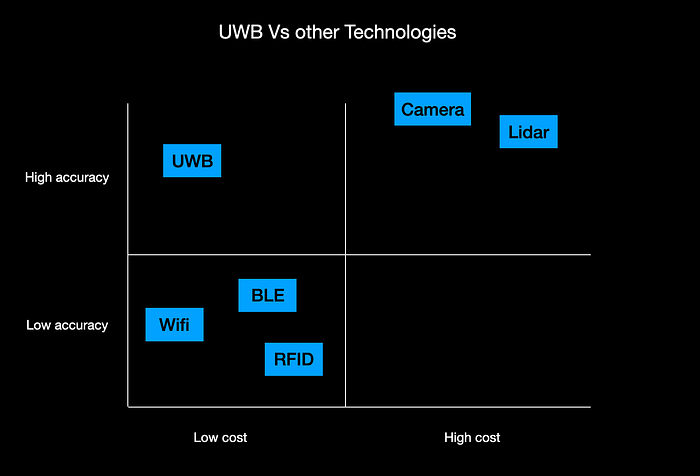
UWB wins hands down when accuracy, cost and size is taken into account. The below plot sums it up. GPS does not work well in indoors so it not included in the plot as a viable option.
Some use cases of UWB
- Car keys
- Smart home door lock
- Warehouse asset tracking
- Hands-free payment system
- Apple's AirTag, AirPods, HomePods, Airdrop use UWB extensively
- Many more
I hope this explains the basics of hands free technology using UWB. Now you may ask where is the demo and fully functioning prototype code?
Stay tuned my friend, that will be Part Two!