In the burgeoning landscape of AI Automation Agencies (AAA), founders face a universal bottleneck: Customer Acquisition Cost (CAC).
For non-members, I have the best Step by Step Guide to setup and use AI automations in N8N for saving 20+ hours each month -> https://aksh8t.gumroad.com/l/aiautomation
The standard playbook — cold outreach, LinkedIn DM campaigns, and paid ads — is becoming increasingly saturated and expensive. Agency owners often find themselves spending 70% of their time hunting for clients and only 30% delivering value.
But a quiet minority of founders have unlocked a superior model. They aren't hunting clients; they are inheriting them.
Lionus, co-founder of AI Union, has utilized this strategy to generate over €30,000 in monthly recurring revenue with 80% profit margins. By fundamentally shifting his agency's position in the value chain, he eliminated the need for a dedicated sales team or a marketing budget.
Here is an analysis of the SaaS Partnership Model and how it effectively solves the agency scalability crisis.
The Paradigm Shift: From Vendor to Ecosystem Partner
The traditional agency model operates in isolation: you identify a client's problem and pitch a solution.
The SaaS Partnership Model operates within an ecosystem: you identify a software company's retention problem and pitch implementation.
The Market Gap
Software-as-a-Service (SaaS) companies excel at building product, but they often struggle with Service Delivery.
- Complexity leads to Churn: If a user buys a complex Voice AI tool or CRM but cannot integrate it, they cancel the subscription.
- Resource Constraints: High-growth SaaS startups rarely have the headcount for a dedicated "Professional Services" team to hand-hold every new user.
The Solution: The agency positions itself as the official implementation partner. The SaaS company sells the software, and immediately hands the client to the agency for integration.
"We don't do marketing. We partner with software companies who already have the leads but lack the capacity to service them. We become their integration arm." — Lionus, AI Union
Strategy I: Identifying the "High-Leverage" Partner
Not all partnerships yield results. Aligning with giants like Salesforce or HubSpot places you in a sea of thousands of competitors. The arbitrage opportunity lies in the Mid-Market and Niche Sectors.
To execute this, you must target companies that fit three specific criteria:
- High Technical Friction: The product is powerful but requires API configuration, webhook setups, or data mapping (e.g., Voice AI, specialized ERPs, Niche CRMs).
- High Velocity: The company is growing fast and their support tickets are piling up.
- Service Vacuum: They have no in-house integration team.
The "Value-First" Entry Strategy
You cannot simply email a founder asking for leads. You must prove competence first. Lionus's strategy involved a "content offensive":
- He identified target software.
- He produced high-quality YouTube tutorials and documentation solving specific user problems for that software.
- He became a visible, trusted expert in their community before proposing a partnership.
Strategy II: Productization for Scale
Bespoke, custom development is the enemy of speed. To make this model work, the agency's services must be as easy to sell as the software itself.
This requires Productizing Services — turning complex consulting into standardized SKUs (Stock Keeping Units).
The Tiered Approach:
- Tier 1: The "Quick Start" (€1,500): Standardized account setup, basic API connection, and one core workflow.
- Tier 2: The "Enterprise Flow" (€4,000+): Custom logic, multi-platform integration, and team training.
Why this works: It removes friction for the SaaS sales team. They aren't selling "consulting hours" (which is vague); they are selling a "Setup Package" (which is tangible). This clarity leads to shorter sales cycles and conversion rates that often approach 100% on referred leads.
Strategy III: The Agency as an R&D Lab
Perhaps the most profound insight from Lionus's model is the long-term play.
When an agency handles hundreds of integrations for a specific niche, it aggregates proprietary data on market inefficiencies. You begin to see exactly where the software falls short and what features customers are desperate for.
Lionus leveraged this operational volume to identify a gap in outbound appointment setting workflows. Instead of building the same automation repeatedly, he codified it into his own SaaS product, Salesfrank.com.
This transitions the business from Service-Based Revenue (linear scaling) to Product-Based Revenue (exponential scaling). The agency effectively funds the R&D for the SaaS.
If you've made it this far, I know you're serious about working smarter — not harder.
And for people like you, I created a complete, end-to-end playbook that shows how professionals are actually using AI automation to reclaim time and scale their output — without hiring more people or learning complex code.
After watching countless professionals get stuck between AI hype and real execution, I decided to bridge that gap with something practical.
Top AI Automations for Professionals is a hands-on guide built from real production workflows, not theory or demos. It shows you exactly how to build AI systems that run quietly in the background and save hours every single week.
This isn't another "AI tools list." It's a practical automation blueprint designed for busy professionals who care about results.
What You'll Learn —
6 Production-Ready AI Automations Proven workflows for email, meetings, CRM, support, social media, and reporting
Step-by-Step n8n Workflows Build each automation from scratch with clear instructions and real prompts
AI That Actually Works in Real Life Error handling, cost control, and deployment strategies included
Time & ROI Focused Systems Automations that save 10–20 hours per week, not just minutes
Professional-Grade Execution The same patterns used by high-performing teams and operators
Perfect For
Professionals overwhelmed by repetitive work
Founders and operators scaling without hiring
Product, marketing, sales, and ops professionals
Anyone who wants AI to work for them, not the other way around
If you found value in this article, imagine having complete systems you can actually implement — step by step.
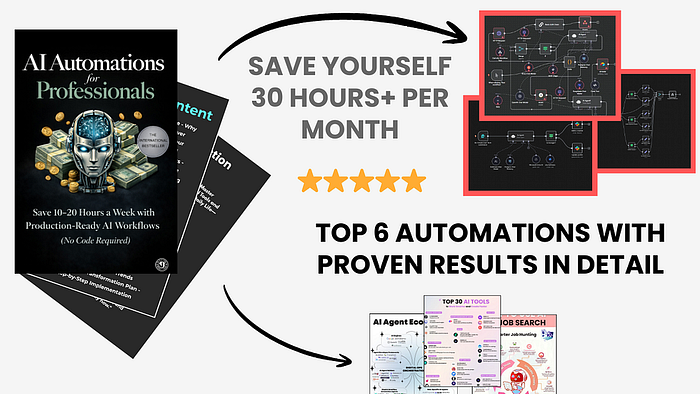
Top 6 AI Automations for Professionals gives you the exact workflows, prompts, and structure to turn AI into a reliable productivity engine.
👉 Get the complete playbook here: https://aksh8t.gumroad.com/l/automationbook
The Execution Framework
For agency owners looking to pivot to this model, the roadmap is clear:
- Audit the Stack: Identify the tools you already use that are complex enough to scare average business owners.
- Create Authority: Publish technical content (Medium articles, YouTube guides) that specifically addresses integration pain points for those tools.
- Engage the Ecosystem: actively participate in the software's Discord or Circle communities. Answer questions for free.
- Formalize the Alliance: Approach the partnership team with a proposition: "I see you have 20% churn due to setup friction. I have a standardized package to fix this. Send me the users you are at risk of losing."
Final Thought
The "Gold Rush" in AI isn't just about the technology; it's about adoption.
By positioning your agency as the bridge between complex tech and non-technical businesses, you secure the most valuable asset in business: Trust.
You stop being a vendor who costs money, and become a partner who saves revenue. That is the foundation of a $30k/month business.
________________________________________________________________
Get My Personal Made Top 6 n8n Automation Ebook of 276 pages with detailed Step by Step Guide that will Save you time and also help make more Money -> https://aksh8t.gumroad.com/l/automationbook