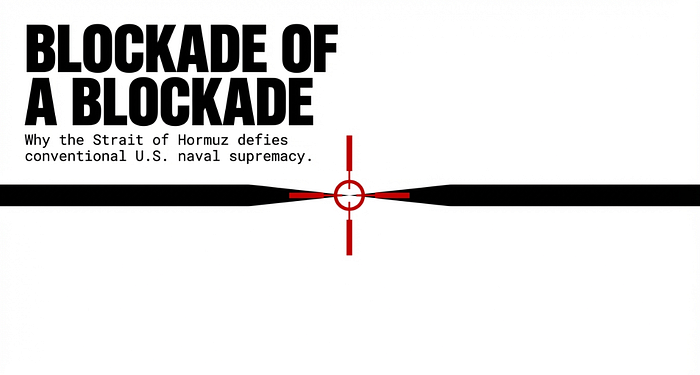
The Strait of Hormuz, a 21-mile-wide passage between Iran and Oman, is the world's most critical oil transit choke point, with nearly 30% of global seaborne crude oil passing through its waters daily.
Unlike open-ocean theaters where the U.S. Navy's technological and firepower superiority reigns supreme, the Strait's confined dimensions, shallow waters, and proximity to Iran's coastline neutralize many of America's naval advantages.
The U.S. has long relied on its Arleigh Burke-class destroyers, such as the USS Frank E. Peterson and USS Michael Murphy, which are currently deployed in the region. However, as ORF Online argues in Dominance without Control: Naval Dynamics in Operation Epic Fury, these vessels — designed for blue-water operations — are ill-suited for the Strait's cluttered, high-threat environment.
Iran's military doctrine has adapted to exploit these conditions. The Islamic Revolutionary Guard Corps Navy (IRGCN) has abandoned traditional fleet-on-fleet engagements in favor of asymmetric warfare, prioritizing quantity over quality. Instead of fielding expensive frigates or submarines, Iran has invested in thousands of low-cost unmanned systems, including:
Ya Mahdi unmanned surface vessels (USVs), which can be deployed in swarms to overwhelm U.S. defenses.
"Sleeping" intelligent sea mines, capable of lying dormant for months before being triggered by specific acoustic or magnetic signatures.
Coastal defense cruise missiles (CDCM), such as the Khalij Fars and Nasr-1, which can be launched from hidden mountain positions along the Strait's northern shore.
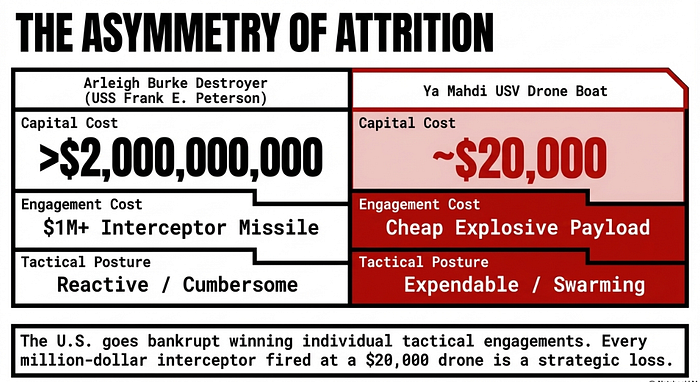
According to SpecialEurasia in The Evolution of Iranian Naval Doctrine 2020–2026, Iran's strategy is built on the principle of "cost-imposition warfare." A single U.S. interceptor missile, such as the SM-6 or ESSM, costs between $1–4 million per shot, while an Iranian USV or drone boat can be produced for $20,000–$50,000.
In a prolonged engagement, the U.S. would quickly exhaust its Vertical Launch System (VLS) cells, leaving its ships vulnerable.
This dynamic was already evident in Operation Epic Fury, where U.S. forces reported expending hundreds of millions of dollars' worth of munitions in just the first week of engagements, while Iran's losses were measured in the low millions — a ratio that is unsustainable for the U.S. in the long term.
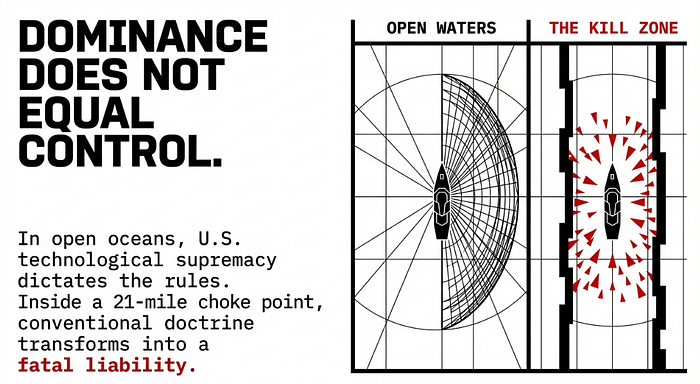
The terrain further amplifies Iran's advantages. The Zagros Mountains, which run parallel to the Strait's northern coast, provide natural cover for Iranian missile batteries, radar stations, and drone launch sites.
As SpecialEurasia notes, Iran has constructed underground tunnels and buried fiber-optic networks to connect its coastal defenses, allowing for silent, jam-proof communications between command centers and launch sites.
Unlike traditional radio-based systems, which can be disrupted by U.S. electronic warfare (EW) platforms like the EA-18G Growler, these fiber-optic links are nearly impossible to detect or disable without physical destruction.
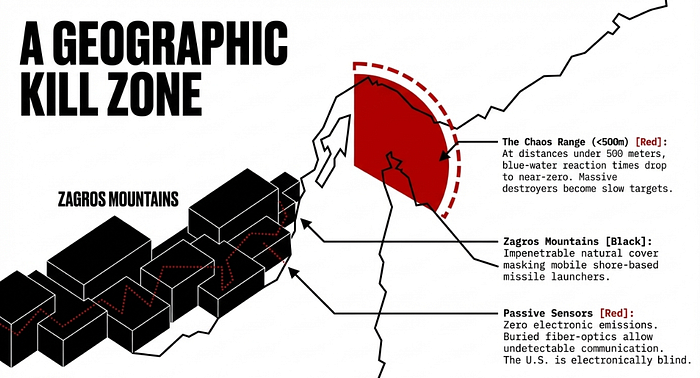
Within the Strait itself, the "Chaos Range" — a term coined by naval strategists to describe engagements at under 500 meters — renders U.S. ships uniquely vulnerable.
At such close distances, even the most advanced Aegis Combat System struggles to track and intercept incoming threats in time. Iran has positioned mobile coastal missile launchers, such as the Tondar (CSS-N-5) anti-ship cruise missiles, in concealed positions along the shoreline.
These systems can be repositioned within hours, making preemptive strikes by the U.S. difficult. The result is a kill zone where U.S. destroyers, despite their advanced sensors and firepower, are forced into a reactive, defensive posture.
Economic Warfare by Another Name
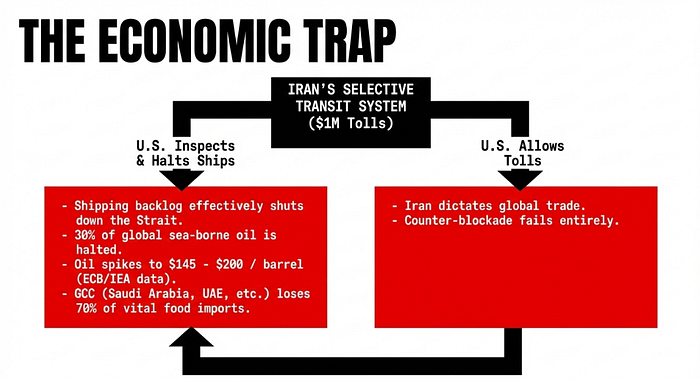
Rather than attempting a total closure of the Strait — which would harm Iran's own economy and alienate its remaining allies — Tehran has adopted a Selective Transit System (STS). This approach, detailed in SpecialEurasia's analysis of Iranian naval doctrine, allows Iran to control the flow of shipping without triggering a full-blown global crisis.
Under the STS, Iran uses a network of passive sensors, including electro-optical and infrared cameras, to monitor vessels entering the Strait. Ships are then classified into three categories:
"Friendly" vessels (primarily those bound for Iran or allied nations like Syria).
"Neutral" vessels (those willing to pay a transit fee).
"Hostile" vessels (primarily U.S., Western, or Israeli-linked ships).
Vessels in the first two categories are allowed to pass, often after paying a "toll" that can reach $1 million per transit, according to reports from Lloyd's List and Reuters. Those in the third category face harassment, boarding, or attack by IRGCN forces. This system has already led to multiple incidents in early 2026, including:
- The seizure of the M/T Stena Impero (a British-flagged tanker) in March 2026, which was released only after a $2.5 million "transit fee" was paid.
- The detonation of a limpet mine on the hull of the *Japanese-owned Chem Pluto in February 2026, after it refused to comply with Iranian demands.
For the U.S. Navy, enforcing a counter-blockade under these conditions is nearly impossible. To prevent Iran from collecting tolls, the U.S. would need to board and inspect every vessel entering the Strait — a task that is logistically unfeasible. With over 100 tankers passing through the Strait daily, even a partial inspection regime would create massive shipping delays, effectively shutting down the waterway — the very outcome the U.S. seeks to prevent. As ORF Online notes, this creates a "policing paradox": the harder the U.S. tries to enforce the blockade, the more it disrupts global trade, playing directly into Iran's hands.
The economic consequences of a prolonged Strait of Hormuz crisis are catastrophic and far-reaching. The Strait is the primary export route for Saudi Arabia, Iraq, Kuwait, and the UAE, which together account for nearly 20% of global oil production. Any disruption to this flow has immediate and severe impacts on global energy markets.
As of April 2026, Brent crude prices have already surged to $105 per barrel, up from $70 in February, as reported by The Guardian. Analysts at Goldman Sachs and the International Energy Agency (IEA) warn that a full blockade could push prices to $145–$200 per barrel within weeks.
The last time the Strait faced a serious disruption — in 2019, after Iran seized a British tanker — oil prices spiked by 20% in a single week.
A prolonged crisis in 2026 would be far worse, with Saxo Bank predicting a "supply shock of historic proportions" that could trigger a global recession.
The impact on food security is equally dire. The GCC states import 70–90% of their food through the Strait, including wheat, rice, and meat from India, Australia, and Brazil.
A shipping slowdown would lead to severe shortages and price spikes, threatening social stability in countries like Saudi Arabia and the UAE. In March 2026, the Saudi Ministry of Commerce already warned of "imminent food shortages" if the Strait's disruptions continued, leading to panic buying in Riyadh and Dubai.
For the U.S., this creates a strategic dilemma: a blockade intended to punish Iran risks alienating its Gulf allies, who would bear the brunt of the economic fallout. In a closed-door meeting in Riyadh on April 5, 2026, Saudi Crown Prince Mohammed bin Salman reportedly told U.S. Secretary of State Anthony Blinken that "Saudi Arabia cannot afford another oil shock" and urged the U.S. to seek a diplomatic solution rather than escalate militarily. Similar concerns were raised by UAE Foreign Minister Abdullah bin Zayed, who warned that a prolonged blockade could "destabilize the entire region."
China's Role: The Superpower Wildcard
China's involvement in the Strait of Hormuz crisis adds a geopolitical dimension that the U.S. cannot ignore. As the world's largest importer of crude oil, with nearly 40% of its imports passing through the Strait, Beijing has a direct stake in keeping the waterway open. However, unlike the U.S., which seeks to isolate Iran, China has deep economic ties with Tehran, including a 25-year, $400 billion cooperation agreement signed in 2021.
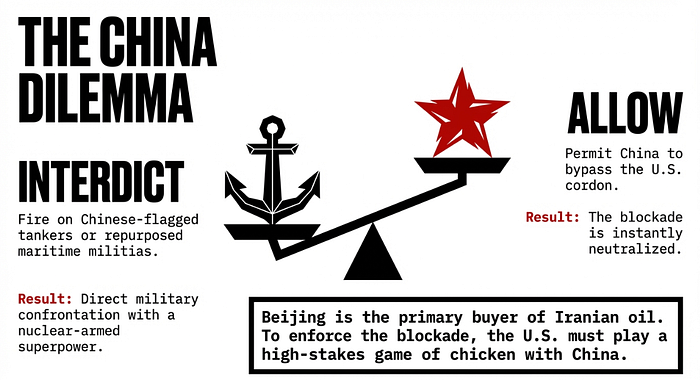
If the U.S. attempts to interdict Chinese-flagged tankers, it risks escalating tensions with a nuclear-armed superpower. As Saxo Bank noted in its April 2026 market report, China has three potential responses to a U.S. blockade:
Naval Escorts: Deploying Type 055 destroyers or Type 071 amphibious dock landing ships to protect Chinese tankers.
"Maritime Militias": Using civilian fishing trawlers (which are difficult to distinguish from commercial vessels) to shadow U.S. ships and disrupt operations.
Economic Retaliation: Imposing sanctions on U.S. companies or restricting rare earth mineral exports, which are critical for U.S. defense manufacturing.
In February 2026, China already tested this strategy when it escorted a convoy of five tankers through the Strait under the protection of the PLAN's 44th Task Force, which included the destroyer Nanchang and the frigate Yantai. When a U.S. P-8 Poseidon reconnaissance aircraft flew overhead, Chinese warships locked their fire-control radars onto the U.S. plane, a provocative act that nearly led to a direct confrontation. The incident forced the U.S. to back down, allowing the convoy to pass unmolested.
This episode demonstrated that the U.S. lacks a viable military option to stop Chinese tankers without risking a direct conflict.
As Admiral John Aquilino, commander of U.S. Indo-Pacific Command, told Congress in March 2026, "We cannot afford a kinetic engagement with China over the Strait of Hormuz."
The result is a strategic stalemate: the U.S. cannot enforce a total blockade without China's cooperation, and China has no incentive to comply.
The Subsurface Threat: Mines and the Invisible War
While the U.S. dominates the surface and air domains, the subsurface remains a dark and uncontested battleground. Iran has heavily invested in sea mine warfare, deploying a mix of traditional contact mines and advanced intelligent influence mines that can be remotely activated when a target vessel passes overhead.
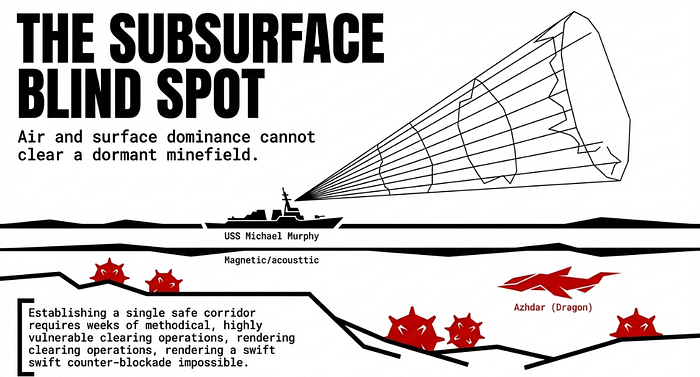
According to a 2025 U.S. Naval Institute report, Iran possesses over 5,000 sea mines, including:
- M-08 "Sadid" mines (copies of the Russian MDM-6), which can be laid by submarines or small boats.
- "Smart" mines equipped with magnetic, acoustic, and pressure sensors, capable of discriminating between different types of ships.
- Drifting mines, which can be released into shipping lanes to create unpredictable hazards.
The Azhdar (Dragon) system, an autonomous underwater vehicle (AUV) developed by Iran, further complicates U.S. mine-clearing efforts. As SpecialEurasia notes, the Azhdar can plant mines autonomously or even hunt for enemy submarines, making it one of the most advanced underwater threats in Iran's arsenal.
Mine-clearing operations are slow, dangerous, and resource-intensive. The U.S. Navy's Avenger-class mine countermeasures ships (MCM) and MH-53E Sea Dragon helicopters are ill-suited for the Strait's shallow waters, where magnetic and acoustic mines are most effective.
Even with the USS Frank E. Peterson and USS Michael Murphy on station, establishing a single safe corridor can take weeks, during which time Iran can replenish its minefields.
In January 2026, a U.S.-led mine-clearing operation near Kish Island took 12 days to clear a 5-mile stretch of waterway.
During this time, Iran laid additional mines in adjacent areas, forcing the U.S. to restart the process. As Captain James Fanell (Ret.), a former U.S. Navy intelligence officer, told Fox News, "We're playing whack-a-mole. Every mine we clear, Iran lays two more."
The psychological impact of the mine threat is just as significant. Commercial shipping companies, fearing insurance premiums skyrocketing (some have already tripled since February 2026), are avoiding the Strait entirely. Maersk, COSCO, and MSC have all rerouted vessels around the Cape of Good Hope, adding 10–14 days to shipping times and dramatically increasing costs.
This de facto blockade achieves Iran's goals without a single shot being fired.
The Double-Front Escalation: Bab-el-Mandeb and the Domino Effect
Strategic analysts warn that Iran would retaliate by activating its proxies across the region, most notably the Houthi rebels in Yemen, who control the Bab-el-Mandeb Strait — another critical choke point at the southern entrance to the Red Sea.
As ORF Online notes in Dominance without Control, the Houthis have already demonstrated their ability to disrupt shipping in the Red Sea. In December 2025, they seized the Galaxy Leader (a Japanese-owned, Israeli-operated cargo ship) and fired anti-ship ballistic missiles (ASBMs) at U.S. and British warships in the region. In March 2026, Houthi leader Abdul-Malik al-Houthi warned that "if the Americans escalate in Hormuz, we will close Bab-el-Mandeb."
If both Hormuz and Bab-el-Mandeb were closed, the Red Sea and Suez Canal — which handle 12% of global trade — would be effectively severed. This would force all Europe-bound Asian trade to take the longer route around Africa, adding thousands of miles and weeks of transit time. The economic impact would be staggering:
- Suez Canal revenues (which averaged $9 billion annually before 2026) would collapse.
- Global shipping costs would increase by 30–50%, according to Drewry Shipping Consultants.
- European gas prices (already volatile due to the Ukraine war) would surge, as LNG shipments from Qatar would be delayed or rerouted.
The U.S. Navy is already stretched thin. Maintaining two simultaneous blockades — one in Hormuz and another in Bab-el-Mandeb — would require at least 12–15 additional warships, according to a 2026 RAND Corporation study. However, the U.S. currently has only 9 destroyers and cruisers in the Middle East, with no immediate reinforcements available due to commitments in the Indo-Pacific (where tensions with China are rising) and Europe (where NATO is reinforcing its eastern flank against Russia).
The Houthi threat is not just theoretical. In April 2026, they test-fired a new anti-ship missile, the "Hatem-2", which has a range of 200 km — enough to strike deep into the Red Sea. U.S. officials believe the missile was supplied by Iran, further demonstrating Tehran's ability to project power through its proxies.
Israel's Strikes on Lebanon: Another Layer of Instability
The already volatile situation in the Strait of Hormuz is being further destabilized by Israel's military actions in Lebanon. Despite a supposed ceasefire brokered in March 2026, Israel has continued airstrikes against Hezbollah positions, raising the risk of a wider regional conflict.
On April 8, 2026, Israel launched a series of airstrikes on Hezbollah missile depots in Baalbek and South Beirut, killing at least 15 fighters and destroying what Israeli officials claimed were "precision-guided missiles bound for the Gaza Strip." Hezbollah responded by firing over 200 rockets into northern Israel, marking the heaviest cross-border exchange since the 2006 Lebanon War.
The timing of these strikes is particularly concerning. With tensions already high in the Strait of Hormuz, any escalation in Lebanon could draw Iran directly into the conflict. Hezbollah, which is armed, funded, and trained by Iran, has threatened to open a "second front" against Israel if the U.S. continues its blockade in the Strait. In a April 10 speech, Hezbollah Secretary-General Hassan Nasrallah warned that "if the Americans think they can strangle Iran in Hormuz without consequences, they are mistaken. The resistance axis will respond in kind."
For the U.S., this creates a multi-front dilemma:
- If it escalates in Hormuz, it risks provoking Hezbollah (and by extension, Iran) to attack Israel or U.S. forces in Lebanon.
- If it backs down in Hormuz, it emboldens Iran and weakens its regional credibility.
- If it supports Israel's strikes on Hezbollah, it further alienates Arab allies (like Saudi Arabia and the UAE) who are already frustrated with U.S. policy.
The interconnected nature of these conflicts means that any military action in one theater could have ripple effects across the region. As General Kenneth McKenzie (Ret.), former commander of U.S. Central Command, told CNN in April 2026, "We're one miscalculation away from a full-blown regional war."
The Strategic Dead End: Why the U.S. Cannot Win
The Strait of Hormuz crisis exposes the limits of U.S. military power in the face of asymmetric warfare, economic interdependence, and geopolitical rivalries. Despite its technological and firepower superiority, the U.S. is outmaneuvered by Iran's low-cost, high-impact tactics, the Strait's unforgiving geography, and the economic and diplomatic constraints imposed by its allies and rivals.
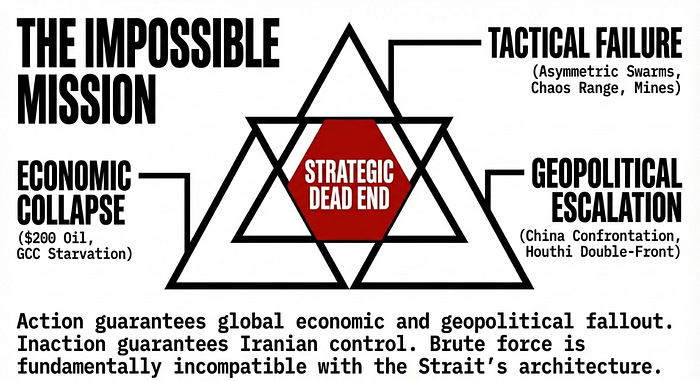
Without a comprehensive strategy that addresses all of these challenges, any U.S. attempt to counter Iran's blockade risks failure.