I stopped taking notes on papers when my literature review collapsed under its own weight. What saved it was a simple shift: tracking claims instead of PDFs.
If you are doing a PhD, you probably know this moment. You open a draft of your literature review, scroll for a bit, and suddenly realize that you definitely read something relevant to this paragraph… but you have no idea where, by whom, or in which paper. You vaguely remember a figure. Or a sentence. Or a result that was "kind of important". But all you have are 300 PDFs, 300 notes, and zero clarity.
That was me. For a long time.
I did what everyone does at first. One paper, one note. Title, authors, year, maybe a short summary. Sometimes highlights copied from the PDF. Sometimes ambitious headings like Methods, Results, Limitations. And for a while, it felt productive. Very academic. Very organized.
Until I actually had to write.
The core problem: papers are the wrong unit
The breakthrough for me was painfully obvious in hindsight: papers are not what you cite — claims are.
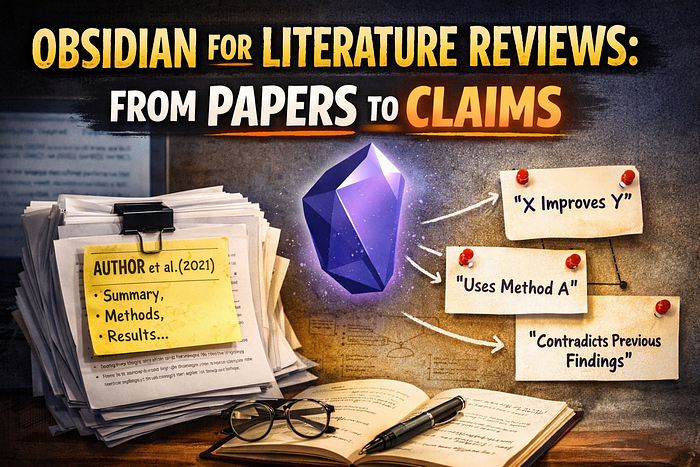
When you write, you don't cite "Smith et al. (2021)". You cite that:
- Smith et al. show that X improves Y under condition Z
- Smith et al. use method A, which assumes B
- Smith et al. contradict earlier findings by C
But my notes were structured around documents, not ideas. Each paper-note was a mini graveyard of mixed content:
- background claims
- methods
- results
- random thoughts
- copied highlights
Everything lived together, even though I never needed it together again.
So I changed the unit of thinking.
One note = one claim
In Obsidian, I stopped creating notes named after papers.
Instead, I started creating notes named after claims.
Not long summaries. Not paraphrases of abstracts. Actual, concrete statements that I might want to reuse in writing.
Examples (realistic, not polished):
- "Navigation errors increase significantly in urban canyons"
- "Map-matching accuracy depends more on sampling rate than sensor noise"
- "Most routing benchmarks ignore human route choice behavior"
Each of these notes contains:
- the claim in my own words
- a short explanation or context
- a citation reference (usually just a BibTeX key or author-year)
- optional notes on limitations or assumptions
That's it.
No fluff. No structure gymnastics. Just one idea per note.
At first, this felt wrong. Almost illegal. Like I was disrespecting the sacred academic paper by ripping it apart into little pieces. But that discomfort disappeared very quickly.
Because suddenly, things started to connect.
Papers become sources, not containers
In this system, papers still exist — but they are no longer the center.
I keep a lightweight paper note with:
- citation info
- maybe a one-line summary
- links to all claim-notes derived from that paper
So instead of one paper-note containing ten ideas, I have:
- ten claim-notes
- all linking back to the same paper
This reversal is powerful.
When I open a paper-note now, I don't reread the paper. I see what I actually extracted from it. That is usually all I need.
And when I open a claim-note, I immediately see:
- which papers support it
- which papers contradict it
- which methods or datasets are involved
That never happened with one-note-per-paper.
Writing becomes assembly, not archaeology
The biggest payoff shows up when writing.
Before, writing a literature review felt like archaeology. Digging through layers of notes, PDFs, highlights, trying to reconstruct what I once understood.
Now it feels more like assembly.
When I write a section about, say, localization accuracy, I don't search for papers. I search for claims. Or I follow links from related claims. Or I open a hub note like "Localization accuracy factors" that just links to relevant claim-notes.
Each paragraph becomes a composition of already-formed ideas:
- this claim establishes the problem
- this one supports it
- this one contradicts it
- this one shows a limitation
I'm not "summarizing literature" anymore. I'm building arguments from atomic parts.
And yes — I still paraphrase, refine language, and adapt tone. But the thinking is already done.
Why this works especially well for literature reviews
Literature reviews are not about papers. They are about positions.
You are mapping:
- what is known
- what is disputed
- what methods dominate
- what assumptions are implicit
Claim-based notes make this visible.
Over time, you start to notice patterns:
- five different papers repeating the same assumption
- one outlier contradicting a dominant narrative
- methods that always appear together
- gaps that nobody explicitly states
These insights almost never emerge from paper-level notes, because everything is buried inside them.
How Obsidian makes this practical (not perfect)
Could you do this in Word? Technically, yes. Practically, no.
Obsidian helps because:
- links are frictionless
- notes are cheap to create
- there is no forced hierarchy
I don't need to decide where a claim belongs. I just link it to:
- the paper
- related claims
- methods
- datasets
The structure emerges instead of being designed upfront.
Also important: I do not obsess over perfect wording. Claim-notes are allowed to be ugly. They are thinking tools, not final text.
Some of my notes literally start with:
"This paper basically says that…"
That's fine. I can polish later.
The hidden benefit: fewer notes, better notes
Counterintuitively, this approach reduced the total number of notes I have.
Before:
- one paper-note per paper
- many long, unfocused notes
Now:
- fewer paper-notes
- fewer but sharper claim-notes
I also stopped taking notes on everything. If a paper does not contain a claim relevant to my research questions, I don't force it. No note is better than a useless one.
This alone saved me hours every month.
What this does to your thinking
Something unexpected happened after a few months.
I started reading papers differently.
Instead of asking:
"What is this paper about?"
I ask:
"What claims does this paper make that I might reuse?"
That shift changes how you evaluate relevance, quality, and novelty. You become more critical, but also more efficient.
And during discussions with supervisors or reviewers, I feel much more grounded. When someone challenges a statement, I often already know:
- which paper supports it
- under which assumptions
- and where the weaknesses are
That confidence did not come from reading more. It came from structuring better.
This is not about Obsidian (but Obsidian helps)
To be clear: this is not an Obsidian trick. It's a thinking strategy.
But Obsidian is unusually good at supporting it because it does not force you into:
- folders
- document hierarchies
- rigid templates
It lets you treat knowledge as a network, which is exactly what literature is.
If you use another tool that supports atomic notes and linking, great. The principle still applies.
Where this still hurts (because PhDs are PhDs)
This system is not magic.
It does not:
- write your literature review
- fix unclear research questions
- make reviewers happy
You still have to think. You still have to revise. You still have days where nothing makes sense.
But the difference is this: you are no longer fighting your notes.
Your notes work with you, not against you.
Final thought
If your literature review feels bloated, repetitive, or strangely hollow, the problem might not be your writing. It might be your note-taking unit.
Try this for one week:
- stop summarizing papers
- extract claims instead
- one note, one idea
It feels uncomfortable at first. Then it feels obvious. And then you will wonder how you ever worked differently.
If you do try it, I'd honestly love to hear how it goes. We PhD students steal workflows from each other all the time anyway — this one just happens to have saved my sanity.