Was Britain still a superpower after WWII? It thought so. But in 1949, a British warship attempted to sail up the Yangtze river in China. A commander in China decided to let his artillery open fire. What happened surprised everyone.
The HMS Amethyst got stuck in the mud and was soon crippled by artillery — disabled for four months before it could limp back to port. The British Navy never sailed the Yangtze again.
It was as good as any year, to mark the end of the British Empire.
That story is repeating itself. But this time, the stakes aren't one ship. It's the Naval power of the United States.
Building a Giant for a War That No Longer Exists.
We need to go back to the 1980s.
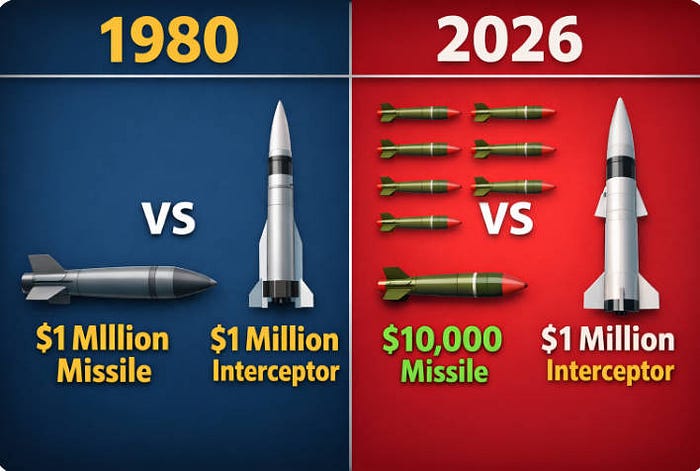
Missiles, in those days, were expensive. A single precision guidance system required advanced electronics that only a handful of nations could manufacture. If you wanted to threaten a super-power you needed to be a super-power yourself — like the Soviet Union.
The U.S. Navy was designed for exactly that world — and it was extraordinarily good at it. The U.S. destroyers of the 1980s were marvels of missile technology.
Then the 2010s arrived.
The same electronics revolution that put a supercomputer in your pocket put precision guidance — for everyone — into cheap military drones.
We saw what cheap drones could do in Ukraine. Tanks — the most dominant land weapons until 2022— became stationary targets by 2024. Commanders stopped moving them. They just sat and got picked off by drones that cost less than a used car.
Navy ships are tanks at sea.
They are slow, enormous and impossible to hide. They have sailed into a new era in which they cannot cope.
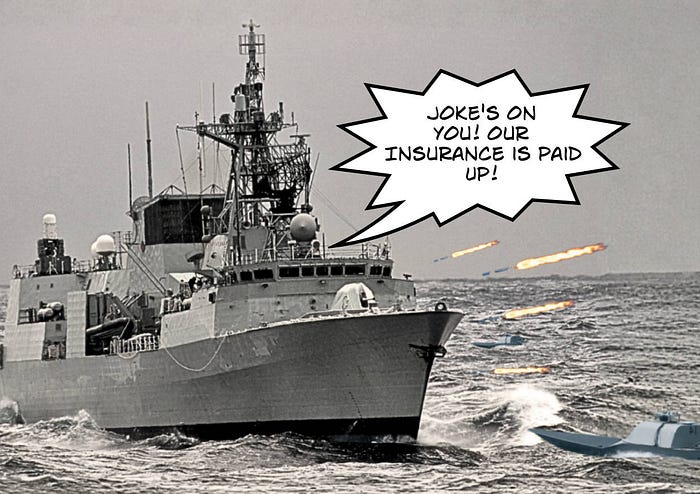
Recall, Ukraine sunk the Moskva from land-fired cruise missiles. A destroy who thought it was safe. The whole Russian Black Sea fleet eventually withdrew from Crimea.
Why would the U.S. Navy do better against Iran?
The Mathematics of Exhaustion
The USS Eisenhower aircraft carrier is a four-and-a-half-acre floating city. Its defensive escort destroyers — the Arleigh Burke class — are among the most sophisticated warships ever built. Their air defense systems can track hundreds of targets simultaneously and intercept missiles mid-flight.
But here is the number that makes a sailor sweat: each destroyer carries less interceptors than the enemy has missiles and drones to hit it.
The Strait That Changes Everything
The Red Sea was the theorem. The Strait of Hormuz might be the proof.
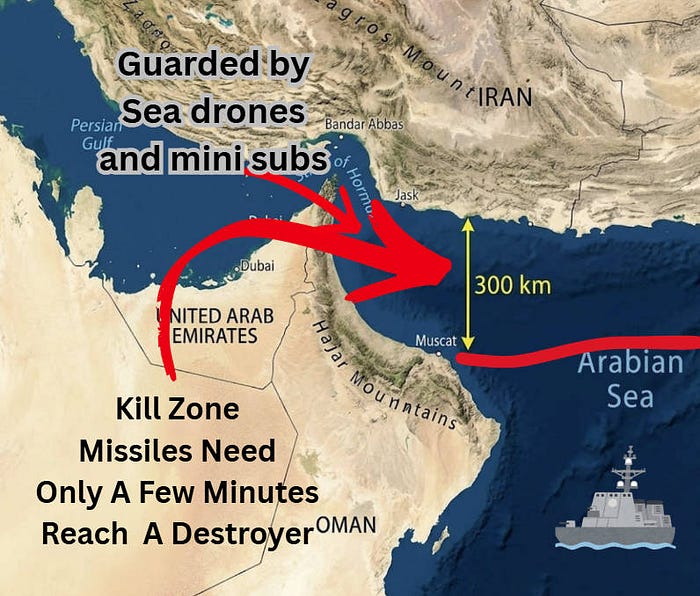
Twenty-one miles wide at its narrowest point. Iran controls the northern coastline. Fixed positions on high ground, with land-based missiles, submarines, drone swarms, and fast attack boats — all with unlimited resupply from domestic underground factories.
A carrier group sailing in has, at most, a few hundred interceptors across its entire escort screen.
Iran has studied Ukraine. They've studied the Red Sea. They know the arithmetic as well as anyone in the Pentagon.
The Navy will tell you about its close-in defenses — Phalanx guns that can shred incoming drones at close range. This is true. It is also a last-resort system. If you're relying on your point defense, the enemy is already at your door. In a 21-mile strait, there is no room to maneuver. There is no "open water" to retreat to.
The Salvo Equation: When the Math Turns Lethal
The terrifying reality of modern naval combat is governed by a cold formula known as the Salvo Equation. Developed by tactical legends like Wayne Hughes, it dictates that a ship's survival isn't based on its "strength," but on the ratio of incoming threats to ready interceptors.
In a "salvo competition," once the attacker's volume exceeds the defender's "staying power" — the physical number of missiles in those 96 VLS cells — the defensive shield doesn't just weaken; it collapses entirely.
When Iran or the Houthis launch a "pulse" of 50 drones against a destroyer with a finite, non-reloadable magazine, they aren't trying to out-tech the U.S. Navy. They are simply trying to solve that equation. Once the interceptors are gone, the most sophisticated warship in history becomes nothing more than 9,000 tons of target practice.
The real-world weakness of the U.S. Navy is in plain sight.
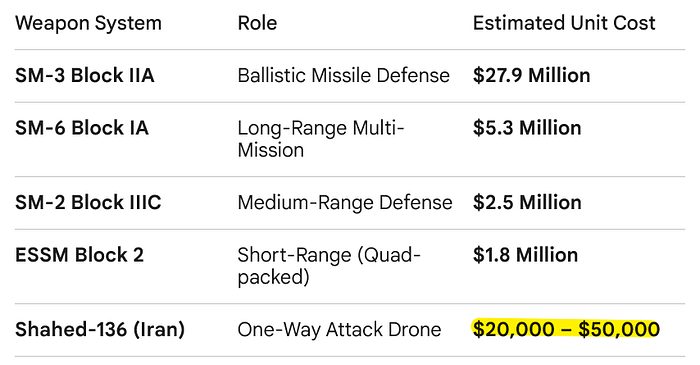
The $20,000 Drone That Broke Global Trade.
In late 2023 and into 2024, Houthi forces in Yemen began targeting commercial shipping in the Red Sea. The U.S. Navy, deployed to manage the situation, found itself in an uncomfortable position.
It couldn't get close to Yemen for the reasons outlined above.
Commercial shipping was quietly rerouted — not through the Suez Canal and the Red Sea, but around the Cape of Good Hope. The long way. A detour of roughly 19,000 kilometers, adding weeks to every voyage and thousands of dollars to every shipment.
The most powerful navy in the history of human civilization couldn't protect ships in the Red Sea. All this forced by the missiles from Yemen — one of the poorest countries on earth.
What This Actually Means
For 80 years, the global economy operated on a foundational assumption: American warships could keep the shipping lanes open. Oil flows. Goods flow. Dollars move. The Pax Americana was, at its core, a naval project.
That assumption has not been formally retired. There has been no announcement, no press conference. But it has ended nonetheless.
The Navy isn't weak. In open ocean, in a blue-water engagement between peer fleets, it remains unmatched. The carriers, the destroyers, the nuclear submarines — they are still the finest instruments of naval power ever assembled.
But the era of sailing into someone else's littoral waters and daring them to do something about it — the era that the Amethyst's crew thought they were operating in, on the Yangtze, in 1949 — that era is over too for the United States.
Will the U.S. test these facts and learn the hard way? I believe so. I wrote about this a couple of years ago.