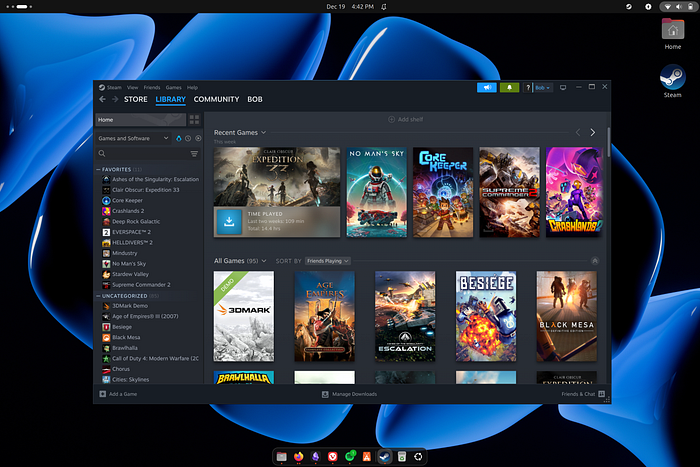
Windows and macOS rule the desktop operating system market, and the odds are the next computer you buy will be running one or the other.
But more and more people are trying out Linux as an alternative and finding that distributions like Ubuntu, Fedora, Zorin OS, Linux Mint and others are actually excellent alternatives to Windows.
Years ago, to have a good experience with Linux, you would have needed to be pretty comfortable with the terminal. I remember back when I tried out Ubuntu 7.10 on my 2007 MacBook Pro that I needed to Google terminal commands for some of the most basic things, like setting up Wi-Fi.
Those days are behind us, thankfully, and now there's very little need to touch the terminal in day to day use. But the fact remains: Linux is more difficult to use than Windows or macOS, and some things aren't as simple as they are on Microsoft's or Apple's platforms. Certain things are more complicated than they are with Microsoft or Apple, like using certain apps or reconfiguring system components.
So why do so many people prefer it anyway?
Freedom and customization
Both Windows and macOS allow for customization, to a degree. You can move the Dock in macOS and apply tinting to app icons. You can turn on dark mode or light mode or change the accent color. Windows has similar settings.
But in Linux, everything is fair game.
Depending on the desktop environment you're using you can change the size and location of key user interface elements, recreate a Windows-like setup or mimic Apple's. On my own Ubuntu 25.10 install, I have a very macOS-like dock setup, complete with the magnification effect.
Some distributions allow more customization out of the box than others, but unlike macOS or Windows, just about anything can be modified with the right know-how or tool.
That level of freedom is attractive to people who want to make their computers their own instead of depending on what Microsoft or Apple think is best.
And yet, after four years of Windows 11, we still can't move or resize the taskbar. Amazing.
Embarrassing, actually.
Windows and macOS both collect data
While Microsoft is definitely the bigger offender here, both Windows and macOS send large amounts of telemetry back to Redmond and Cupertino.
Since they're commercial operating systems, Apple and Microsoft want to make sure they're running smoothly and that any major issues are reported so they can be addressed.
Advertisers have a vested interest in knowing just what you're doing on your system too, of course, and Microsoft is happy to share some of that data with third parties to enable "personalized advertising."
Fun.
Many people rightly want no part of that and would much rather use an operating system that respects their right to not be tracked, categorized or advertised to.
And that, in fact, is one of the main reasons I very much prefer Linux over Windows for general use. It's not that Windows is bad at what it does. It's not. It's just that I don't trust Windows to not spy on me, especially in light of Microsoft's continued push to force users into useless Microsoft accounts just to use their own computers.
And as much as I do love my Mac, Apple's not innocent here either. Better, but not innocent.
Andrii is 100% correct that the "privacy" Apple sells is not what it seems. It's better than what you'd get from Microsoft, but it's enough to make any serious privacy-conscious person sit up and take notice.
Better performance
Windows is an operating system that tries to do a lot all at once. That leaves fewer system resources for the tasks you actually want to run.
Linux, on the other hand, generally performs better on the same hardware because there's less going on in the background, hogging your system's memory and CPU.
This is especially important in certain workloads, like data crunching or 3D rendering.
In my own testing, I found that Blender renders significantly faster on the same hardware running Ubuntu than it does running Windows. Now that could just be my specific hardware and my specific
That alone isn't going to be enough to get the masses to switch, but it's a big consideration for anyone who wants to get the absolute last drop of performance out of his hardware.
Just how great the performance gain is depends on the Linux distro and the applications you need to run, of course.
But in general, Linux is able to devote more processing power to any given task because it's not wasting that power on background tasks and services that are often of little benefit to you, the user.
That's why Linux is an obvious choice for older systems that don't work as well on Windows anymore.
Support for older hardware
When Microsoft ended support for Windows 10, it simultaneously locked millions of perfectly-good, still-working systems out of Windows 11, deeming them too old and thus "unsupported." That left millions of users and businesses with the tough decision to either use an unsupported operating system, qualify for or buy an extended security updates (ESU) plan, or buy a brand new computer.
That's ridiculous.
And, again, as much as I like my Mac, Apple only supports Macs for an average of seven years with software updates. After that time, they're deemed too old to support and are left out of the latest version of macOS.
Linux, on the other hand, doesn't care about any of that. It doesn't care if I have a TPM or if my processor is new enough.
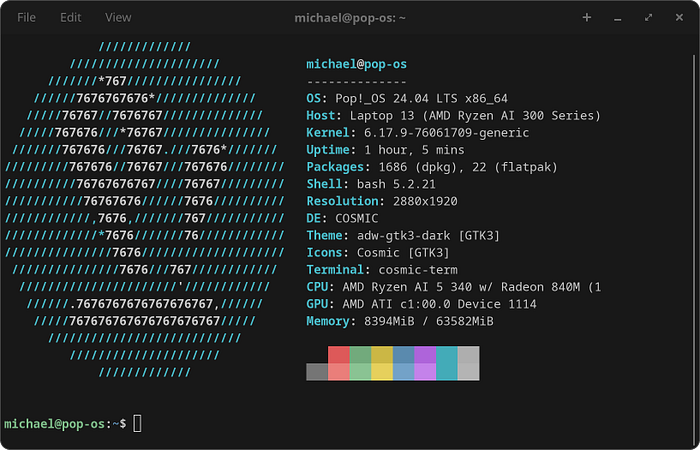
I've rescued several old, "unsupported" systems from the recycling pile by installing a new SSD and installing Linux. Unlike Windows or macOS, Linux will run on a potato.
Some distros require more recent, more powerful hardware than others, but for the most part, if your computer turns on and was made in the last fifteen years, you're good to go.
As someone who hates the idea of e-waste and how much we throw away every year, I love Linux for this. You take an old system that Microsoft refuses to support anymore and install a solid Linux distro, like Linux Mint, and you have yourself a great system that will last for several more years.
You can't beat the price
For some things in life, you do get what you pay for. If you don't pay for something, odds are it's not great. Or at least that's the line we're often fed.
In this case, it's not true.
While there are paid versions of Linux, like Red Hat Enterprise Linux (or RHEL), the vast majority are completely free for personal or commercial use.
If you want to download Fedora and run your fleet of business computers on it, go for it. Need a server and don't want to have to mess with Windows Server licensing? No problem. Just want to replace Windows on your old laptop? That's cool too.
Linux doesn't need product keys, always-on Microsoft accounts, dongles or any other software licensing hoopla.
It's free, and free forever. Download it. Use it. Modify it to fit your needs. Whatever.
And that makes it a powerful tool, both for businesses who don't want to spend stupid amounts on software licensing and for home users who don't want to have to worry about licensing and activation headaches.
Linux is open source software
Unlike Windows and macOS, Linux distros are typically powered by the community. That community works together to improve features, fix bugs and make the OS better for everyone. The code is available for anyone to see, suggest changes, and improve upon.
On the other hand, while macOS and Windows each have some open source components included, they are what you'd call "closed source." That means you and I have little to no idea what's going on behind the closed doors of macOS or Windows.
All we can do is sit and hope that nothing nefarious is going on in the deep recesses of our computers, where no code inspector dares to go.
Open source software has a distinct advantage here. I don't have to wonder what's going on. With Linux, I have access to the core components and software running on my system in a way that I could never with macOS or Windows.
But more importantly, because it's open source, it can be modified to fit my needs or the needs of a company.
Not everyone likes Ubuntu, for example. And so you have alternatives, like Linux Mint, which are based on Ubuntu (which is, itself, based on Debian). Scores of distributions are tweaks of other distributions, tweaked to better suit the needs or preferences of certain people who then shared that work with others.
That's diametrically opposed to the philosophy of Microsoft and Apple who want us to use their operating systems as served without looking under the hood or behind the curtain.
Is it worth the frustration?
As much as I enjoy Linux, I'll heartily agree with those who point out the fact that certain things are more difficult than they are on Windows and macOS. That's true.
One of the tools I use for work, for example, just works out of the box in Windows and macOS. In Linux, I have to download a shell script, give it executable permissions, and drag it into a terminal. Extra steps to do the same thing.
Or to use the Splashtop Business app, I have to use Wine or Bottles with the Windows .exe file since the Linux native app is unreliable.
But to me, and many others, these benefits are worth the frustrations.
If I had to rank operating systems in order of how much or how little I trust them, Linux would be first. Apple's macOS would be in the middle. Windows would be in a very distant last place.
And while the customization options we got with macOS Tahoe are great, and I like them very much, they're still a far cry from what I can do with Linux.
That's to say nothing of the fact that I can't peek under the hood and just have to trust Microsoft and Apple that they're not doing anything bad. (And I don't trust them, if I'm being honest.)
No, Linux isn't for everyone. It's barely a blip on the radar when it comes to desktop market share. Windows takes that crown with macOS as a very distant second. But as Microsoft does more and more (every day, it seems) to alienate its users, I have a feeling the popularity of Linux will grow.
Especially considering the rough few months that Windows 11 has had.
Linux is great but not for everyone
I've said before, and I'll say it again just so I'm clear. Linux isn't for everyone. There are great reasons for preferring macOS or Windows over Linux, and that's perfectly fine.
I still use Windows frequently (much to my chagrin), and I very much still enjoy using my MacBook.
Linux is a great option for lots of people, but it isn't the right fit for all.
There's still plenty of software that works only (or best) on macOS and Windows, and if you need some of that software, there's nothing wrong with that.
In environments where there's a need for specific software that doesn't work on Linux, then Linux is a hard sell at best and potentially even unwise.
Still, I'm hoping to see more people try out Linux over time. I don't have any illusions that it will take on Microsoft's or Apple's dominance. But I do hope that more and more people will give it a try and find that it meets their needs.
No, it's not perfect, and yes there is a learning curve. Still, for the extra benefit of feeling like you own your own computer and not having to tolerate telemetry and ads, it's a solid option.
One that I'm recommending more and more.