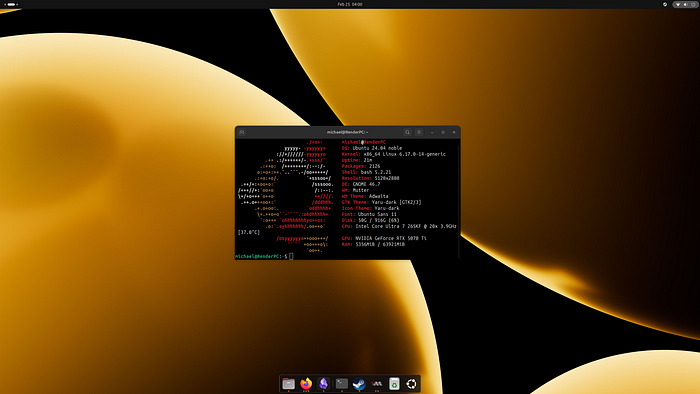
One of the good but daunting aspects of Linux is the fact that there are so many distributions, or distros to choose from. At last count, there are over 600+ active.
Some big. Some small. Some with corporate backing. Some that are one-man teams as weekend hobbies.
No matter your preference, there's likely to be something that fits your needs.
Personally, I'm a big fan of Ubuntu.
Ubuntu is far from the only distro out there though, and I don't even claim it's the best. It's very good and does a lot of things very well. But why would I choose it over something like Linux Mint or Fedora or Cachy OS?
A few reasons. Let's talk about them.
Strong NVIDIA support
While I'm not nearly the gamer that I once was, I do enjoy gaming a bit here and there. And working with Blender is best with a decent GPU.
But in order to really take advantage of that GPU, I need strong driver support.
NVIDIA support is something that has been a rough spot for Linux over the years. AMD driver support has been excellent, by comparison.
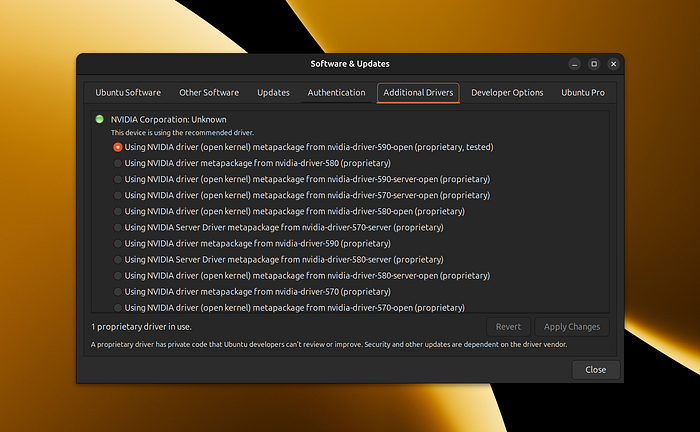
Ubuntu, thankfully, makes it very easy to install the right drivers for my RTX cards and keep them up to date.
I know other distros are doing better with this too, and your favorite might be great at it.
Personally, I just like how easy it is to do in Ubuntu. It's just a couple of clicks, a reboot, and done. It couldn't be easier.
I love that.
A huge community
Ubuntu has been around since 2004, just a little bit after Fedora's 2003 debut.
In that time, Ubuntu has gained a huge following and has an impressive community of users, volunteers, and contributors willing to help if anything should go wrong.
Certainly Ubuntu isn't the only popular distro. Fedora, Linux Mint, Zorin OS, and many others have their own active and helpful communities.
They're all solid options and would most definitely check this box on my list.
I enjoy Linux, and I think it's a great option for someone wanting to escape the Windows trap, but I don't know everything there is to know, and I take comfort in the fact that if I run into issues, I know there are people I can ask.
That's why I tend to stay away from the small, one-man-show distributions. As cool as I think they are, I need something that I can get help with if I need.
If I were to run into a problem in the middle of the night, I know that I could find resources and people to help.
Maybe the best analogy is that of a city. I like living in the suburbs. Not too far from grocery stores and other conveniences. But also not downtown.
To me, Ubuntu is like a suburb. It's big enough that I can find what I need if I need help, but it's not the big city of Windows or macOS and it's not a small rural town with more livestock than people.
Maybe that's a bad analogy, but it makes sense in my brain at least.
Corporate backing
As with anything that's free (or even paid) projects come and go. If you're old enough, you likely remember software that used to be at the top of its game that's now barely a memory.
I've seen plenty of great free apps abandoned over the years because their developers couldn't devote time to maintaining them, or because they started to cost too much to maintain, which is totally fair.
There are hundreds of actively developed Linux distros, but there are others that once were maintained that are now defunct. Distros are coming and going all the time. Especially the smaller projects.
Certainly I want those small projects to succeed and grow over time, but longevity is a concern to me. Right now, projects like CachyOS and Bazzite and Nobara are growing, but they're still quite a bit smaller than something like Debian or Ubuntu or Fedora.
More importantly, Ubuntu and Fedora have significant corporate backing.
The trademark for Fedora, while still a community distro, is owned by Red Hat, the company that makes Red Hat Enterprise Linux. Fedora serves as the upstream test bed for Red Hat Enterprise Linux.
Ubuntu is a more commercial distro, being owned and developed by Canonical with heavy community and volunteer involvement. Some people may not like that, though, which I understand.
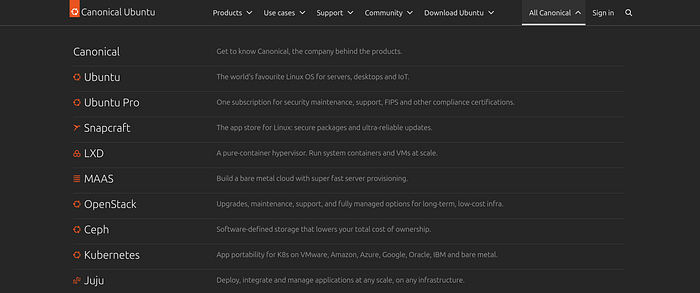
Fedora and Ubuntu both have the advantage of considerable firepower behind them. Canonical and Red Hat each have a vested interest in ensuring the longevity and health of each.
Therefore, someone like me can have a reasonable assurance that neither of these projects is going anywhere for the foreseeable future.
That's important to me. I don't want to start using something, like it, get used to it, and then have it fade away in the short term. I want to use something that I can reasonably assume will be around for a long time.
As much as I like Fedora, I don't really want to be a guinea pig for Red Hat, as others have pointed out. I'd rather use a distro that isn't a test bed for a different distribution. I want a distro that's designed to be a finished, complete project of its own and not something that funnels into another.
That's why, of the two, I choose Ubuntu.
Linux software support often assumes Ubuntu
Working in IT, I sometimes need specialized software that I just can't avoid. And I've found that often times, the vendors for certain software packages assume that if you're using Linux, you must be using one of a select few distros. Including Ubuntu.
When downloading the Splashtop Business app for Linux, for example, you're given the option to choose between a download for Ubuntu and Debian or one for CentOS and RHEL.

Or when downloading the Amazon WorkSpaces Client, for connecting to Amazon's cloud desktops, Amazon assumes you're using Ubuntu. Not Fedora. Not Zorin OS. Not Mint. Ubuntu.
Now the good news is that especially packages offered in Debian's .deb format should work on most distros that are Debian based, as Ubuntu is. But not all will. And some do actually require Ubuntu.
Another example? RingCentral's Linux app was tested on… guess which distro. Ubuntu.
Love it or hate it, Ubuntu is one of the assumed defaults for many software vendors.
Of course I recognize that many of these packages will work on other distros, but your mileage may vary.
Personally, I just need something that I can be reasonably sure will work with the software I need it to run, and that's Ubuntu for now.
Customized GNOME
In the Linux world, there are a lot of desktop layouts to pick from. KDE, GNOME, Xfce, Cinnamon, Mate, Budgie… and the list goes on.
Personally, I've found that I like GNOME best. It works the way I think, and I just like it.
Ubuntu uses a somewhat modified version of GNOME, customized with extensions and tweaks to get that iconic Ubuntu look.
The vanilla version of GNOME doesn't include a dock or desktop icons or app indicators. Though those can all be enabled with extensions.
As much as I do enjoy even the vanilla GNOME experience, I find that I like Ubuntu's take just a bit better. That said, I know some people absolutely hate Ubuntu's take, and that's fine.
I suppose that's why it's good that we have options, eh?
If you want a more vanilla GNOME environment out of the box, you might consider Fedora.
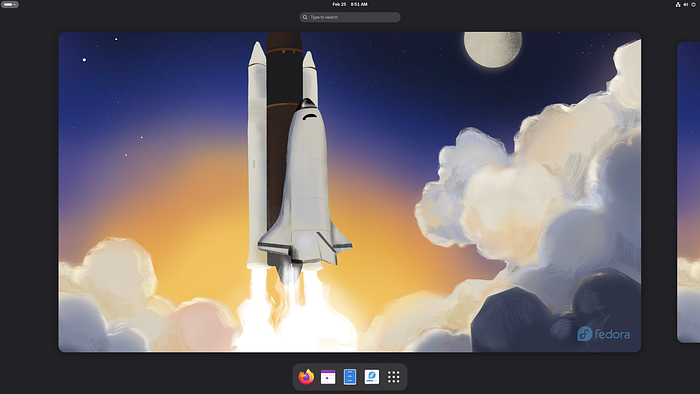
As a bonus, Fedora typically has a more up to date version of GNOME while Ubuntu tends to stick with an older version. Ubuntu's way is better for stability, focusing on stable code over new features. But Fedora's push to get the newest and best release also appeals to many, which I can understand.
Strong industry support
One of the great strengths of Windows is the degree to which it is supported by nearly every hardware vendor. If you go buy a computer from your local big-box store that isn't a Mac, you'll most likely be getting a Windows system.
(Unless you get a Chromebook, in which case… I'm sorry.)
But in recent years, even the likes of Dell, HP and Lenovo have started offering models with Ubuntu preinstalled. These machines are meant primarily for developers, so they're not likely to ever make an appearance in your local retail store.
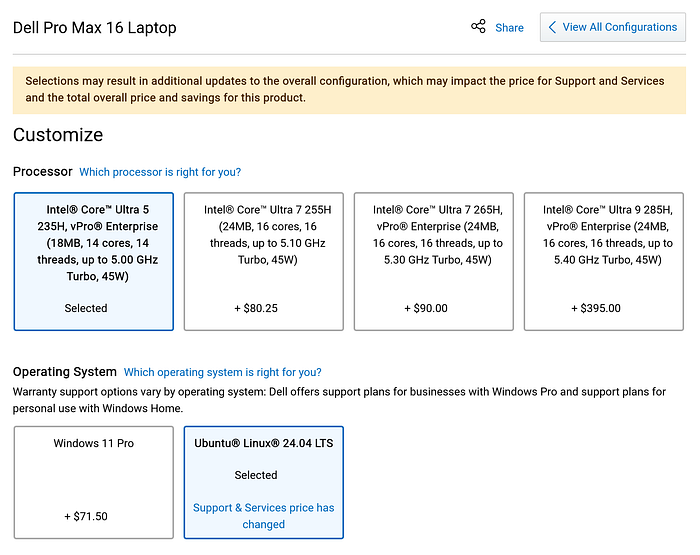
Still, I think it's cool to see that Dell, HP and Lenovo all recognize Ubuntu as a stable, viable Windows alternative.
Ubuntu has secured a reputation for being great for developers, data scientists, DevOps, and the like. It's been battle tested repeatedly in a variety of workloads, and that's something that's important to me.
As much as I love to tinker and tweak my system, at the end of the day I need something that I know is solid, and it's nice to know that several of the big OEMs recognize that stability too.
There are good reasons to not like Ubuntu too
To be fair, I know some people aren't a fan of Ubuntu for a few reasons. Some feel strongly about Canonical's push for snaps, for example. I get that, and that's fair.
Personally, I typically replace several of the snap packages with their Flatpak equivalents and call it a day, just as a matter of preference. Not that you have to do that of course.
Some Ubuntu derivatives, like Linux Mint, removed snaps out of the box for a number of good reasons.
Others remember a privacy controversy that erupted back in 2012–2016 which stemmed from Ubuntu's inclusion of Amazon search in the Unity desktop environment, which effectively resulted in sending searches to Amazon to search for products. Canonical claimed the data was anonymized, but it understandably left a bad taste in the mouths of many.
That functionality was removed in Ubuntu 16.04 LTS, thankfully, after significant backlash from the community.
My hope is that Canonical learned its lesson and won't try something that stupid again. I suppose time will tell.
Ubuntu isn't the only great option
Now before someone replies with "Yeah, but what about…" I recognize that many of these things are true of other Linux distros too. Ubuntu is not the only great choice, and there are lots of great reasons for preferring something different.
I really like what Zorin OS is doing. And Linux Mint is hard to not love, especially for those escaping Windows.
You may prefer Mint or Fedora or CachyOS or one of a hundred alternatives, and I won't tell you that your preference is wrong. Because it's not.
That's the great thing about Linux, isn't it? Freedom. We don't all have to like or want the same thing. Even Ubuntu comes in several flavors for those who prefer KDE or the Cinnamon desktop or MATE, etc. Fedora has several versions too.
The important thing is to find a system that works best for you, that works how you want it to work and fits your preferences.
If that's Ubuntu, awesome! If not, that's great too.
Ultimately, I'm just happy when someone learns that there are good alternatives to Windows and macOS and enjoys the journey.
Ubuntu is a great starting point or a great destination
That said, I do think that Ubuntu is a great place to start a Linux journey. If you're switching from Windows or you're just kicking the tires to see what the fuss is all about, I think Ubuntu provides a nice mix of features and stability that will appeal to many.
The fact that it has a massive community of users, strong support from some key players, and great hardware support out of the box makes it a compelling option in my opinion.
But even as someone who's relatively familiar with a variety of distros and desktop environments, I keep coming back to Ubuntu. For me, it's not just a starting point. It's a destination. I use Ubuntu for gaming, for creative work, and for everything in between.
It's a solid system that gets out of my way and lets me do what I need to get done. And honestly? That's hard to not like.