I've had a love/hate relationship with Microsoft Windows for the past several years. It's the operating system I grew up with. It's what I learned first. And for most of my life, it's what I used exclusively.
Since the launch of Windows 11 though, Windows has been a bit of a soiled brand in my opinion. And Microsoft's latest push toward Copilot and AI in all aspects of the operating system, telemetry that we can't truly disable without the registry or third party tools, forced Microsoft accounts and even ads… it's given Windows a bad name.
So much so that the Internet has coined the term "Microslop" in lieu of "Microsoft."
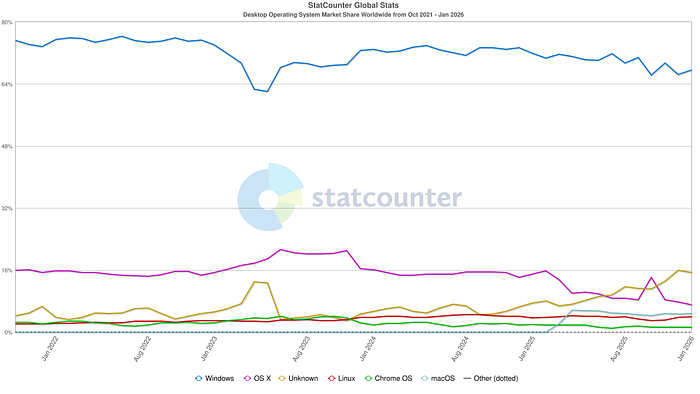
Over the past several years, Windows' desktop market share has been falling. In October of 2021, the month Windows 11 launched, Windows had a reported 75.18% of the global desktop market share. As of January 2026, that's fallen to 67.6%. Meanwhile, macOS and Linux are both creeping up.
Expanding the chart out to October of 2015, paints an even worse picture.
In October of 2015, Windows enjoyed a global market share of 86.44%. January 2026's 67.6% is a huge dip.
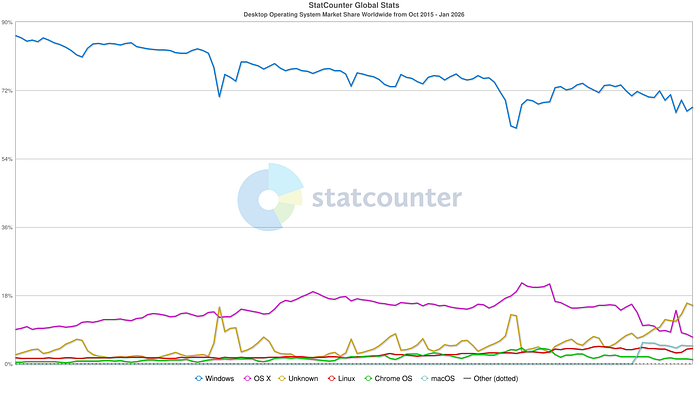
Windows is steadily losing users while the competition is growing, slowly or not.
Microsoft can turn this ship around if they want. What would that take?
Let's talk about it.
Stop pushing AI everywhere
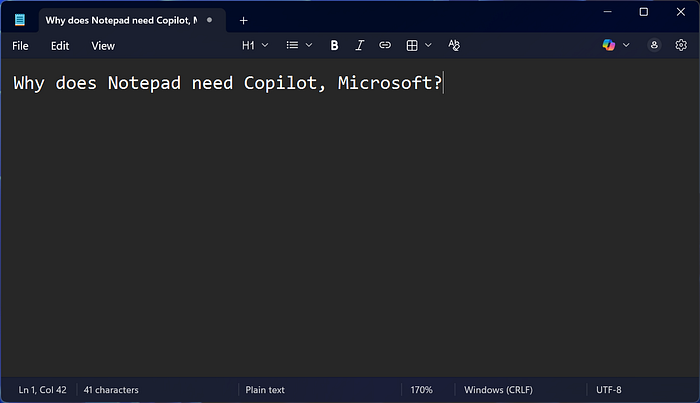
Microsoft has been pushing hard for Windows 11 to become an "agentic" OS, forcing Copilot into every corner (even Notepad) and making it difficult to escape.
I fully support the rights of those who want to use Copilot and AI tools in Windows. But those tools shouldn't be shoved in our faces.
Apple has a far more sensible approach with Apple Intelligence. During the setup of a Mac, macOS asks if you'd like to turn on Apple Intelligence. If you say no, it stays off. It's not shoved in the user's face.
After a major OS update, macOS may ask again if Apple Intelligence should be enabled, but if the user says "skip," it's not enabled. It stays off, and the user isn't forced to see it plastered everywhere.
This is the approach Microsoft should take.
I'm not saying don't make Copilot available. There are some people who want to use it, and they should have it at their disposal if that's truly what they want. I'm saying give the user an option to be rid of it and then respect the user's decision.
This shouldn't be difficult or revolutionary.
I think I speak for many of us when I say that AI fatigue is growing. It seems nearly every app and service is adding some form of AI, and more and more I think people are rightly sick of it.
Don't misunderstand me. I'm glad the tools exist for those who want to use them. But they shouldn't be shoved in the faces of those of us who don't.
Reportedly Microsoft is starting to rethink this strategy. Has the backlash against Copilot and forced AI finally been heard by Redmond? I hope so.
Stop forcing Microsoft accounts
From the beginning, Windows 11 Home was said to require an active Internet connection and a Microsoft account. Fortunately there have been ways around that, and local user accounts could still be created.
Then Microsoft came for Windows 11 Pro and tried to enforce Microsoft accounts there too.
In recent months, Microsoft has stated that they're actively working to remove all known workarounds for exiting the out of box experience (OOBE) without a Microsoft account. They claim that this is to ensure a device is set up correctly.
Translation: Create or log in with a Microsoft account or you won't be able to use Windows (if Microsoft is successful, that is.)
I fully agree that there are some benefits to logging in with a Microsoft account. There are. But there are many more privacy concerns, and frankly not everyone wants that. I certainly don't.
Apple, again, has a good way of handling this. The user is asked during setup if he would like to sign in with an Apple account, which does enable some fun features. But if the user declines, the OS respects his decision and his user account isn't connected to an online account.
This sort of flow makes perfect sense. Explain to the user the benefits of logging in with an Apple or Microsoft account and respect his decision to decline. And if he declines, move on.
It's not difficult.
As an IT guy, I can personally vouch for the fact that there are many times when signing in with a local account, either for troubleshooting or for setting up a machine, is the best way to go. If I'm setting up a computer for a client, there's no reason that I should have to sign in with a Microsoft account just to create a local user account for the user, install his apps and get everything set up.
That's just ridiculous.

I do understand why Microsoft wants users to use Microsoft accounts. It makes sense for their bottom line. Microsoft accounts are a perfect way to funnel users to other Microsoft services like OneDrive, Game Pass, and so on.
But all of that should be 100% optional. Let's be real. The real reason Microsoft wants to force Microsoft accounts has nothing to do with ensuring a system is set up correctly or "security."
It is less secure to connect a system to an online account. Not more.
Turn off telemetry by default or at least let us REALLY turn it off
Windows and macOS collect a concerning amount of telemetry, logging actions on a level that can only be described (in many cases) as incredibly creepy.
Some Linux distros, also, can be configured to send optional telemetry. Ubuntu, for example, asks after a fresh install if you'd like to send some non-personal information to help the developers. That info is just basic stuff like your hardware specs, etc. If an app crashes, you also have the option to send a crash dump to help with troubleshooting. But both are completely optional.
The KDE desktop environment also gives the option to send telemetry, app usage, crash logs, etc. The key word there is option. It's off by default.
I'm not at all opposed to optional telemetry. If it helps the developers of my apps and my OS ensure everything is working well, then I'm not opposed to sending my hardware specs so they know what sort of hardware to target or a crash log so they can pinpoint a bug. But that must be entirely up to me to change at any time, without resorting to third party tools like O&O.
In the case of Ubuntu, if I decline to share data, then that's that. In Windows, there is no way for the average user to disable sending telemetry, data that may even be personal and linked to me.
That's not okay.
As an IT guy, I have a vested interest in seeing Windows bugs fixed, and if I were given the option to send an occasional crash report instead of telemetry being forced to the on position, I'd be far more likely to want to contribute.
But I absolutely do not respect or appreciate Microsoft's demand for telemetry that I can't disable without the registry or external tools.
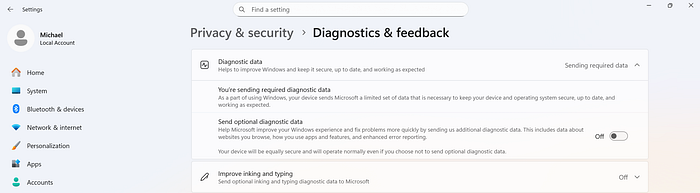
Out of the box, I have no option to send anything less than "required diagnostic data" to Microsoft with no way to say "send nothing."
I could even be okay-ish with Microsoft's telemetry in Windows 11 if they allowed all users, even Windows 11 Home users, to completely disable it without having to resort to registry hacks, third party tools or firewall rules.
Give us some easy to understand toggles in the Settings app that let us opt out of sending any diagnostic data, not just "optional diagnostic data."
Drop the ads
Ads have invaded our digital lives to such a degree that it's hard to go anywhere or do anything online without seeing an ad of some kind along the way (without a good ad blocker that is). I get it. It's a way for sites to monetize a bit.
But Windows isn't a website that needs monetization. It's a commercial operating system that users either bought with their computers or purchased separately.
Yet Microsoft thinks it's okay to show users sponsored… sorry… "suggested" apps alongside their own.
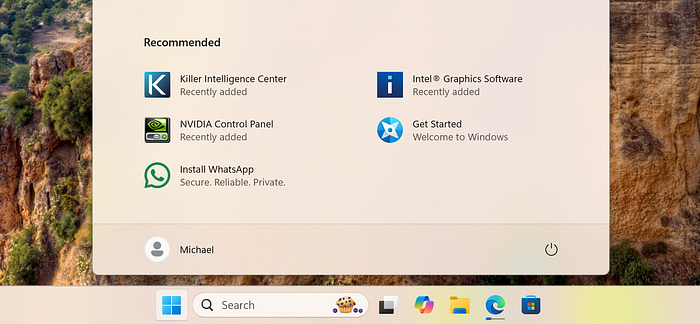
To make matters worse, users can expect to see notifications advertising Game Pass, OneDrive, and other services.
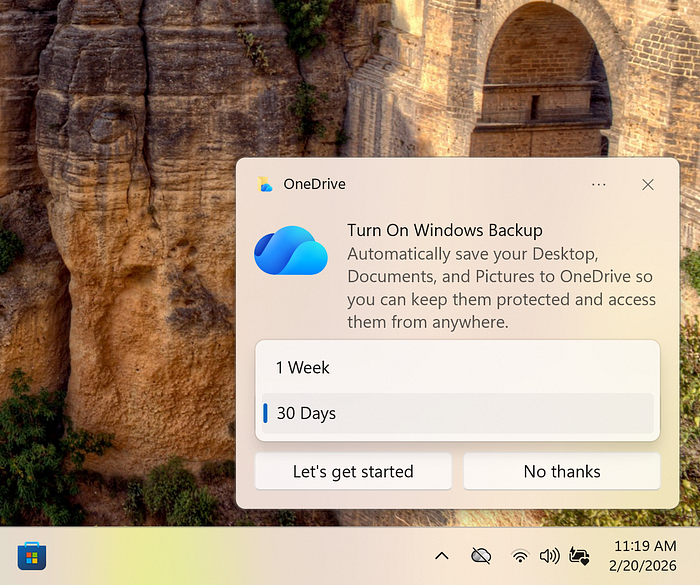
Microsoft isn't alone in this, to be clear. Apple and Microsoft both use their respective operating systems to beg users to sign up to various services, like iCloud, OneDrive, Apple TV, Game Pass, and so on. I get that, and to a point I can respect it.
What I don't respect is shoving ads into the Start menu for apps I don't have and will never use or sending notifications.
The Start menu ought to be a place for me to find my apps and files. And notifications should be for my apps, not what Microsoft wants me to buy.
Thankfully this "feature" can be turned off in Settings, but I hate that it's on by default. It makes Windows feel like a janky free-to-play, ad-supported game instead of a legitimate operating system.
Test every update thoroughly before launch
2025 wasn't a great year for Microsoft, and 2026 hasn't been stellar so far. Numerous Windows updates broke core features of the OS, even interfering with starting up and shutting down.
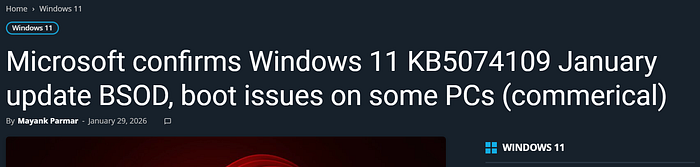
Yikes.
But the sad reality is these sorts of issues aren't new for Windows. Going back decades, I've run in to all sorts of fun issues caused by Windows updates that should have spent more time in testing.
I know I'm not alone in that.
I remember with great amusement one morning, when I worked for a school district, having to roll back an update that was pushed out, causing all of our Dell all-in-one PCs' screens to flash random colors and fail to boot. I and the other district techs had to go to each machine and uninstall the KB that was the culprit. Fun times.
Jerry Berg, a former Microsoft quality engineer explains why these bugs are so common these days. Microsoft laid off a huge chunk of its quality assurance staff (those responsible for testing) and instead opted for a strategy that uses the public, you and me, as testers.
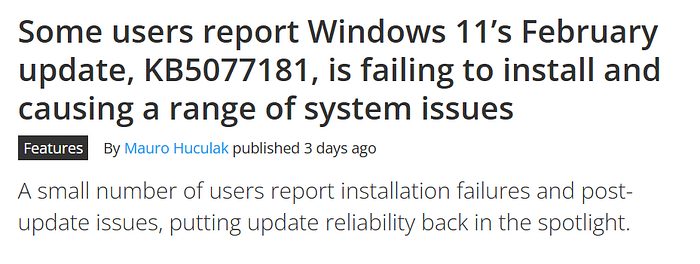
Microsoft figures if something goes wrong with an update, someone will yell.
The problem? By the time someone yells or a news article gets posted, your computer might fail to boot or your data might be destroyed.
I don't know about you, but I don't feel good about being thrust into a beta tester role I never agreed to.
Other operating systems can have and had have show-stopping bugs too, to be fair. I'm not saying that Apple never has or that a Linux box couldn't be broken with an update. Of course that could happen.
But I don't remember ever having this many issues, one after another. Windows seems to be in a league of its own here.
And that's not a compliment.
Microsoft needs to take a step back and spend some serious time on quality control.
Spend less time on new features and more time on making sure updates don't break things. Stop vibe coding and start optimizing code with real, human talent.
That would be a start.
Windows COULD be a respectable OS again
But whether or not it ever will be is entirely up to Microsoft. As I've said before, Windows is the operating system I grew up with. It's the OS I first learned as I was learning computers.
It's the primary OS that I support daily as an IT guy. I want Windows to be awesome. I want Windows to be an operating system, once again, that just gets out of the way and lets the user work without telemetry, without ads, without forced AI, and without feature-breaking updates.
Truly, I don't think I'm asking for too much here. I really don't.
Right now, Microsoft is all-in on AI and doesn't seem to understand that many of us simply don't want an "agentic" OS. All we want is a stable, reliable operating system that gets out of the way and lets us get work done without being bombarded by ads and features we don't want.
For some reason, that seems like a foreign concept to Microsoft.
The one glimmer of hope I see is that Microsoft is reportedly reconsidering its recent AI push.
I know Microsoft has had big plans for Windows, but as they planned, they forgot their users.
The best thing Microsoft can do for Windows at this point is to return to the philosophy that made Windows 7 great: solid, simple, and stable. Stop pushing new features. Start listening to users.
That's how Microsoft can fix the reputation of Windows in my mind.
Will it ever happen? Who knows. But I certainly hope so.
The alternative? Windows continues to lose users. Linux and macOS continue to grow in popularity. And maybe one day Microsoft will wake up and realize that they, not the users, were actually in the wrong.
Until that time, switching to macOS or Linux seems like the smart move.
I moved my creative work over to Linux a few months ago and am loving it. And macOS? It's hard to not recommend too.