With the ongoing horrors of the genocide in Gaza, one element of the October 7 attacks slid under the radar. The IDF intentionally killed some Israelis during the immediate response to the Hamas attacks and no one knows how many.
Hannibal Protocol
The Hannibal Protocol is an IDF directive which instructs that any means necessary should be used to prevent the kidnapping of Israeli hostages. As it is stated Israeli policy to never negotiate with terrorists, the idea is to make sure they don't have to. When dealing for hostages, the Israeli government is usually forced to release prisoners kept in what they call "administrative detention", meaning someone who has been arrested without trial and held indefinitely.
Operationally, a dead IDF soldier is better than a captured soldier, and presumably the same holds for Israeli civilians. If this seems odd, many in Israel agree. The author of the IDF Code of Conduct, Asa Kasher, has refused to accept it exists because it would be "wrong ethically, legally and morally". As he said in an interview with Ha'aretz, "How is it possible that a high ranking army official would give a command that so immediately and definitely endangers the life of so many civilians?"
The IDF has never confirmed the Hannibal Protocol, but several Israeli officials have spoken about it. In 2016, because it was "misunderstood", they replaced it with a series of stepped-down protocols where it was specifically pointed out that the IDF were to "avoid hitting the captive".
On October 7, 2023, thousands of Hamas soldiers attacked IDF positions on the Gaza border and killed a number of civilians at a nearby music festival. The IDF were in total panic as their outposts on the border had been comprehensively dismantled. The Southern Command leaders could not contact the soldiers because they were all dead. When the Air Force backup finally arrived, the situation on the ground was completely out of control. Pilots had no idea what to do as there was no local command structure and started firing at everything they could see.
One former Israeli officer, Air Force Colonel Nof Erez, told Ha'aretz that there were "tons and tons of openings in the fence, and thousands of people in every type of vehicle, some with hostages and some without". He claimed what had happened was a "mass Hannibal". Another Air Force pilot said his commander instructed pilots to "to shoot at everything they see in the area of the fence".
Israelis largest-circulation newspaper, Yedioth Ahronoth, reported that "Twenty-eight fighter helicopters shot over the course of the day all of the ammunition in their bellies, in renewed runs to rearm. We are talking about hundreds of 30-millimetre cannon mortars and Hellfire missiles". It said that "the IDF instructed all its fighting units in practice to follow the Hannibal Directive".
Six months later, an Air Force investigation concluded that "the hostages could not be distinguished from terrorists". Tanks on the ground were also ordered to shell houses which they knew contained hostages. There was no longer any doubt that the Hannibal Protocol had indeed been extended to cover Israeli civilians.
Yedioth Ahronoth concluded by saying that "It is not clear at this point how many of the abductees were killed due to the activation of this order" and as the IDF still refuses to admit that Hannibal exists, we may never know.
Even without the Hannibal Protocol, the indiscriminate bombing in Gaza during this time endangered many Israeli lives. Hamas claimed in late November 2023 that 60 Israeli hostages had been killed not by them, but by Israeli bombs. Given the orders to kill these people before they were captured, the concomitant suspicions that the IDF might not have the best interests of the hostages at heart fuelled public anger as hundreds of thousands of Israelis took to the streets.
When Westerners on social media first signal-boosted these Israeli reports, many were accused of spreading antisemitic conspiracy theories by those unfamiliar with the history of Israel.
In June 2024, the UN reported in their investigation that the IDF had engaged the Hannibal Protocol. In July 2024, Ha'aretz confirmed that the Hannibal Protocol was ordered by the IDF in three separate locations due to "crazy hysteria" following the Hamas attacks. In early 2025, the Minister for Defence at the time of the attacks, Yoav Gallant, admitted he ordered Israelis to be killed on Oct. 7.
It seems apodictic to everyone except Zionists and their fellow travellers that Israel is an apartheid state committing a genocide against a population who are unable to flee. In any case, the abuse of the Palestinians is covered by Jewish Israeli human rights groups like B'Tselem and Yesh Din better than any article could. Their brutal treatment of Palestinians is so salient that it drowns out everything else, as if the resolution of the abuses against Palestinians would expunge their other crimes.
In fact, Zionism was a colonial white supremacist project from the beginning and that white supremacy continues. Ashkenazi Jews still predominate in Israeli universities. The "majority of judges on the higher courts and higher-ups in the security establishment" are Ashkenazi. Despite only comprising around 30% of the population, every single prime minister in the history of the state has been Ashkenazi.
Even before Israel was officially established, Zionists actively sought relationships with those who worked towards the annihilation of all Jews, deliberately lied, cheated and deployed terrorism against Jews, especially in Muslim countries, to convince them to move to Israel and directly targeted Jews for violence and persecution for other reasons. When they arrived, non-Ashkenazi Jews were often treated terribly and subject to horrific abuses. Jewish lives have always been sacrificed to Zionism when Zionists felt it advanced their goals.
1. Working With Nazis
In 1933, after Hitler was appointed Chancellor of Germany, attacks on Jews and Jewish businesses intensified. Hermann Göring, who ran the police known as the Gestapo, said that he would protect Germans, "but I refuse to turn the police into a guard for Jewish stores".
The majority of Jews everywhere rejected Zionism, which was regarded as a fringe group of extremist weirdoes. Even the orthodox Jews didn't like them because Zionism was essentially a secular organisation redefining what it meant to be a Jew based on land rather than religion.
In the US, only 1.5% of American Jews considered themselves Zionist enough to join the Zionist Association of America. Most Jews were left-wing and felt like Zionism was self-evidently ridiculous. As Benjamin Balthasar, a scholar of race and labour relations in the US, put it, the Zionists were "a small and often-mocked minority within the Jewish socialist Left" seen as "small-minded idiots".
European Jews felt much the same. The most vocal was Chief Rabbi of Hungary, who said Zionism was "a renunciation of faith". Even after the war, at the 1948 conference of Agudath Israel, an Eastern European Orthodox Haredi Jewish organisation with half a million members, delegates said that, "Zionism constitutes a danger, spiritual and physical, to the existence of our people".
Meanwhile, back in Germany, the organisation of Jewish intellectuals based in Berlin and set up in 1893 specifically to fight antisemitism was the Centralverein deutscher Staatsbürger jüdischen Glaubens, the Central Association of German Citizens of Jewish Faith. By 1926, they had around 60,000 members.
Like most Jews around the world, having lived there for centuries, they saw themselves as Jewish citizens of where they lived, in this case Germany. Throughout the worst antisemitic violence the world has ever seen, they steadfastly rejected Zionism as fundamentally un-Jewish. They maintained their anti-Zionist position right up until 1938, after Kristallnacht, when the organisation was shut down and their assets were seized.
There were lots of reasons for German Jews to reject Zionism. One was the antisemitic trope of "divided loyalties" which had been used in many countries to attack Jews. As time went on, it seemed like the Zionists were determined to repatriate every antisemitic trope which had historically been used to oppress them.
For instance, rumours circulated in medieval Europe after the Black Death that the Jews had been poisoning the wells. This became a reliable antisemitic trope tacked onto any epidemic, including, mostly recently, COVID. However, in 1948, the IDF poisoned Palestinian drinking water wells with typhoid bacteria. The Israelis called this Operation Cast Thy Bread.
German Jews also noticed that Zionists had much in common with Nazis: they believed in unsupported racial theories, they had almost religious positions on Volkscharakter and were both clearly promoting a racially exclusive ethno-state. Lehi, the Zionist paramilitary organisation that would eventually form part of the IDF, more than once offered to actively fight on Hitler's side in the war in exchange for the Reich's help in the establishment of a "Jewish state on a national and totalitarian basis". These offers came to nothing.
1933 Ha'avara Agreement
The Zionists had been exporting Jews to Palestine secretly and illegally since 1920, at first mostly from England, although it widened its scope throughout the 1930s for obvious reasons. The organisation in charge of these illegal immigrations was the Mossad LeAliyah Bet, which means "the institute for illegal immigration". Aliya literally means "ascent", which is the core Zionist value and how they characterised Jewish immigration to Palestine. Mossad as a Hebrew word just means "Institute".
In 1933, when Hitler took over, the majority of Jewish organisations (and many governments) in the world pushed for a boycott of Nazi Germany. There were some fears in Jewish organisations that, in the words of the New York Supreme Court Justice, Joseph M. Proskauer, it might cause "more trouble for the Jews in Germany by unintelligent action". The Chief Judge of the Appeals Court of New York, Irving Lehman, felt that even talking about a boycott "may add to the terrible dangers of the Jews in Germany". Eventually, when it became clear that there was no way for things to get worse for Jews in Germany, even the holdouts supported the boycott — except for the Zionists.
David Ben-Gurion, chairman of the executive committee of the Jewish Agency and later the first prime minister of Israel, said: "Zionism bears the obligation of a state; it therefore cannot initiate an irresponsible battle against Hitler as long as he remains a head of state." Prominent Revisionist Zionist (i.e. the faction of Zionism in favour of the Greater Israel project) lawyer, Abba Ahimeir, happily described himself as "a fascist" who had "a great admiration for Hitler". They later changed their minds when it became clear that the admired Hitler was not going to give up antisemitism.
That same year, Zionists were the first to break the boycott on Nazi Germany. The Zionist Federation of Germany and the Anglo-Palestine bank (which would later be the National Bank of Israel) negotiated the Ha'avara Agreement with the Nazis, Under this agreement, 60,000 Jews would be transferred to Palestine in exchange for the value of their assets, which was converted to Reichmarks. The total haul for the Nazis was around 105 million Reichsmarks at a time when no one else would do business with them.
Both Zionists and the Nazis favoured rich Jews for the Ha'avara programme. Zionists always wanted to attract the wealthy, European Jews to Palestine, and although the Nazis were happy to be paid anything for what they considered their worthless trash, richer Jews meant more Ha'avara Agreement cash. In fact, the Ha'avara agreement provided a substantial export market for German factories all the way through the war.
Defenders of the Ha'avara Agreement argue that any means necessary were correctly deployed by the Zionists to get Jews out of Germany. They are somewhat undercut by the reactions, varying from lukewarm to outright hostile, to plan to resettle Jews in Alaska. In fact, the only Jewish organisation to back the proposal was the relatively uninfluential Labor Zionists of America.
In what would become a pattern, the Zionists had sacrificed the welfare of Jews in the diaspora (i.e. nearly all of them) on the altar of the Zionist goals. It will therefore come as no surprise that after the war, the Zionists, now the Israelis, had their own version of Operation Paperclip.
Mehadek Niyar
The well-known secret US operation to hunt down Nazi war criminals immediately after World War II with the intention of hiring them rather than prosecuting them was called Operation Paperclip. Less well-known is that the Israelis had their own version which did not have its own name and which was not common knowledge even in Israel until 2022. Most of this research was done by Danny Orbach, a professor of history at the Hebrew University of Jerusalem, who suddenly found a "huge, fat envelope" of redacted documents from Mossad in his mail after years of requests. Two of these Nazi war criminals were Walter Rauff and Otto Skorzeny.
Walter Rauff
Rauff was instrumental in developing the Nazi "gas van", a mobile murder machine that killed thousands of Jews. He also led a special Nazi unit to expand the Holocaust to the Levant called Einsatzkommando Egypt which was shelved after Rommel's forces got routed in the Second Battle of El Alamein.
In Tunisia, he headed up a special unit dedicated to the extermination of Jews. In Italy, he was the head of the secret police in Milan where he was "responsible for the indiscriminate execution of both Jews and local partisans". After the war, he ran to Syria, where he, with other Nazis, helped train their intelligence services to run "along Gestapo lines". Here he again invented machines to torture Jews.
There were a number of coups in Syria in 1949. After one of these coups, Rauff was expelled. This was when he started working for the Israelis. His contact was Shalhevet Freier, who worked for the Israeli Foreign Ministry and also on Israel's nuclear programme.
Rauff was posted in Rome to collect intelligence about Arab states including lots of information about Syria. He remained in touch with Freier until 1951. He returned to Germany in 1960 to collect his pension but was later recruited by Augusto Pinochet as an advisor on Chile's secret police. Chile refused extradition requests from Israel and West Germany because "his behavior was always beyond reproach". He died in 1984 of a heart attack having never repudiated Nazism. There were Nazi salutes at his funeral.
Otto Skorzeny
Skorzeny was a Nazi war hero whose most famous operation was as leader of the commandos who freed Mussolini from captivity in September 1943 and for which Hitler awarded him the Iron Cross.
After the war, he was an arms dealer and mercenary. He helped recruit military advisers for Syria and associated with German scientists who were putting together a missile programme for Egypt. Mossad's secret programme to kill them was called Operation Damocles and was overseen by future Israeli prime minister, Yitzak Shamir. One of these scientists was Heinz Krug.
After multiple death threats, Krug became concerned for his own wellbeing in Cairo and reached out to Skorzeny for advice. Skorzeny arranged for some bodyguards. In September of 1962, Skorzeny and his bodyguards kidnapped Krug and shot him dead. Then they poured acid all over him and buried the remaining body in a hole they dug. Skorzeny was now working for Mossad.
The efforts to hire Skorzeny began in 1960, two years earlier. Rafi Eitan, a seasoned Mossad Nazi hunter, got to Skorzeny through Skorzeny's wife with whom he was in an open marriage. This provided the perfect opportunity for a meeting. He first met Skorzeny in Dublin and then, after recruiting Avraham Ahituv, who would later be the director of Shin Bet, the internal security service, in a hotel in Madrid.
Ahituv found the whole thing very distasteful and could not help bringing up the Holocaust. Skorzeny said he had nothing to do with killing any Jews and that in any case, he admired Israel as a plucky, go-getter country whose people "excel in physical work".
When the men and their dates went back to Skorzeny's house, Skorzeny suddenly pulled a gun on them and the conversation, according to the Mossad report, went like this:
"I know who you are and I know why you're here. You are Mossad, and you've come to kill me."
"You are half-right. We are from Mossad, but if we had come to kill you, you would have been dead weeks ago."
"Or maybe I would rather just kill you."
"If you kill us, the ones who come next won't bother to have a drink with you, You won't even see their faces before they blow out your brains. Our offer to you is just for you to help us."
Thus was Skorzeny hired. He was never paid for his service to the Zionists. Instead, he asked for a favour: to have his name removed from the Simon Wiesenthal's list of wanted Nazis. Skorzeny was at the time involved in Die Spinne, an organisation set up by him specifically to funnel Nazi war criminals from Germany into South America. He died of lung cancer in 1975, having never repudiated Nazism. There were Nazi salutes at his funeral.
2. Targeting Jews in Muslim Countries
After 1948, the Zionist government in Israel assumed that European Ashkenazi Jews would naturally flock to their fledgeling state to set up a white colonialist utopian oasis in a desert of underdeveloped Arabs. They started to panic when they saw the remaining smart, able-bodied, educated (or at least healthy and military-age) Jews instead migrate in their droves to the United States and England. All the Zionist would have to build a country was poor, uneducated, sick, disabled and/or elderly European Jews. In any case, European Jew populations had collapsed more than anyone could have guessed.
None of this could be stated in the open, of course, as the entire public-facing reason for the existence of Israel was to act as a safe haven for all Jews, not just the white, healthy ones. Attention turned to the Mizrahi Jews, who had mostly been living in peace in security under the Ottoman Empire for centuries and had no desire generally to leave. Something would have to be done.
Journalist and author of When We Were Arabs: A Jewish Family's Forgotten History, Massoud Hayoun, briefly describes his own Tunisian Mizrahi Jewish family experiences which are broadly representative of a number of Israeli operations:
"Zionist operatives perpetrated attacks and conducted a series of operations in our home cities. Those actions aimed at once to destroy our Arab world, to call into question our loyalties to our homelands by painting Jewish Arab communities as Zionist operatives, and ultimately to funnel us away from our homelands to increase Jewish settler demographics in Occupied Palestine."
Almost every MENA country has some experience with similar Zionist programmes. Two of these countries were Morocco and Iraq.
Morocco
Jews in Morocco saw themselves as Moroccan Arabs and not frustrated Israelis. They did not want to move and, as mentioned above, like most Jews, regarded Zionism as a bunch of cranks. In the 1920s, a leader of the Moroccan Jews, Yomtov Semach, said: "Zionism is like a voice in the desert without an echo."
However, since before the establishment of Israel in 1948, under a secret Zionist programme called Cadima, Jews in Arab countries were targeted for Aliyah. Zionist agents operated under the disguise of libraries and specifically targeted Jews in poor areas of Moroccan cities with stories of limitless opportunity, even though they would overwhelmingly remain poor when they landed in Israel.
As they were being moved through Algeria, riots kicked off in the border towns of Oujda and Jerada attacking the emigrants. These are called the "1948 anti-Jewish riots" but should more accurately be called the "1948 anti-Zionist riots" as local Muslim populations came to the reasonable conclusion that the groups of Jews being ferried through their towns in the middle of the night by Zionist agents were themselves Zionists, or at least supported Zionist goals.
As further evidence, during the Naqba, Mohammed V of Morocco said he "affirmed Jews' traditional protected status in Morocco but also warned them not to demonstrate any solidarity with the Zionist cause." Mohammed V also refused to deliver any Jews to the Nazi Vichy government.
Given their desperate need for labour-capable people, and their willingness to do anything to get them to Israel, it is not unreasonable to suspect that part of the Zionist plan was to create previously non-existent animus between Muslim and Jewish populations across MENA countries. If that was the goal, it was moderately successful as in the following ten years, nearly half of the entire Moroccan Jewish population, around 100,000 people, had moved to Israel.
However, they didn't want just anyone. In 1951, another programme developed alongside Moroccan immigration called Seleqseya, a "draconian and frequently cruel policy" which actively discriminated against Moroccan Jews who were poor, sick or not of military age.
In 1951, Knesset member, Eliezer Livne, said that "Israel is not a refuge for the backward and unproductive circles of the Diaspora communities, but a center for their pioneers and the best among their sons." This same Eliezer Livne would say the quiet part out loud in 1966 "that for the Zionist leadership, the rescue of Jews was not an aim in itself, but only a means". In 1952, Ben-Gurion said that "there are 250,000 Jews in Morocco," so, "why should we start with the paralyzed and the blind?" A Knesset member in 1955 said Moroccan Jews should be selected "like we choose among horses or cows in a market, they should be healthy, strong, and useful for our purposes".
Again, despite the central claim of Israel that they are a safe haven for all Jews, their immigration policies in the real world have often divided them up into Good Jews and Bad Jews based on race, state of health, income and other criteria, sometimes with the sinister implication that the Zionists regarded other Jews as livestock.
The same clearly held true for Jews from other countries. In 1958, for instance, the Foreign Minister of Israel, Golda Meir wrote a secret letter to the Israeli ambassador in Poland to the effect that Israel "cannot continue accepting sick and handicapped people" with her hopes that this could be "explained to the Poles without hurting immigration."
Under international law, countries are entitled, within certain limits, to adopt whatever selection procedures they like for immigrants. However, Israel's foundational value is that any Jew is unconditionally welcome, but especially if they are being discriminated against. The fact that these programmes were all kept secret indicates the Zionists understood this. Nevertheless, the following year, Golda Meir was the prime minister.
Even after Seleqseya was applied to Moroccans, they were segregated on the worst land into Arab villages, which would in another context be called ghettoes, where they were subject to extreme deprivation and discrimination from the Ashkenazi Jewish power structure. Moroccans quickly realised they had been lied to, that they had become pawns of a colonial ideology. One such emigrant from Casablanca, Fani Mergui, says that "Moroccan Jews took to the streets with portraits of King Mohammed V, saying 'We want to go back home', but this was not possible; it was a one-way trip." One Moroccan Israeli warned his family back home: "If you want my advice, stay in North Africa; it's better than the Land of Israel."
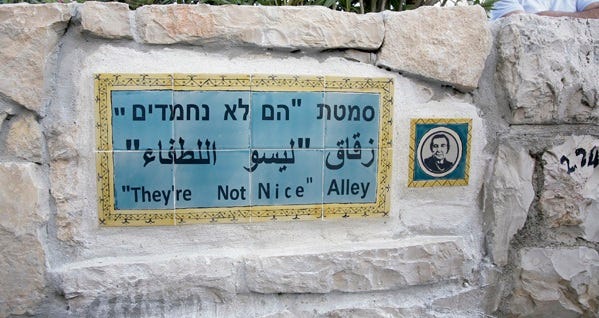
Second-generation Moroccan immigrants formed the Israeli Black Panthers, modelled after the US movement, in 1971 to highlight Ashkenazi discrimination against Mizrahi Jews in general and Moroccan Jews in particular. A street in Jerusalem renamed "They're Not Nice" Alley commemorates a comment made by the ever-reliable Golda Meir about the Israeli Black Panthers.
In the mid-1950s, Morocco restricted Jewish emigration. In response, Mossad set up Operation Mural, a secret programme to smuggle hundreds of Jewish children to Israel. Mossad agents went house-to-house in Casablanca to persuade parents to let their children make Aliyah. The organisation was so secret the lead agent, a volunteer named David Littman who pretended he was taking children on a holiday to Switzerland, was unaware he was working for Mossad.
By 1967, Moroccan emigration to Israel had dropped to an all-time low and the Zionists started panicking again. Mossad came up with Operation Yachin. They approached Hassan II of Morocco, Mohammed V's son, with their plan. Hassan II, like his father, had no problem with Jews, had several Jews in high public office, stated his wishes to protect them as Moroccan citizens, and visited the Casablanca synagogue every year to make an address.
When Mossad approached him about taking his Jews, they offered him an initial lump sum of $500,000 followed by $100 for the first 50,000 Jews and $250 for every Jew after that. Israel also provided Morocco with "weapons and training for its security forces and intelligence operations".
Where Camida failed, Operation Yachin succeeded. Today, around 160,000 Israelis are Moroccan Jews who still report significant discrimination. Meanwhile, Mohammed VI of Morocco actively supports and integrates the country's much-reduced Jewish community of 2,000, most of whom are Amazigh (i.e. Berbers).
Iraq
Iraq had a large, integrated Jewish community who were hostile to Zionism from the start. In 1941, when the government collapsed after the British won the Anglo-Iraqi War, a proxy war of World War II, Baghdad was chaotic and violent. Pro-Axis armed gangs took to the streets and killed 180 Jews, among others, in what is today regarded as an antisemitic pogrom called the Farhud. Some Jews left Iraq afterwards, but not all for Israel and many of those people returned to Iraq soon afterwards, partly due to a "general disillusionment with life in Palestine".
Even straight after the Farhud, in 1942, a Zionist agent in Iraq said that "they have no Zionist thinking, or even a Zionist instinct." In 1945, Iraqi Jews formed an anti-Zionist organisation to "explain to the population the difference between a Jew and a Zionist and to work for the lessening of communal hatred." They called for a democratic government to be elected in Palestine and a prohibition of Zionist emigration.
In March, 1950, the Iraqi parliament, in opposition to the anti-Zionists, passed a law stating that any Jew who wanted to leave was free to do so after registering their intent. This offer was not taken up by many Jews who, again, mostly saw themselves as Iraqi Arabs, not Israelis.
In April 1950, a bomb exploded in a Jewish café in Baghdad. Israel immediately began Operation Ezra and Nehemiah, the two-year programme that airlifted almost the entire Jewish population of 130,000 people from Iraq to Israel.
In May, a grenade was throw at a Jewish company in Baghdad. In June, another grenade exploded in a Jewish part of Baghdad. The following January an explosion at an Iraqi synagogue killed for Jews and injured ten. Two months later, in March, a bomb went off in the American Library which was frequented by many Jews, injuring some of them. In June, a bomb went off next to a Jewish-owned business on El Rasjid Street in Baghdad. All of these violence attacks accelerated the Jews out of Iraq. By 1968, there were 2,000 Jews in Iraq. Today, there are three.
The American and British embassies in Baghdad at the time both concluded that the attacks were carried out by Zionists to terrorise Iraqi Jews. The British embassy further felt that the violence may have been particularly aimed at the well-off Jews who wanted to stay in Iraq. In 2023 Avi Shlaim, a Jewish-Iraqi historian, concluded on the basis of an Iraqi police report and recollections of one of the original participants in the Iraqi Zionist underground confided to him in 2017, that Zionists had indeed been responsible for at least three of the five bombings. He presents more "undeniable proof of Zionist involvement in the terrorist attacks" in his book, Three Worlds.
This view is shared by many Jewish historians, including Uri Avnery and Marion Wolfsohn and Naeim Giladi, who claims he has irrefutable evidence "linking the Zionists to the attacks". A senior CIA officer, Wilbur Crane Eveland, claimed that Iraqi police provided with "evidence to show that the synagogue and library bombings, as well as the anti-Jewish and anti-American leaflet campaigns, had been the work of an underground Zionist organization". Wolfsohn and Avnery wrote that this explanation retroactively became a lot more plausible after the Lavon Affair became public in 1954, when it was revealed that Israeli agents were caught red-handed planting bombs in civilian targets in Cairo with the intention of blaming the Muslim Brotherhood.
3. Abuse of Non-Ashkenazi Jews
Although Israeli racism against Palestinian Muslims is legendary, Jews from pretty much every ethnic division, particularly Arabs, have reported discrimination from Ashkenazi Jews since the dawn of the state. Discriminatory Israeli attitudes towards Maghrebi Jews have already been mentioned, but Jews from Ethiopia and Yemen have been affected in different ways.
Beta Israel
Beta Israel is the name for the Ethiopian Jews who had existed as a community since at least 600 BC, but are now racially indistinguishable from non-Jewish Ethiopians and had become disconnected from other Jewish populations. When they were rediscovered by Europeans in the nineteenth century, no one was sure if they were in fact Jews at all. In 1908, the chief rabbis of 45 countries made a joint statement officially declaring that "Ethiopian Jews were indeed Jewish".
Operation Moses in 1984, Operation Joshua in 1985 and most famously Operation Solomon in 1991, were three separate secret airlifts which comprised many efforts to bring almost the entire Jewish population of Ethiopia to Israel. Since then, black Jews have been subject to discrimination, racism, and poverty. There have been many incidents of police brutality and in 2019, an Ethiopian Jew was shot dead by an off-duty police officer, setting off a series of demonstrations and riots.
In 1996, it emerged that blood donations from Ethiopians were systematically "thrown out unused" without being tested because of the perceived risk of AIDS contamination. Donors were not told that their blood was being destroyed because "telling them to go home would be more offensive and embarrassing". This led to demonstrations and protests in the Ethiopian community and strained already tense relations with Israeli society.
In 2013, Knesset member, Pnina Tamano-Shata, was turned away from a blood drive held at the Knesset, even though she had lived in Israel since the age of three. She was told that she had a "special kind of Jewish-Ethiopian blood" that made her ineligible. She said: "I served in the IDF and even though I'm a member of the Knesset, I am still not good enough to donate blood. Why? Why is my blood inferior to yours?"
In response, then-president Shimon Peres made a public statement that "There can be no differentiation between one blood and the other in the state of Israel." In 2016, Israel finally lifted the ban on Ethiopians donating blood.
In the 2010s, Israeli social workers noticed that Ethiopian were not having babies. Some Ethiopian areas had a birth rate of zero. In fact, in that decade, the fertility rate of Ethiopian Jews in Israel had dropped by 50%.
In a news story by journalist Gal Gabai, Ethiopian women claimed Israeli officials at transit camps in Ethiopia coerced them to receive injections of Depo-Provera, a long-acting birth control drug, "against their will", as a prerequisite to immigration. Furthermore, many of the women claimed they were "under the impression that the shots were vaccinations".
Many women continued to receive Depo-Provera after arriving in Israel, despite suffering such side effects as severe headaches and abdominal pains and in some cases, having conditions which were contraindicated for Depo-Provera.
A hidden camera in a local health clinic recorded a Ethiopian woman being told by a nurse that "they forget, they don't understand, and it's hard to explain to them, so it's best that they receive a shot once every three months… basically they don't understand anything."
The Israeli government denied everything.
In 2013, an Israeli women's rights group led by Hedva Eyal conducted a study which revealed that over half of all Depo-Provera users in Israel were Ethiopian. Eyal said it was part of an "unspoken policy" in Israel that aimed to reduce "the number of births in a community that is black and mostly poor".
In 2012, the Israeli government denied everything again. The State Comptroller (ombudsman), Joseph Shapira, said his investigation concluded that "no evidence could be found for the claims raised that shots to prevent pregnancy were administered to Ethiopian women under pressure or threats, overt or covert, or in any way that was improper."
Later that year, the Israeli government ordered an official investigation into the allegations. In 2013, the government finally admitted that they had been covertly injecting female Ethiopian immigrants with Depo-Provera without their consent when the Minister for Health instructed that local clinics should "cease administering Depo-Provera immediately".
Again there was no direct admission, but they issued a series of guidelines to ensure that this thing, which they did not directly admit to, would not happen again.
Yemen
Unlike many other places, Yemenite Jews had been suffering from sustained and harmful antisemitism in Yemen. In 1922, for instance, Yemen passed the Orphan's Decree, mandating that Jewish orphans be forcibly converted to Islam. In theory, this was supposed to ensure that orphaned infants would have someone to take care of them, but in practice it was a brutal act of cultural genocide on the part of the Yemeni government. Jewish communities were, we have to assume, as capable of looking after their orphans as anyone else. Jews were also expected to defer to Muslims in public, and were not allowed to physically defend themselves against attacks by Muslims (instead they had to go find a Muslim to do it for them). In other words, Jews in Yemen had the opposite of the Jewish experience in Morocco.
When the partition of Palestine was announced in 1947, things got even worse, with one anti-Jewish riot in the British port of Aden killing 80 Jews and destroying many Jewish homes.
In 1949, Operation Magic Carpet was the secret Israeli effort to transfer 50,000 Yemeni Jews who were apparently unknown to the Israeli government before this time. Although celebrated in Israel as a roaring success, it was somewhat shambolic. Thousands of Jews were left sitting in transit camps in Yemen and in similar transit camps in Israel while David Ben-Gurion decided what they should do with them. At least 700 Jews died in the camps waiting for the green light from Israel and even after they arrived, child mortality rates were high due to the "disastrous management" of the Israeli refugee camps.
So many children were dying that, according to the former Israel State Archivist, Yaacov Lozowick, doctors wanted to find out why and ordered autopsies without the parents consent because autopsies were forbidden under Jewish law at the time. Sometimes the parents were only notified of the child's death. Lozowick concedes this was handled insensitively, but that no further wrong occurred, or as he put it: "There was no crime, but there was a sin."
As more and more children were disappearing from camps, Yemeni immigrants started to ask questions. Here is one account of many, from Said and Saada Gamil:
"We came to Israeli in an airplane, my wife and I with three of our sons, aged 15, 10 and Haim who was one. We were sent to Camp Gimel at Rosh Ha'ayin and put in a tent. After a few days a nurse came and took Haim to the children's home where it was warm. My wife visited him and nursed him a few times a day. One day he wasn't in his bed. A nurse said he was sick and had been sent to the clinic. My wife and son went to visit him there and saw him, but a nurse said we shouldn't come to the hospital because the visits aggravate the child. We waited a few days then they went back to the clinic but were told Haim had been transferred to the hospital in Pardes Katz. We wanted to visit him there but a nurse told us we shouldn't make the effort and he'd be home in a few days. We followed her instructions and waited. Then my wife and son went to the camp office to request some money to go visit Haim in Pardes Katz. The clerk said Haim had died and been buried. We never saw him, nor a grave."
These reports had much in common. The missing children were almost all under the age of three, the children of new immigrants and from Yemen. They disappeared while they were supposed to be in hospital. The parents only received verbal confirmation that their children had died and never saw a dead body or even a death certificate. The lack of death certificate was confirmed around thirteen years later when some families received a recruitment order from the IDF for the dead child.
Rumours started that they were being kidnapped by Israeli forces and given to Ashkenazi families to adopt. These rumours did not go away. In 1967, the Bahlul-Minkowski Committee determined that most of the children had died.
In 1995, the four-year Shalgi Committee ordered by Yitzak Shamir concluded that 65 cases of missing Yemeni children were unsolved but would make no further determination. A senior Israeli politician and committee member said "I personally believe, in contradiction to the Shalgi report, that there were more than a few cases of kidnapping of Yemenite babies."
In 2001, the Kedmi Commission, born directly out of public dissatisfaction with the Shalgi Committee, concluded that of the 56 cases where the fate of the child was unknown, it was "possible" that they were handed over for adoption.
In 2016, Netanyahu ordered that all the archive material about the Yemenite children be made public and an Israeli cabinet minister, Tzachi Hanegbi, re-examined all the evidence presented at previous committee hearings. On Israeli television, he said that "they took the children and gave them away. I don't know where." He put the number of children taken without their parent's consent at "hundreds".
In 2021, Ha'aretz leaked an internal Health Ministry report which said that doctors, nurses and caregivers were acting as middlemen in kidnapping the children for adopting, sometimes in exchange for money. The report chronicles racist perceptions at the time of Mizrahi Jews who were "considered filthy and unhygienic" and that it was felt to be in the "best interests of the children" to place them with Ashkenazi families.
4. False Flag Antisemitic Attacks
There are so many examples of Mossad false flag attacks, most famously, the Lavon Affair mentioned above, it's a running joke among geopolitical commentators.
For instance, in 1997, Mossad agents infiltrated Jordan using fake Canadian passports to poison Hamas leader, Khaled Mashal, causing an international crisis only resolved when Bill Clinton called Netanyahu to demand he hand over the antidote.
In 2001 a month after 9/11, two Israelis were found with guns and explosives in Mexican parliamentary buildings. Early reports mentioned Pakistani passports, although all mention of these passports was dropped in all official documentation and they were quietly returned to Israel without standing trial in Mexico.
In 2004, two undercover Mossad agents were caught trying to apply for New Zealand passports using the identity of a man with cerebral palsy.
In 2007, Mossad agents masquerading as CIA agents, tried to recruit Iranian militant separatists. In 2010, dozens of Israeli agents using fake passports from at least six countries were involved an operation to assassinate Hamas official, Mahmoud Al-Mabhouh, in Dubai.
Less common and almost unheard of are the Mossad false flag operations targeting Jews, of which perhaps the best example not already mentioned is the bombing of the Israeli embassy in England.
The Embassy Bombings
On July 26, 1994, 14 people were injured when a car bomb exploded outside the Israeli embassy in Kensington Palace Gardens, London. Soon afterwards, six people were injured when a second bomb hit Balfour House, the headquarters of United Jewish Israel Appeal, a "prominent Jewish fund-raising organization" which, among other things, arranges Taglit trips for young British Jews.
On December 11, 1996, Samar Alami and Jawad Botmeh, two student Palestinian activists, were found guilty and jailed for 20 years. There were many problems with the investigation and judicial process.
Suspicion had first landed on Hezbollah or some other highly-organised, Iran-back terrorist group due to the sophistication of the attacks, so it was with some surprise that a group called Palestinian Resistance Jaffa Group admitted the attack in letters to Arab newspapers. There is no record of any Palestinian Resistance Jaffa Group before or after these attacks.
The prosecution case seemed to rest on the fact that Alami and Botmeh were Palestinian activists, and that they had been researching home-made bombs, both of which they admitted. They claimed that they were planning on taking their bomb-making expertise back to Palestine where it could be deployed in defence of their people. They also said that they had no interest in bombing Western targets as they would be counterproductive for the Palestinian cause.
During the trial, the judge failed to dismiss a juror who had been directly contacted by an Israeli journalist and additionally had failed to correctly advise the jury on what inferences could legally be taken from some incorrect statements Alami had provided during her interviews. In his summary, the judge said that the whole trial had been "rather like trying to get a firm grip on a piece of soap in the bath".
In 1999, an appeal judge admitted that "not all documents which should have been placed before the trial judge were placed before him", and some of the documents provided were redacted. The prosecution was forced to admit to "a catalogue of errors and incompetence by the police, intelligence services and the original lawyers in the case". No one was able to identify the specific type of explosive used, which remains a mystery today.
During the appeal hearings, it was revealed that specific requests for information by the defence counsel, for example intelligence reports on attacks in other countries, particularly the car bombing of Jewish cultural buildings in Argentina shortly before the London campaign, were ignored. Requests for more information about the Mossad agents on the scene of the bombing were also ignored. Their lawyer called it "deliberate non-disclosure".
"Somebody undoubtedly did come from Israel and for some reason nobody knows who they were or what they took away from the scene or what conclusions they came to." — Michael Mansfield, QC
In 1996, MI5 agents David Shayler and Annie Machon resigned with the intention of going to the press with evidence and accusations of illegal MI5 activities. First they told the press about secret MI5 files held on the government ministers in charge of MI5 funding, illegal MI5 phone taps, etc. They were forced into exile in France and Shayler says it was with some irony he watched Home Secretary Jack Straw talk about refusing to extradite Augusto Pinochet on compassionate grounds.
"I read that in a French newspaper, in a French prison, and I was thinking 'this is absolutely ridiculous'. This is a man who has murdered and tortured thousands of people. I have written a bloody newspaper article and he [Straw] is going for me and not for this other guy… I'm being hounded for telling the truth." — David Shayler
One of the more dramatic claims of Shayler and Machon is that the embassy bombings were a false flag attack actually arranged by Mossad for two reasons.
"One was to increase security around all the Israeli assets in London… but they also wanted to shatter a Palestinian support network which was operating in London at the time."
They claimed that MI5 had received advance warning of an attack on the Israeli embassy but ignored those warnings. Shayler further claimed that the Israeli attack on their own embassy could be put in the broader context of a secret "tit for tat" war between Israel and Iran played out over several countries at the time.
In 2000, after a disclosure order on the Crown Prosecution Service by three appeal judges, the CPS was forced to admit that Shayler was substantively correct that the security services were warned before the 1994 car bombing of the Israeli embassy in London that the building was being targeted by a terrorist organisation. They were further forced to reveal that this terrorist group was unconnected with the two young Palestinians eventually convicted of the bombing.
Amnesty International said that they had been denied a right to a fair trial, and legal moves to release them were supported by trade unions, human rights lawyer, Gareth Pierce, and several MPs, including Jeremy Corbyn and John McDonnell.
"The more you study this case, the more it becomes clear that Samar and Jawad were set up by a person or persons far more resourceful that they. If the bombing, like almost all embassy bombings, was carried out by agents of a foreign power, then it seemed more than likely that the two prisoners had been fingered long before the bombing as the people who would be blamed for it." — Private Eye and Guardian journalist, Paul Foot
In 2008, they were released after serving their sentences and having many appeals denied.
While Israel's crimes against Palestinians are well-understood and well-documented, we don't see much in the public discourse of how poorly they have treated some of the most vulnerable people they were specifically established to protect. Even if these crimes were removed, it seems clear that Zionism would still be a remarkably cynical and violent ideology.