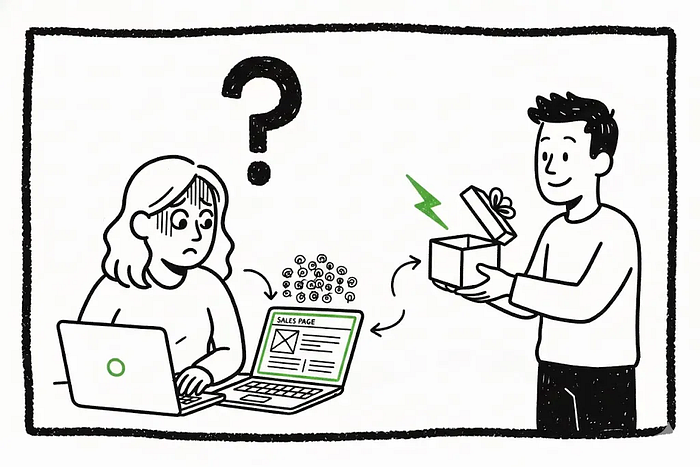
You know that moment when you're watching your Hotjar recordings and you see someone land on your sales page?
(If you've never done that, I definitely recommend. Incredibly enlightening… and humbling!)
They scroll down…
… reading your carefully crafted benefit bullets…
… the testimonials you spent hours selecting…
… the FAQ section you agonized over…
… then they scroll back up…
… then down again…
… then they close the tab.
Average time on page: 47 seconds.
You spent weeks on that copy.
I've been there. That sinking feeling where you're watching real people, who actually cared enough to click, just… not get it. They read the words and saw the offer, but something didn't click.
Not a member yet? You can read the story for free here.
So what do you do?
At that point, you do what any reasonable creator would do.
- You rewrite the headline. (because… of course!)
- You tighten the positioning. (because you saw April Dunford talk about it on a YouTube video you watched two days ago.)
- You add another testimonial. (because the six you already prominently feature must not pack enough punch.)
- You A/B test the CTA button color. (because… 'nuff said.)
- You bring in a copywriter friend to review it. (because you clearly suffer from marketing myopia.)
- You read it out loud to make sure it flows. (for the 57th time.)
And still…
47 seconds.
Tab closed.
I wish someone had told me back then:
"The problem ain't your copy, buddy."
The problem was that I was asking people to do something incredibly difficult. Something that requires enormous mental effort, deep trust, and a level of self-belief most people just don't have when they land on a sales page.
More information makes your sales page worse, not better
Think about what happens when someone lands on your sales page.
You're asking them to read about an outcome they've never experienced. Then you're asking them to believe that outcome is possible for them. Then you're asking them to trust that you can guide them there. And then you're asking them to believe they have what it takes to actually do the work.
That's a lot of asks.
All of it happens in their head. All of it requires them to imagine a version of themselves and their life that doesn't exist yet.
For some people, that's energizing. For most, though, it's exhausting.
Imagination is mental labor. It requires cognitive energy, emotional bandwidth, and a willingness to be vulnerable with yourself about what you want and whether you believe you can have it.
Most people who are scrolling your sales page at 10 PM after a long day don't have that energy.
As creators, what's our immediate reaction when we see those bounce rates?
- We double down on clarity.
- We add more detail. More bullet points. More testimonials. More FAQs. A longer guarantee. A breakdown of every module. Screenshots of the member portal.
- We think: "If I can just explain it better, they'll get it."
Problem is,
More information doesn't reduce the imagination burden. It increases it.
Every new detail is another thing they have to mentally process and project onto their own life. Every testimonial is another story they have to imagine themselves living. Every module breakdown is another step they have to visualize themselves taking.
Rather than making it easier, you're making it harder.
I did this for years with my own offers. I kept adding more. More examples. More proof. More explanations of how it works and why it works and who it's for and what makes it different.
It did nothing to move my conversion rate.
Honestly, it was demoralizing… I'd spend hours perfecting my sales copy, convinced that if I could just explain it better, people would see the value. But the bounce rates stayed the same. The questions stayed the same. The hesitation stayed the same.
I started questioning everything. Was my offer not good enough? Was I not good enough? Was I missing something obvious that everyone else could see?
Then I eventually tried something different.
Instead of asking people to imagine their transformation, I started giving them a taste of it. Right now. Before they paid me anything.
I stopped trying to convince them the outcome was possible and started showing them what a small version of that outcome felt like.
That's when everything changed.
Imagination is the most expensive thing you can ask for
When someone lands on your page, they're not showing up fresh and energized. They're arriving with baggage.
- Skepticism. They've been burned before by offers that promised transformation and delivered mediocrity.
- Decision fatigue. Your offer is one of dozens they've considered this month. Maybe this week.
- Overwhelm. They're already juggling too much. The idea of adding something new, even something that could help, feels heavy.
On top of that, you're asking them to do three incredibly difficult things at once.
First, they need to trust you. A stranger on the internet. Someone they've maybe seen a few times in their feed or found through a Google search. You're asking them to believe you can actually deliver what you're promising.
Second, they need to trust the method. Your framework. Your approach. Your way of solving the problem. Even if they trust you as a person, they might not trust that your way is the right way for them.
Third, they need to trust themselves. They need to believe they have what it takes to actually do the work and get the result. This is often the hardest trust gap to bridge because it's not about you at all. It's about their own history of starting things and not finishing them.
That's a three-way trust gap.
You're asking them to bridge all three gaps in their imagination, based on words on a screen, before they've experienced anything.
Do you see the problem?
While you're waiting for them to complete this mental obstacle course, they're doing something much simpler: clicking away.
Somewhere else, someone is offering them something easier to understand, that doesn't require them to imagine and shows them the outcome right now.
Also, here are three things that happen when you keep relying on imagination-based marketing.
You attract fewer buyers. Most people don't have the energy or trust to bridge those gaps.
Also, you attract the wrong buyers. The ones who are good at imagining often imagine something different than what you're actually offering. Then they're disappointed when reality doesn't match their fantasy.
And then, you tire yourself out. You're constantly over-explaining, answering the same objections, trying to convince people who aren't convinced. It's exhausting.
As a downstream effect, you start to believe the problem is your offer, your positioning, or your market.
In reality, the problem comes down to:
You're asking people to imagine when you should be helping them experience.
The shift that changed everything (and it's simpler than you think)
Stop asking people to imagine their transformation. Give them a taste of it instead.
Right now. Before they pay you anything. Before they fill out a form. Before they even decide if they trust you.
Show them what a miniature version of that outcome feels like.
This is the shift that changed everything for me.
Instead of trying to convince people my framework would work, I started giving them a tiny piece of the framework they could use immediately. A mini-experience that delivered a small win right now.
Your goal is to collapse the trust gap.
When someone experiences a small transformation, they don't have to imagine anymore. They don't have to trust your words. They don't have to believe in themselves in some abstract future scenario.
They already know.
They know you can deliver because you just did. They know the method works because it worked. They know they can do it because they already did.
The trust equation flips completely.
Instead of asking them to imagine: "If I buy this, will it work for me?" they're thinking: "That just worked. What else is possible?"
That proof beats any testimonial you can put on your page. It's undeniable.
People who experience proof don't need to be convinced. They're already halfway in.
Imagination doesn't build trust. It's built through experience.
So what does all of this mean?
You're not in the persuasion business. You're in the proof business.
You're no longer in the imagination business
The good news is you don't need to build something new from scratch. You also don't need the perfect lead magnet. Neither do you need a fancy quiz funnel or a multi-part video series.
Shift where you're focusing your creative attention.
Instead of spending your energy on making your sales copy more convincing, spend it on designing a tiny experience that delivers proof.
Ask yourself: What's the smallest version of my transformation that someone could experience right now?
Maybe it's a framework they can use today.
Maybe it's one question that creates clarity.
Maybe it's a template that saves them time this afternoon.
Maybe it's an insight that shifts how they see their problem.
Whatever it is, make it real. Make it valuable whether they ever buy from you or not.
When you do this well, the people who experience that small win and feel nothing self-select out. They weren't your people anyway.
On the other hand, the people who experience that small win and think "Wait, that actually worked" lean in. They want more. They're already building trust with you because you delivered something real.
Those are your people. And they're already halfway convinced before they ever see your sales page.
You're not in the imagination business anymore.
You're in the experience business.
Welcome.
Want to skip the imagination burden entirely?
If you've read this far, you already understand the problem.
You know that asking people to imagine their transformation is a losing game. You know that proof beats persuasion. You know that experience is what builds trust.
That's where the Ice Cream Funnel comes in.
It's a practical ebook that shows you exactly how to give people a taste of your transformation before they buy.
Inside, you'll learn:
- How to write magnetic words that pull people in without hype
- How to create clarity around your offer so people know exactly what they're getting
- How to structure offers that sell themselves because they deliver proof upfront
I've been marketing online since 2007. Before that, I ran a successful bakery chain in Brazil. I know what it's like to have great knowledge and coaching skills but struggle with marketing.
The Ice Cream Funnel is what I wish I'd had back then.
If you're ready to stop convincing and start proving, check it out here.