Non-Medium Members Can Read the Full Article by Clicking Here.
👆 👆👆👆👆
Are you ready to learn the truth?
How many of these brain myths did you think were real?
Let me know in the responses!
Note: I used Scott O. Lilienfeld's "50 Great Myths of Popular Psychology — Debunking Widespread Misconceptions about Human Behavior" as a reference.
If interested, you can check this book with my affiliate link: https://amzn.to/4dvsVWR
I may earn a small commission if you click on it :)
🦜 Follow me to learn more about Science: Axel
Myth 1: We Only Use 10% Of Our Brain
No, we use 100% of our brain.
This myth is so widespread that even psychology students and other well-educated people thought this was real!
The reality is that the brain is pretty active anytime, even when sleeping.
Why this myth began is a mystery, but a popular hypothesis is that it was generated (or expanded) by the misunderstanding of functional brain images.
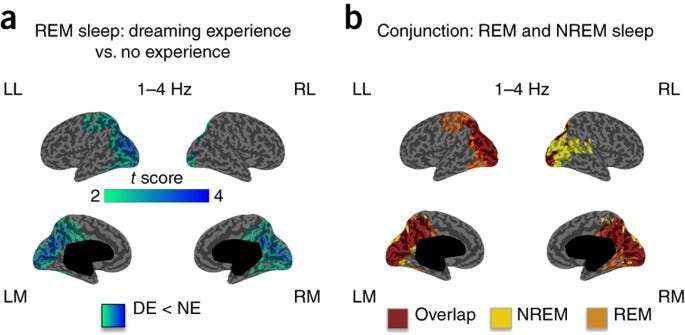
This image doesn't mean that some brain regions are working.
No, it means that those colored areas are more active than the others because some brain regions are more specialized in some tasks like attention, sleeping, decision-making, and so on.
They don't mean that the rest are inactive/useless/unfunctional.
Myth 2: Memory Works Like A Video Camera
When you talk to friends or family about remembering something, you may notice that most of the time they differ in what they remember.
This already challenges the view that memories are like tape recorders or video cameras, storing and replaying events exactly as we experienced them.
The truth is that memory is more like an ever-changing machine that creates our narratives of our past and present.
Our memories are not exact replicas of past events, but constant reconstructions influenced by the past and present.
Myth 3: We Have 5 Senses
I learned in primary school that there are 5 senses: sight, hearing, touch, taste, and smell.
However, there are more:
- Proprioception: sense of body position.
- Nociception: the sense of pain.
- Vestibular sense: balance and spatial orientation.
Myth 4: Some People Are Left-Brained, Others Are Right-Brained
Wrong.
This myth was popularized by pop psychology and some businessmen who argued that one could be more artistic by suppressing analytical thinking.
The truth is that both hemispheres work together for most cognitive functions.
However, some brain functions are more specialized in some brain hemispheres, as different abilities could be more affected by injuries to one side of the brain than the other.
But they still work together, and suppressing one ability will not benefit another.
Myth 5: Students Learn Best When Teaching Styles Are Matched to Their Learning Styles
Nope.
Effective learning is influenced by many factors that go beyond specific learning styles.
This could be:
- Prior knowledge
- Motivation
- Context
Instead, educators should teach diverse learning preferences and correct students for their shortcomings, not avoid them.
Also, good technique must prepare us to confront the real world that will not work on our preferences.
Myth 6: Subliminal Messages Can Persuade People to Purchase Products
Wrong.
However, indeed, brief stimuli called priming can momentarily influence perceptions.
For example, research shows there's a higher probability of subjects choosing the word "guide" by priming them with words like "direct", "lead", and "escort" (Merikle, 1992).
But to extend this notion to consumer decisions is a huge overcomplication, as complex factors like individual preferences, social preferences, and conscious deliberation shape these.
Myth 7: Dreams Possess Symbolic Meaning
When I started studying Psychology, I thought dreams possessed some symbolic meaning.
But there's no scientific evidence for this.
This misconception was popularized by Freud's psychoanalysis. In his theory, dreams conceal unconscious elements such as trauma, emotions, and other psychological content.
Although Freud warned that dream symbols are not universal, he frequently violated this rule by interpreting patient dreams with little or no input from them.
Today, scientists reject the idea of dreaming possessing symbolic meaning.
And if we look closer, most people's dream reports reveal that most of them are about everyday activities and concerns.
Additionally, during REM sleep (the sleep phase where dreams are more vivid), our highly activated brains produce illogical and emotional dreams.
Curious fact: in Post traumatic stress disorder, dreaming content are important for the treatment of the patient, as they constantly dream about their traumatic event.
Myth 8: Listening to Mozart Makes You Smarter
No.
The interesting part of this myth is that even some scientists cited in their the "Mozart effect" boosting intelligence in babies!
This myth is a huge misconception from a study published originally in the prestigious Nature about how 3 students who listened to 10 minutes of a Mozart piano sonata displayed a significant improvement on a spatial reasoning task, compared with groups who listened to a relaxation tape or silence.
However, this finding only applied to a specific task administered immediately after listening to Mozart's music.
It said nothing about the long-term effect of spatial ability, let alone intelligence in general!
In summary, while music can have some cognitive benefits, these effects are short-term and not related to general intelligence.
Well, how was it? Did you know these myths?
Do you know more?
Let me know in the responses!
Check Scott O. Lilienfeld's "50 Great Myths of Popular Psychology — Debunking Widespread Misconceptions about Human Behavior" for more myths:
https://amzn.to/4dvsVWR (affiliate link).
I may earn a small commission if you click on it :)
If you liked my article, here are some ways you can help:
👏 Clap 50 times and respond to this article
🦜 Follow me to learn more about Science: Axel
🗂 Subscribe to get my newest articles
You May Be Interested In:
Thanks for reading!
See you,
Axel