If reality is no more than a construction of our nervous system, do we perceive the same world as a bird, whale, or an octopus?
Animals fascinate a lot of people. But although we've long shared the planet with a diverse array of animals, understanding the nature and extent of how animals perceive their world remains a challenge. However, since 1950 science learned a lot about them, from their behavior to their neural basis of.
But this article delves into something even deeper than behavior and cognition: consciousness. Whether animals possess consciousness has been a longstanding and complex topic that involves both philosophy and neuroscience. But what does science specifically say about this topic? Here I'll give you a brief introduction.
Article's Content:
1. What is Consciousness? 2. Are animals conscious? 3. We may live in a world with different types of consciousness 4. Conclusion and References
What is consciousness?
Defining consciousness is another complex topic that has been debated for a long time. However, most neuroscientists agree that consciousness is any kind of subjective experience [1]. Thus, consciousness is the 'what is it like' to be me, to be you, and to be another animal.
Consciousness is that subjective experience when you listen to your favorite music, when you admire the views from your favorite place, etc. Consciousness also involves that you're aware of your subjective experience. For example, you are not aware of how many times you breathe the last minute until you pay attention to it (as you probably are now, sorry for that).
And there's one more thing that makes consciousness so special: it is YOUR experience. It is private. It belongs to you.
We know that we humans are conscious, of course. But the question here is if other animals have it: can animals have subjective experiences and be aware of them? Or are they just like living machines, like Descartes thought? To answer these questions, we need to study the place where consciousness emerges: the brain.
Are animals conscious?
Neuroscience says …
Studying consciousness in humans is easier than in other non-human animals. This is because I can ask you about your experiences directly. Thus, verbal communication allows us to gain insights into human consciousness more readily. In contrast, animals don't speak, so deciphering their subjective experiences becomes a hard, really hard challenge.
As determining the neural substrates of subjective experiences is very challenging, some neuroscientists created an experiment paradigm to study the 'limits of consciousness' [2]. The premise is that when an image is presented at an extremely rapid pace, individuals may not be consciously aware of it. If a person claims to have seen the image ('yes, I did'), it serves as evidence of consciousness. Conversely, if the image goes unnoticed, the conclusion is that the individual was not conscious of it.
It turns out that if I show you an image at an extremely fast rate, the brain is not capable of disseminating the information of that image globally across other brain regions, resulting in a lack of consciousness. The interesting part is that even if you're not conscious of it, it can influence some of your decisions. That's called priming, but it's another story that I'll not cover here.
By doing this and recording brain activity during the experiments with electroencephalogram (EEG) and functional magnetic resonance imaging (fMRI), researchers found that the pre-frontal cortex was a key area related when subjects reported to have perceived the stimuli [3]. Therefore, a biomarker of consciousness was discovered, providing a new way to assess consciousness without relying on verbal reports.
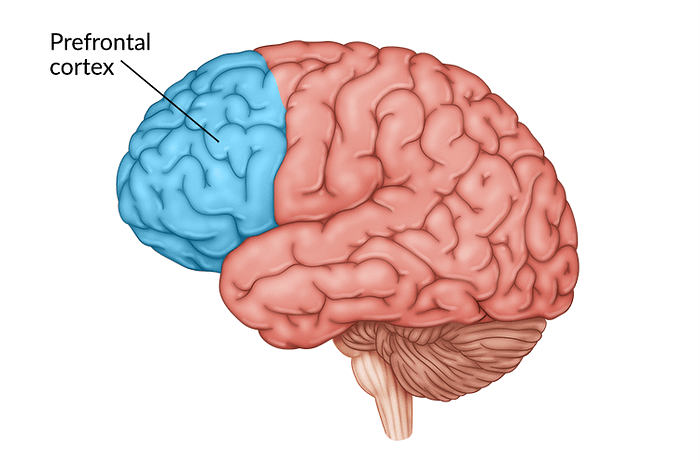
This kind of experiment were started to be done on monkeys. These animals were trained to report whether they perceived a stimulus by pressing a key. Scientists found that the pre-frontal cortex was implicated when monkeys reported perceiving the stimulus, providing evidence of consciousness [4].
Later, in 2020, neuroscientists replicated this experiment in crows. They also found that the avian equivalent of the pre-frontal cortex, known as the nidopallium caudolaterale, was implicated when crows reported seeing a stimulus [5].
Ethology and Psychologists say …
However, determining whether animals are conscious or not is not limited to neuroscience or finding biomarkers of consciousness. By observing and studying their behavior, we can get clues and insights about whether certain actions might need consciousness.
For example, when I was living in Sydney, Australia, I once saw a curious incident between a sulfur crested cockatoo (Cacatua galerita) and a currawong (S. graculina). The clever cockatoo strategically hid from the currawong's view, only to reveal itself with a squawk, causing the currawong to fly away in fear. There was no nest or immediate threat; it appeared the parrot simply scared the currawong for fun! In Australia, it is very common to see cockatoos mocking other birds or doing clever behaviors, also earning the nickname of 'clown birds' 🤡 🦜.
Think more about this! The cockatoo probably had to be aware of the currawong's gaze. Thus, the cockatoo made a plan to hide from its gaze to be able to scare it. This plan and execution may require consciousness. Therefore, we can infer that the cockatoo is conscious.
There are several examples in the animal kingdom like this. I highly recommend you observe your pets or the animals living in your surroundings, and ask yourself whether those behaviors require consciousness or not.
Can that behavior be explained only by genetics and instinct, or does it require something more?
Conclusion
If animals are conscious, is it the same consciousness in humans? Do we perceive the same world of a bird, whale, or an octopus?
No, because animals evolved different nervous systems based on their needs. Parrots and hummingbirds see way too many more colors than humans. Dogs are dichromatic, and their main perception is their olfaction. Bats and dolphins perceive their environment mainly by echolocation, and so on. Thus, there may be multiple types of consciousnesses, all of them based on how the nervous systems evolved.
And there's one more thing that I would like to share with you:
Because we humans thought that other animals perceive and experience the world like us, we transformed the planet based on what WE perceived and experience. By doing this we brought light to darkness, noise to silent hills and oceans, and more. We are threatening other animal worlds, and leading them to brutally adapt to our perceptive world.
And what do you think? Are animals conscious?
I hope this article gave you a deeper understanding of consciousness and animals. In the next ones, I will write more about how animals experience the world! Stay tuned!
❤️ If you liked it, please clap 👏 (50) to motivate me to write more articles about sleep, neuroscience, animals, and Python.
🦜 Follow me to take a look at all my articles.
Cheers!
📚 References:
Seth, A.K., Bayne, T. Theories of consciousness. Nat Rev Neurosci 23, 439–452 (2022). https://doi.org/10.1038/s41583-022-00587-4
Dehaene, S., Naccache, L., Le Clec'H, G. et al. Imaging unconscious semantic priming. Nature 395, 597–600 (1998). https://doi.org/10.1038/26967
Dehaene, S., & Changeux, J. P. (2011). Experimental and theoretical approaches to conscious processing. Neuron, 70(2), 200–227. https://doi.org/10.1016/j.neuron.2011.03.018
Wilke, M., Logothetis, N.K., and Leopold, D.A. (2006). Local field potential reflects perceptual suppression in monkey visual cortex. Proc. Natl. Acad. Sci. USA 103, 17507–17512.
Andreas Nieder et al. A neural correlate of sensory consciousness in a corvid bird.Science369,1626–1629(2020).DOI:10.1126/science.abb1447