So, do you wanna start learning a new language but don't have the time or money to do so?
I feel you. I was there.
I was working and studying Psychology and didn't have a flexible schedule to attend lectures, even online ones. I also didn't have the money.
And I wanted something fast, not courses that would take me 2 years to reach a B1 level.
Without even noticing it, I started learning German during the pandemic with the power of ultralearning.
And went from 0 to B1 in just 54 days.
Let me show you how you can as well in this detailed article.
Ultra What?
Ultralearning is a methodology popularized by Scott Young to learn consistently and intensively about a topic.
It doesn't mean studying 8 hours per day.
It means to be consistent and focus on learning a task in the time you decide to invest. Could be 1 hour per day, less or more.
I won't go into much in deep here, as I published an article about it:
Interested in Ultralearning? I will write an article summarizing and going in depth from 9 ultralearning principles, so follow me and stay tuned!
My First Ultralearning Project: Learning German in 2 Months
First things first, what do I mean by "learning German"?
I mean to be able to go from 0 to B1, a level where I consider you can talk the language pretty much.
It's not fluency or bilingual level (B2, C1, C2), but it's still a good level.
So I wanted to achieve a B1 German in just 2 months.
At a normal pace studying from online lectures, that goal would take me 2 years (one lecture per week) to finish.
So how did I achieve this in just 2 months?
With ultra learning and a few steps.
This was the step-by-step I followed to learn German in just 54 days.
Step 1. Meta-learning
The first thing I did was to learn how the knowledge was structured.
In other words, learn how to learn German.
I looked up how German courses were instructed at the Goethe Institute, the most prestigious institution to learn German (like Cambridge for English).
Then, I looked up free resources (cheat sheets, books, YouTube videos, tests, etc.) both from Goethe and from kind people who shared their materials.
During this search, I found an incredible free resource from Deutsch Welle called 'Nico's Weg' that I highly recommend you use if you wanna learn German.
It has courses from A1 (basic level) to B1 (intermediate).
Each one has around 18 chapters, with 4 sub-chapters. These are the first chapters from the A1 level:
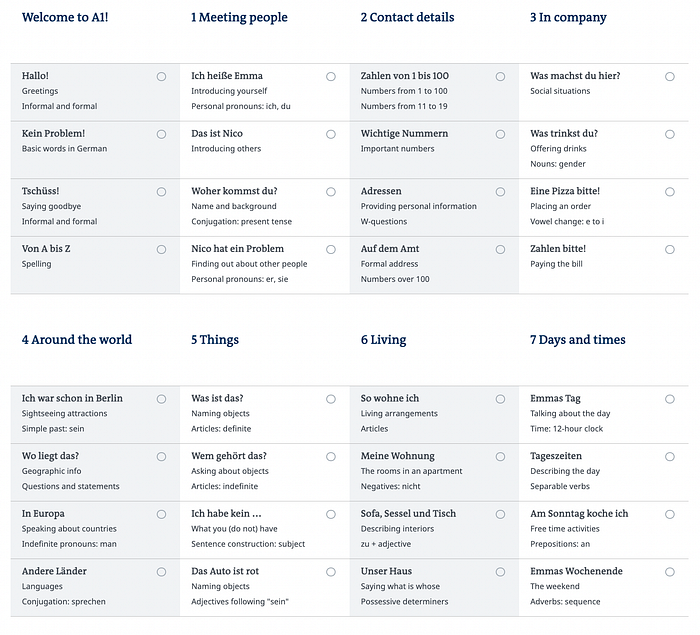
My strategy was then to complete one chapter per day.
If successful, I would go from A1 to B1 in just 54 days.
Additionally, I needed to study from the resources I found from Goethe, and make tests.
That's how I structured my Ultralearning project.
Step 2. Focus and Study Habits
Once done with the organization, I started studying and learning.
I dedicated 1 hour and a half during the morning, and 1 hour and a half in the evening to study and only study German.
I used Pomodoros to get complete focus on my task and made it a habit.
This is important!! Make a schedule to study!
Don't do it whenever you feel like it.
Make it a responsibility!
Step 3. Go to the Point and Learn In Context
I went straight to what I wanted to learn.
If I felt like some words or conversations were not that relevant (for example conversations about F1, sorry F1 fans) I didn't t get too much time on that.
Also, I tried to learn in context.
With this, I mean to study and understand how to use German in daily life contexts.
For example, Duolingo is great for learning new vocabulary but fails in the directiveness of learning.
Why?
Because you're learning vocabulary out of context.
You probably thought like "Okay, but how can I use this in a real-life situation?" after learning in Duolingo.
That's why you need to go to the point and learn in context!
Step 4. Retrieval and (a lot) of Tests
Yeah, this is kinda obvious.
I took a lot of activities and tests from Nicos Weg's.
Additionally, I tried to solve activities from books used in Goethe's courses.
As you probably know, you need to take the test to retrieve and encode the information you learned.
You can even ask GPT to make some tests for you to save some time!
Step 5. Feedback
This was a fundamental step in my journey to learn German.
Feedback is uncomfortable but necessary for learning.
I know, it will make you feel bad some days. But believe me, you will learn way faster if you receive feedback from native or fluent people.
For this, I used an App called HelloTalk, which is like social media but for learning new languages.
The idea is simple: you know x language and wanna learn x language.
Someone is native or fluent in the language you wanna learn, and he or she wants to learn the language you're native to.
So this is an exchange of knowledge.
People will correct how you write, express, and how you talk.
Additionally, you will see how native people express and talk.
By doing I received a lot of feedback and my German improved a lot!
I also started talking with a decent accent, as I was learning from native people.
Step 6. Experimentation
Experimentation means to apply your learning out of your comfort zone.
To do this, I took harder tests from Goethe and started making calls or sending voice messages in German to native German speakers.
Additionally, I started talking with people from Austria and Switzerland, as they have other German accents.
By improvising and experimentation, I could apply what I learned in a new context.
Again, this also improved my German a lot!
Conclusion
Doing these 6 steps, I went from 0 to B1 in just less than 2 months.
With this ultralearning project, I saved a lot of money and time.
I learned from free resources and studied at my own pace.
I think everyone can learn a language pretty fast nowadays.
There are a lot of free and incredible resources on the internet, use them!
Now it's your turn to learn a new language or to start building up your first ultralearning project.
Good luck!
Interested in Ultralearning? I will write an article summarizing and going in depth from 9 ultralearning principles, so follow me and stay tuned!
🦜 If you liked my post, please clap 👏 50 times for more content about Neuroscience, Psychology, Productivity, Animals, and Python!
And don't forget to follow me for more!
Thanks for reading!
My Friend retro games NES SEGA