
Not a Medium Member? Click here to read the article.
Ultra-learning saved my career.
I love learning something new. When studying at the university, I was hungry for knowledge. I wanted to know more than just Psychology and behavior: a new language, programming, neuroscience, animal cognition, etc.
But I hit the brutal truth. I had no money.
Neither time. Both variables are necessary to enroll in another degree or take more courses. However, everything changed when I discovered ultra-learning, even without noticing it.
Since then, I learned to learn anything while saving time and money.
Ultra-What? Ultra-Learning!
Ultra-learning is a learning strategy popularized by Scott Young.
In his fantastic book Ultralearning: Master Hard Skills, Outsmart the Competition, and Accelerate Your Career (affiliative link), Scott teaches us how to acquire skills by learning them self-directed and intensely using nine principles.
His most popular ultra-learning project is the MIT challenge.
He finished a computer science degree from MIT in just one year! For this, he used the resources provided by MIT Open Course Ware, including lectures, exams, and programs.
With ultra-learning, you can master any skill.
Math, neuroscience, biology, drawing, or playing an instrument. Ultra-learning helps you create a master plan to learn these effectively, saving you money and time.
This skill is underrated.
Learning, adapting, and solving problems efficiently and quickly is a gold skill every employer values.
It is a skill that will make you outsmart the competition.
3 Big Benefits:
- Save money: Tuition fees for universities and courses are expensive. Ultralearning helps you learn effectively using free resources.
- Save time (and avoid stress): you study at your own pace. You're free to choose your times.
- Hidden advantage in a competitive world: any job will value a person with a portfolio of learning skills effectively and fast.
How To Become An Ultra-Learner?
Ultralearning doesn't mean studying until burnout.
It means being consistent and intense enough when you decide to invest in learning a new skill. This is crucial. Some people have busy lives studying, having a family, or working, but they can still apply ultra-learning.
Find your pace.
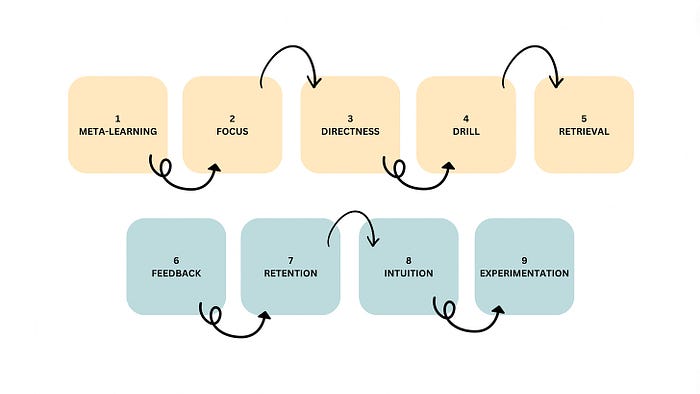
To start, Scott proposes nine principles:
- Meta-learning: learn how knowledge is structured and make a roadmap.
- Focus: Focus on studying and make it a habit.
- Directness: learn by doing the thing you want to become good at.
- Drill: isolate your weakness and drill it.
- Retrieval: recall and use the information you learned.
- Feedback: Try to get feedback from others and work on it.
- Retention: understand what and why you forget. Improve your encoding.
- Intuition: Understand how understanding works. Focus on examples in context.
- Experimentation: explore outside your comfort zone. Apply your knowledge in other contexts.
3 Ultra-Learning Project Examples
1. Learning Machine Learning
This is my favorite example.
Machine learning requires many sub-skills, including programming, math, data analysis, scientific thinking, etc. This is how you can apply ultra learning to master this colossal field:
- Apply meta-learning: how can I learn this? Understand which sub-skills you need (math, Python, etc). Find courses, books, and videos, and read articles from experienced people suggesting how to learn or how they would relearn. Pro tip: use university programs.
- Focus and study: create a study routine. Evaluate how much time you have during the week. Use Pomodoros to focus and study. When learning, practice retrieval or other effective study methods. You can read more here.
- Drill: Math was my weakest point when learning this. I drilled it by using more pomodoros to understand it better.
- Feedback: Try to contact experienced machine learning programmers. You can also use Chat GPT to suggest improvements in your code and explain why.
- Learn by doing: code projects.
- Experimentation: code projects outside your comfort zone.
2. Learning a Degree
There are many excellent free resources available on the internet.
Some of them include lectures from MIT, one of the best universities in the world. Platforms like Coursera or EdX also offer courses from other top universities and companies like Google or IBM (most of them for free.)
Here are some links to find university programs:
- MIT resources: https://ocw.mit.edu/
- MIT lectures: https://www.youtube.com/@mitocw
- Open Source Society University (Computer Science Degree): https://ossu.firebaseapp.com/#/curriculum
- Open Source Society University (More Degrees): https://github.com/ossu
You can find free online courses or lectures for each subject.
3. Learning German
Learning a new language is also a top skill.
During the pandemic, I decided to learn German using the Deutsch Welle course "Nico's Weg." It is organized like any language course and includes A1, A2, and B1 levels.
Each level has 18 chapters, so by studying one per day, you could go from 0 to B1 in just two months.
Of course, that pace is extreme, so I recommend taking it easier.
This is an example of how crucial meta-learning is. I wanted to learn German. I googled and read recommendations from resources. I read students' recommendations from the Goethe Institute. I found Nicos Weg.
Then I created a learning routine and learn it.
Ultralearning saved my career.
If you're interested in reading more, I recommend you read Ultralearning: Master Hard Skills, Outsmart the Competition, and Accelerate Your Career (affiliative link) by Scott Young.
It is a game changer.
It changed my life forever.
Ways I can help you:
- Subscribe to my new free newsletter The Super Learning Lab.
- Stay tuned for an upcoming free learning ebook and an email course!

Thanks for reading!
See you,
Axel
My Friend retro games NES SEGA