It was about a year ago. I started working early in the morning, when it was still dark.
After a couple of hours of writing technical documentation, I realized the whole house was still in twilight. I still hadn't lifted the blinds. It was 8.23 a.m., and I had no idea what the weather was like outside.
What is the most normal gesture to know if it's raining or it's sunny? For me, it was asking Siri. Yes, I was iPhone-addicted. But that morning, something cracked.
A couple of questions ripped the veil: 'What if Siri made a mistake?' Then, immediately after, with no apparent logical link, another question arose, 'But how the hell do I use the phone?'
Then my eye fell on the birthday present my wife had given me.
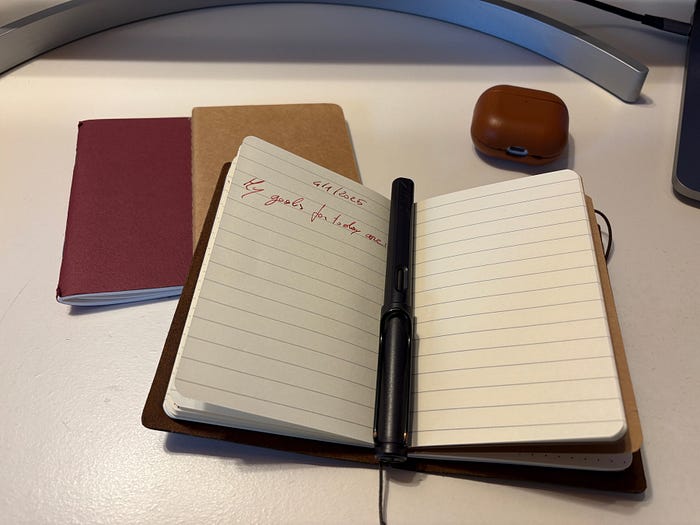
The Midori Travel Notebook was open on the desk. A doodle I wrote as soon as I woke up said, "My goals for today are:" The sentence did not end. The good intention to write my goals had broken against the bad habit of jumping from one activity to another, forgetting some of them.
In that stream of thoughts, an idea peeked out. It was about making it a habit to note each period of time during the day when I move the iPhone away from me and concentrate on an "unconnected" activity.
From this intuition, my brand was born, first The Note Strategist, then The Learning Strategist. But even more important, from that moment on, superpowers have entered my life.
Write down your bad habits
As a man and as a professional, I found my superpowers when I started writing my intentions and managing them with note-taking techniques.
What do I mean?
Try this experiment. It requires discipline, but it's doable. For three months, track a bad habit you want to take control of. In my case, it was about being addicted to my iPhone. Day by day, write down when, during the day, you play that habit. Write those notes daily and add them to your note-taking system.
Use a couple of tags:
- The bad habit name (iPhoneAddiction, in my case)
- The friction that the bad habit caused that day (DisconnectionFromReality, in my case)
After three months, you have around 90 habit notes. The friction tags are likely to link those notes to many others in your note-taking system. The web of connections gives you a scary idea of the impact that your bad habit has on your thinking capabilities.
The life-changing awareness
Discovering the ramifications of bad habits in our knowledge system gives an emotional boost to change. It's like finding the massive impact of a small but recurring expense in the family budget. It leads you to reconsider what you do in light of your goals.
"Is that what I want?" This is the question.
You could discover that you are a slave to habits and that you perpetuate them because others around you behave in the same unconscious way. That is realizing that you are in a cage.
And you can see that cage in the web of links between your habit notes and your knowledge system. You can feel the trap.
Take control of bad habits
The good news is that the tiny habit of tracking bad habits by taking notes is the solution. The act of tracing black on white, when the bad habit manifests itself, empties the occult power and transfers the beneficial power to choose your actions to you.
The hard news is that even a small habit is difficult to take. Taking a new habit requires reprogramming our unconscious mind. Only forced repetition can reprogram us, and it's tiring.
Funny that we say taking notes as well as taking habits! Both are a take, but there's a third one: taking control. "Take the habit of taking notes of your bad habits. You'll take control of them and be free," this is the take chain.
Note-taking can change people
If you've never tried it, it may seem exaggerated to hear statements like "Note-taking can change people". But this is the effect that the word 'note-taking' has on people who do not practice it.
Practicing note-taking sharpens your mind, giving it the superpower to see itself reflected in the outside world. And this is what gives an otherwise unattainable awareness.
In my book The Game Changer Note-Taking Guide, I provide a detailed but concise way to an empowered status of mind:
Every time you take notes, you build a shield against uncertainty, and a springboard for change. [Chapter 8]
I'd love to help you see the world with the clarity I've gained from note-taking as a way of life.
Wrap-up
What began as a tiny, almost accidental habit — writing down when I distanced myself from my phone — turned into a doorway to awareness.
Through the simple act of noting, I learned to see the invisible architecture of my thoughts, habits, and distractions. Every line written was a mirror reflecting not what I was doing, but who I was becoming. That's the hidden power of note-taking: it's not about information, but transformation.
You stop being a passive passenger of your routines and start steering them with intention. Over time, your notes stop being pages of ink. They whisper back to you, "You are not your bad habits. You are the author of your actions."
So, start with one small note today. Track one habit, one thought, one intention. Because the moment you begin to take notes, you begin to take control. And that's when your story truly starts to change.
Before leaving…
Want to turn your notes into your most significant advantage? Learn how to think, learn, and grow through intentional note-taking. Get my new book, The Game Changer Note-Taking Guide!
Meanwhile, enjoy my free learning path: My Note-Taking Learning Path!
Happy to meet you, my reader! I'm Luca Vettor, The Learning Strategist.
If this article inspired you, share it and invite others to join the 1% who learn as a way of life!