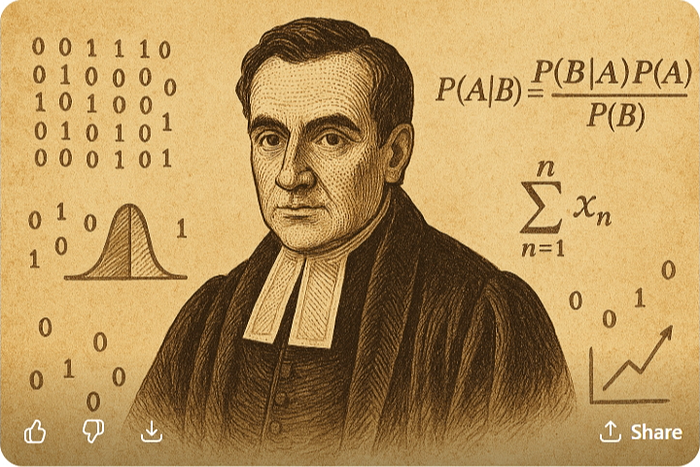
There is a kingdom older than the United States, older than electricity, older than the very idea of technology. It has no borders, no anthem, no flag — yet every nation, every invention, every civilization has depended on it.
It is the Kingdom of Numbers — a realm where ideas reign, and the laws that govern reality take shape in the language of abstraction.
And America, the world's AI superpower, is quietly starving it.
We are living in a time when artificial intelligence dominates headlines, stock markets, policy debates, and public imagination. Politicians speak of AI as the new electricity. Entrepreneurs call it the final frontier. Investors pour billions into data centers and GPU clusters.
But beneath all the noise lies a truth that Silicon Valley and Washington rarely acknowledge:
AI is not powered by compute. AI is powered by mathematics.
Every transformer architecture, diffusion model, and reinforcement-learning loop is built upon centuries of mathematical discoveries. Every LLM, every protein-folding model, every autonomous system is an edifice constructed from algebra, calculus, probability, and geometry.
And yet the United States — the country that once led the world in mathematical brilliance — is now neglecting the very discipline that makes AI possible.
Funding is shrinking. Math departments are collapsing. Students are fleeing the field. K–12 math literacy is declining at historic rates.
America is building the supercomputers of the future on foundations that are beginning to crack.
As an AI researcher, I've come to believe this is one of the greatest strategic risks facing the United States — a slow-moving crisis that threatens everything from economic competitiveness to national security.
This is the story of that crisis.
Beneath the Silicon: The Mathematics That Powers Everything
The deeper I go into AI, the more humbled I am by the mathematical machinery beneath the surface. Strip away the branding, the hype cycles, the billion-dollar valuations — and every model, no matter how sophisticated, reduces to a set of elegant mathematical operations.
The intelligence we attribute to machines is nothing more than:
- matrices and tensors being multiplied,
- gradients sliding down the slope of a loss function,
- eigenvectors capturing hidden structure,
- probabilities updating with new evidence,
- optimization algorithms refining approximations.
Silicon Valley sells "magic." Wall Street buys "innovation." But at its core, AI is built from ideas conceived long before electricity existed.
Neural networks? They're tensor calculus. Backpropagation? Differential calculus. Attention? Weighted linear algebra. Bayesian inference? 18th-century probability theory. Optimization? 19th-century mathematical analysis.
The beating heart of AI is not the chip. It is the equation.
And the people who understand those equations — the mathematicians — are disappearing.
A Silent American Decline
Here is a fact that should alarm every American worried about the future of U.S. competitiveness:
America's mathematical proficiency has collapsed to its lowest point in decades.
The National Assessment of Educational Progress (NAEP) reports historic declines in K–12 math performance. American students now lag behind dozens of countries in mathematical literacy.
Meanwhile:
- U.S. universities have quietly begun shrinking or merging math departments.
- Fewer American students pursue mathematics degrees.
- International students now make up the majority of graduate-level math enrollment.
- The U.S. struggles to produce even a fraction of the mathematical researchers it once did.
This is happening at the exact moment AI — the most mathematically dependent technology in human history — becomes the backbone of the U.S. economy, military strategy, and global influence.
We are entering a new Cold War — a competition for computational and algorithmic supremacy — and America is cutting off the oxygen supply to its mathematical engine.
The Cheapest, Highest-ROI Field in All of STEM
America spends billions on the outputs of math, yet spends pennies on math itself.
Mathematics has always been the most cost-efficient field in science.
Physics needs billion-dollar accelerators. Biology needs expensive labs and consumables. Engineering needs materials and manufacturing.
Mathematics? A chalkboard and a mind.
And yet the return on investment is enormous.
Take cryptography — the foundation of everything from banking security to Pentagon communications. Take genetics — now decoded using topological and statistical mathematics. Take Wall Street — built on stochastic calculus and probability theory. Take AI — powered by linear algebra, differential equations, and optimization.
A single mathematical breakthrough can ignite entire industries. And still, the U.S. continues to treat mathematics like an academic accessory rather than the engine of scientific and technological power.
The American AI Illusion
There is a dangerous illusion spreading across the country:
That AI progress comes from bigger models and more compute.
Silicon Valley believes scaling laws are destiny. Startups believe more GPUs mean better intelligence. Politicians believe AI leadership is a hardware race.
But hardware is only half of the equation.
Innovation comes from new mathematics.
America cannot compute its way out of a mathematical stagnation.
Without breakthroughs in:
- optimization theory
- approximation theory
- combinatorics
- numerical analysis
- information theory
- geometry and topology
- probability and statistics
…the next generation of AI will simply never emerge.
This is the bottleneck hiding in plain sight.
Computers run mathematics. Only humans create it.
And the U.S. is producing fewer mathematical creators with each passing year.
The Invisible American Architect
A few years ago, I walked the halls of a math department at a public university in the Midwest. The walls were bare. The classrooms outdated. Faculty members were juggling impossible teaching loads. Several positions had gone unfilled due to budget cuts.
"We're holding the line," one professor told me. "No one realizes everything depends on us."
He was right.
The quiet mathematicians working in America's universities are the invisible architects of our entire society:
The algorithms that optimize Amazon logistics? Math.
The cryptographic systems securing U.S. intelligence? Math.
The models predicting hurricanes and drought? Math.
The AI systems powering autonomous drones, self-driving cars, biomedical research, and climate simulations? Math.
Yet society sees none of this.
These mathematicians are America's unsung strategic asset — and we are abandoning them.
The Real AI Doom Scenario
People love imagining catastrophic AI futures.
Runaway AGI. Synthetic consciousness. Machines taking over humanity.
But the real doom scenario — the plausible one — is simpler and more painful:
The U.S. loses its mathematical edge.
If that happens:
- AI innovation slows.
- Scientific discovery plateaus.
- America falls behind geopolitical rivals.
- National security capabilities weaken.
- Technological infrastructure becomes vulnerable.
- The AI workforce becomes dependent on other countries' expertise.
This is not science fiction. It is already unfolding.
The nations investing most aggressively in mathematics today — China, India, South Korea, Singapore — are the ones that will lead in AI tomorrow.
If America does not reverse course, it will be out-thought, not out-computed.
The America We Could Choose Instead
Imagine a different trajectory — one where America remembers what made it great:
Relentless curiosity. Frontier thinking. Unapologetic investment in intellect. Faith in human ingenuity.
What if the U.S. treated mathematics like the national security asset it truly is?
What if:
- Math departments received DARPA-level funding?
- American mathematicians were paid like software engineers?
- K–12 math education were rebuilt from the ground up?
- Math anxieties were treated as a public health crisis?
- Scholarships for mathematics matched those in AI and computer science?
- Congress recognized mathematics as core infrastructure?
The breakthroughs would be staggering:
- New AI architectures beyond transformers
- Revolutionary cryptographic systems
- Unprecedented advances in quantum computing
- Mathematical tools for personalized medicine
- Predictive models for climate and disease
- New frameworks for reasoning, planning, and intelligence
A renaissance of thought. A rebirth of American intellectual power.
The Kingdom of Numbers is infinite. But only nations that invest in it can access its riches.
The American Story We Forgot
For most of the 20th century, America was the global powerhouse of mathematical discovery.
It produced legends:
Von Neumann. Shannon. Feynman. Julia Robinson. Emmy Noether (who found refuge here). John Nash. Claude Shannon. Richard Bellman. Donald Knuth. Solomon Lefschetz.
Mathematics helped America win wars, land on the moon, dominate the global economy, and build the digital world.
Today, that legacy is fading.
Not because Americans lost the talent — but because America stopped cultivating it.
You cannot lead the world if you neglect the discipline that powers everything important.
Returning to the Kingdom
I often imagine the Kingdom of Numbers as a great American city — part Manhattan, part Silicon Valley, part forgotten library.
In its towers and cathedrals sit the ideas of every mathematician who came before us. Their theorems do not wither. Their discoveries do not age. Their logic does not falter.
This is a city with infinite streets still unexplored.
But the flow of American explorers has thinned.
Instead, we pour billions into data centers, cloud platforms, military AI programs, and GPU farms — while the very people capable of unlocking the next breakthroughs struggle to secure basic research grants.
America must return to the kingdom. Its future depends on it.
The Most Important Investment America Can Make
Here is the conclusion I've come to — as a writer, as an AI researcher, and as someone who believes deeply in the American spirit of innovation:
The future of America's technological power is not built on compute. It is built on mathematics.
Math is not a cost. Math is a multiplier.
Every mathematician America supports becomes:
- a century of innovation,
- a generation of breakthroughs,
- a force multiplier for national security,
- a catalyst for entire industries,
- a guardian of U.S. technological leadership.
If the AI bubble bursts, mathematics will still remain. If today's models become obsolete, mathematics will guide what comes next. If compute becomes abundant, mathematics will determine what we do with it.
The Kingdom of Numbers will outlast every trend.
But whether America remains welcome in that kingdom — whether we continue to lead in the age of AI — depends on decisions made right now.
Mathematics is America's quiet superpower.
And it's time we treated it that way.