Learn agentic AI step by step with this beginner-friendly guide. Understand AI agents, LLMs, workflows, tools, and how to build your first simple agent.
Imagine an AI that does more than answer questions. It can help you complete a task. For example, instead of only telling you what to pack for a trip, it could help build a checklist, gather destination details, and organize the plan step by step. That is the basic idea behind agentic AI.
Non-medium member read here
If you have been hearing terms like AI agents, LLM vs AI agents, or agentic AI workflow and feeling a little lost, don't worry. This guide is written for beginners. We will keep it simple, practical, and focused on what you actually need to know to get started.
What Agentic AI Means in Simple Words
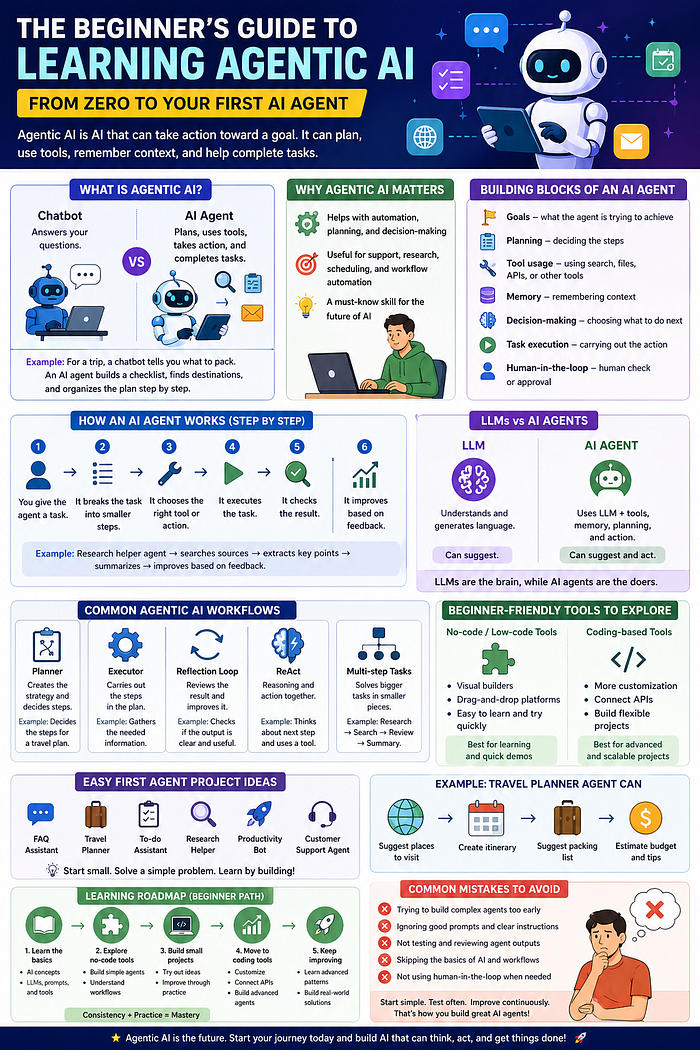
Agentic AI is AI that can take action toward a goal. A regular chatbot answers what you ask. An AI agent can go a step further: it can plan, use tools, remember context, and help complete tasks.
Think of it like this:
- A chatbot is a helpful assistant sitting at a desk.
- An AI agent is a helpful assistant who can also move around the office, check files, send emails, and follow up on tasks.
A simple example: if you ask an AI agent to help with a weekend trip, it might gather travel ideas, create a rough itinerary, and suggest a packing list. That is why people are excited to learn about AI agents in beginner-friendly terms.
Why Agentic AI Matters Today
Agentic AI is becoming important because it helps with automation, planning, and decision-making. Businesses can use it for support tasks, research, scheduling, and workflow automation. Beginners should care because this is one of the most practical ways to understand how modern AI is being used.
If you are just starting out, learning agentic AI gives you a strong foundation for:
- AI automation for beginners
- practical AI agent examples
- building simple productivity tools
- understanding how AI systems can act, not just respond
The Basic Building Blocks of an AI Agent
Before building anything, it helps to know what makes an agent work. The main pieces are:
- Goals — what the agent is trying to achieve
- Planning — deciding the steps
- Tool usage — using search, files, APIs, or other tools
- Memory — remembering useful context
- Decision-making — choosing what to do next
- Task execution — carrying out the action
- Human-in-the-loop control — letting a person check or approve important steps
These are the core AI agent building blocks you will keep seeing as you explore more advanced topics.
How an AI Agent Works Step by Step
A beginner-friendly way to understand how AI agents work is to break the process into a few steps:
- You give the agent a task.
- It breaks the task into smaller steps.
- It chooses the right tool or action.
- It executes the task.
- It checks the result.
- It improves based on feedback.
For example, if you ask a research helper agent to summarize a blog topic, it might first look for sources, then pull out key points, and finally give you a short summary. That flow is what makes agentic AI feel more useful than a basic chatbot.
Now that the process is clear, it helps to understand what powers it behind the scenes.
LLMs vs AI Agents
A large language model (LLM) is the part that understands and generates language. An agent uses an LLM, but it is not the same thing.
Here's the simplest way to think about it:
- An LLM can suggest.
- An AI agent can suggest and act.
So if you ask, "What is the best way to organize my study plan?", an LLM can suggest ideas. An agent can go further and help create a schedule, list tasks, and even update a plan over time.
That difference matters when you are learning prompt writing for AI agents or trying to build your first project.
Common Agentic AI Workflows
There are a few common patterns in agentic AI workflow design:
- Planner — creates the strategy. For example, it decides the steps for a travel plan.
- Executor — carries out the steps. For example, it follows the plan and gathers the needed information.
- Reflection loop — reviews the result and improves it. For example, it checks whether the output is clear and useful.
- ReAct — reasoning and action together. For example, the agent thinks about the next step and then uses a tool.
- Multi-step task handling — solving bigger tasks in smaller pieces. For example, a research task is split into search, review, and summary.
You do not need to master all of these on day one. Just knowing they exist will help you understand how more advanced agents are built.
Beginner-Friendly Tools to Explore
If you want to try this yourself, start simple. There are many low-code AI agent tools and no-code AI agent builders available for beginners, such as visual workflow builders and drag-and-drop automation platforms. These are useful because they let you experiment without needing to build everything from scratch.
Use no-code tools if you want to:
- Understand the flow quickly
- Build a small demo
- Focus on learning concepts
Use coding-based tools if you want to:
- customize behavior
- connect APIs
- build more flexible projects
For many beginners, the best path is to start with no-code, then move to code later.
Easy First Agent Project Ideas
The best beginner projects are small and useful. A few good first AI agent project ideas are:
- FAQ assistant
- travel planner
- to-do assistant
- research helper
- productivity bot
- simple customer support agent
If you want the easiest starting point, begin with an FAQ assistant or a to-do assistant. A travel planner or research helper is a little more involved, but still manageable.
For example, a travel planner agent could help you list places to visit, organize a short itinerary, and create a packing checklist. That is enough to teach you the basics without making the project too complex.
How to Plan Your First Agent Project
When you are ready to build, keep your first version focused.
Choose:
- one small use case
- one clear goal
- only the tools you really need
For example, if you are building a travel assistant, do not try to make it book flights, manage emails, and plan an itinerary all at once. Start with one simple task, test it, and improve it later. This approach keeps the project manageable and helps you learn faster.
A Simple Roadmap for Learning Agentic AI
If you want a clear agentic AI roadmap, follow this order:
- Learn AI and LLM basics, so you understand the foundation.
- Practice prompting, so you can ask models for useful results.
- Understand what agents do before trying to build one.
- Try simple no-code tools to see how workflows work.
- Build a small first project to learn by doing.
- Improve it with feedback so the agent gets better over time.
- Explore more advanced frameworks later, once the basics feel comfortable.
This path is practical, beginner-friendly, and much easier than jumping straight into complicated systems.
Common Mistakes to Avoid
Beginners often make the same few mistakes:
- making the project too complex
- using too many tools at once
- skipping testing
- ignoring safety
- expecting full autonomy too soon
These mistakes are normal, but they can slow you down. The safest way to learn is to keep things small and build up step by step.
Final Thoughts
Agentic AI can sound complicated at first, but the core idea is simple: AI that can help you do things, not just explain them. Once you understand the basics of LLMs, workflows, tools, and task planning, the rest becomes much easier.
If you are just starting out, do not worry about knowing everything. Pick one small project, build it, test it, and learn from it. That is the fastest way to grow.
Agentic AI for beginners is not about perfection. It is about starting small and learning by doing.
A message from our Founder
Hey, Sunil here. I wanted to take a moment to thank you for reading until the end and for being a part of this community. Did you know that our team run these publications as a volunteer effort to over 3.5m monthly readers? We don't receive any funding, we do this to support the community.
If you want to show some love, please take a moment to follow me on LinkedIn, TikTok, Instagram. You can also subscribe to our weekly newsletter. And before you go, don't forget to clap and follow the writer️!