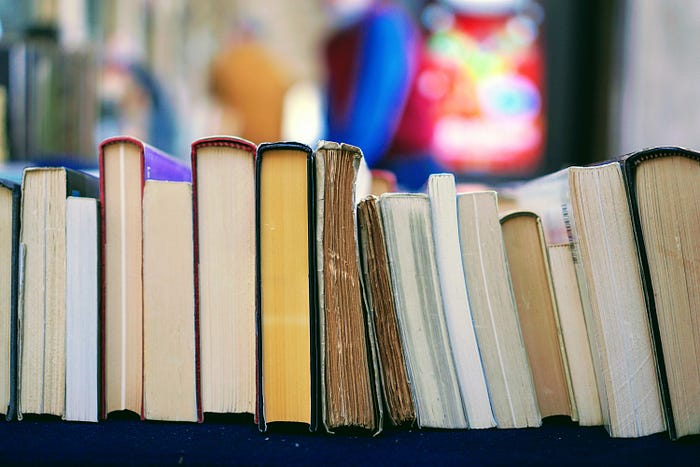
Two years ago, I went on a non-fiction reading spree.
You might be familiar: reading 1000 books per year or 10 books a day, being crowned a "reader" based on raw numbers.
And I fell right into the mania. I even made a Bookstagram account three years ago.
For those who don't know, it's a tiny corner on Instagram where people post aesthetic book photos, talk about reading goals, and call themselves bookstagrammers. I took photos, posted quotes, and made stacks look cute.
Sometimes I even read the books in those photos.
In my defense, I was in dire need of a community and needed some escape from a major health crisis, and it worked for a while.
I felt like I was doing something meaningful by reading book after book, only to realize I was just counting numbers.
The Myth of Speed Reading
Social media sold me a simple equation.
Quantity= Growth
Speed = Intelligence
And like an idiot, I believed it. Sadly, I was living in an illusion, thinking I was being "productive".
I was brainwashed by the same world that thinks your life is only meaningful if you optimize your poop timing and have a morning routine with seventeen steps.
Obviously, "reading more books faster" had to be part of that hyper-efficient fantasy, else you would be crowned illiterate.
But slowly the cracks started to appear. I realized I wasn't retaining anything or learning anything new.
I just kept buying more, finishing more, chasing whatever I saw on social media, only to realize I wasn't actually reading; I was just consuming.
Here is a funny thing about consumption. It gives you a false illusion of learning or knowledge, but in reality, it's just an illusion. I felt smart for a moment, but my mind remained unchanged.
That's when I felt it's not reading unless it shifts something in me, not momentarily but more like a permanent imprint that stays with me.
Reading needs to move something within, like a perspective shift, or a belief change, or a new thought, or maybe just new information that perfectly gives that "aha" moment when it fits the unsolved puzzle in the mind.
If nothing happens, you just skimmed your precious moments.
An interesting line I read in the book " Make it Stick" still resonates with me, and that's how I approach my reading now.
"Learning is deeper and more durable when it's effortful. Learning that's easy is like writing in sand, here today and gone tomorrow." ~Make it Stick
For me, reading is learning.
A thought, belief, perspective, emotion or knowledge.
Reading Is an Art (and I Was Doing It All Wrong)
By then, it was obvious that whatever I was doing wasn't reading. Reading to understand is an entirely different art.
It's meant to be savored like a delicious dish, melting slowly in the mouth where every flavor lingers long after we step out of the restaurant.
Of course, what I did was the exact opposite. I was rushing through books the way we rush through a horrible hotel breakfast, just trying to get it over with so I can say I ate something.
And, worst of all, I was forcing myself to finish books I couldn't care less about simply because someone online said they were a "must read." Okay, got the point. Now what?
Somewhere along the way, I had picked up the belief that not finishing a book somehow said something about my character. As if quitting a book meant quitting on life. Looking back, it sounds ridiculous,but it felt true then.
Now, I am not saying speed reading is bad. It was created with good intentions and useful techniques. It might be helpful for some.
But the social media version, which shrinks reading to a race, is horrible. It misses the entire purpose of reading.
While I am just talking about reading to learn or improve, not for entertainment, I wonder how it's even possible to speed read fiction and still enjoy it? It's like watching a movie at 2x speed, just to know the story. Google it then.
Anyways, coming back to the point.
Now the only time I use speed reading is as a filter to check whether a book actually has something valuable for me.
A lot of books recycle the same ideas with slightly different twists. I don't want to spend my life reading the same concept dressed in new outfits and then feel falsely accomplished that I'm "well read."
That's another illusion, and I want to stay far from it.
So I speed read only to see if a book deserves my time and energy, whether there's something worth going deep into, something that can unlock a new perspective or help me build on the ideas already forming in my mind.
Otherwise, speed reading is useless to me. Our mind has a minimal working memory, and when it's bombarded with too much information at once, it simply can't process or connect anything meaningfully.
There's this idea called Miller's Law, which initially suggested that our working memory can hold about 7±2 chunks of information at a time.
However, newer research even argues it's fewer, somewhere close to only 4. Even less.
So when we're speed reading, we're basically shoving more information into the brain than it can hold, which means nothing really sticks.
So what remains is just noise because we fail to connect dots and retain anything in our so-called long-term memory, where real connections happen.
The number of books completed is a vanity metric. As you know more, you leave more books unfinished. Focus on new concepts with predictive power.~Naval Ravikanth
Reading is a purposeful game.
This is around the time I realized that reading is also a purpose-driven activity. Not every book is meant for everyone.
A question we have in our minds. And not every book deserves the same depth, the same attention, or even the same season of our life.
Some books make sense only when we need what they offer. Others feel empty simply because the timing is off.
That's when I stopped picking books because they were trending and started picking them because they answered something I was genuinely thinking about.
This is when reading slowly finally made sense to me. I realized how my brain was craving intentional reading.
Reading with purpose.
For some people, it might sound rigid, but here's the thing: purpose-driven reading isn't about forcing structure into something that should be natural.
It's about aligning what we're reading with what our mind is actually curious about in that moment.
When I read randomly, everything felt scattered. Nothing connected or sometimes even good books felt off to me.
But when I shifted my lens from finishing books to finding answers to my burning question, ie, reading with purpose, things started connecting.
I would sometimes pick 4–5 books at once, and it was interesting to see how one idea linked to other concepts across different books.
Sometimes they would create a new web of ideas, and other times they would give me enough evidence to understand why something made sense.
It also helped me escape an author's narrow worldview.
Reading widely around a topic exposes us to multiple perspectives, which naturally gives us a more balanced understanding and helps build more connections.
Connections help build knowledge, which does not come from overconsumption but giving the brain the chance to absorb and understand what we read.
The more we link new knowledge to existing knowledge, the more we can develop complex mental models to explain and understand reality.
I didn't learn this overnight.
It took rejecting "good" books, leaving things unfinished, and admitting that sometimes just my timing was wrong.
It was the moment of truth for me that not every book serves the purpose.
Even good books sometimes picked at the wrong time can feel disconnected.
So, I stopped wasting my time trying to bond with something that did not work.
Life is too short. I wanted to use my time thoughtfully.
Once this clicked, I stopped picking books based on labels or bestseller lists, online hype, or how many people swore it "changed their life."
The only real question that mattered was:
Does this book help me think differently? Does it add something meaningful to the network of ideas already forming in my mind?
Reading is not an obligation to finish out of guilt. It's something to do when it actually adds weight to our understanding.
There's no reward at the end of a book if nothing stays or shifts.
It does not matter that even if Bill Gates or Warren Buffett recommended the book. If it does not help me, it's not worth my time.
One thing I live by now:
If I'm curious about a topic, I read for that curiosity. Sometimes one book is enough. Sometimes I need five. And sometimes, I drop all five because none of them scratch the itch I actually have.
Reading became intentional instead of random.
And for the first time in a long time, I could feel myself learning and not collecting titles.
How Reading Fueled my Creativity
It's funny how creativity is not lying outside the box but about what's inside you.
Creativity is built on basic foundational knowledge, as the brain has more building blocks to work with. Creativity is not just random ideas but novel ways to connect existing knowledge, new ways to solve more complex problems.
Innovation requires creativity, which requires a foundation of basic knowledge ~ Make It Stick
As I kept reading with this new approach, something interesting began to happen. The more I followed my curiosity, the more the books began speaking to each other. An idea in one book casually clarified something I had underlined months ago in another. A concept from psychology is connected to something in a history book.
And the interesting part was that those connections were not forced; the insights automatically emerged as I started reading slowly, with purpose.
And once I learned this art, choosing the next read became easier too. I could literally sense the missing link, which idea needed sharpening, and what question needed more answers.
Curiosity itself becomes the compass.
That's the real value reading added in my life when I fixed my reading mistakes, and instead of focusing on numbers, speed shifted my perspective to slow, intentional, and purpose-driven reading.
If a book doesn't move your thinking, add depth, or spark a new link in your mind, it doesn't matter how fast you finished it or how many people recommended it.
What stays with you after you close the book is the only thing that counts.
Thank you for reading!!
Shruti