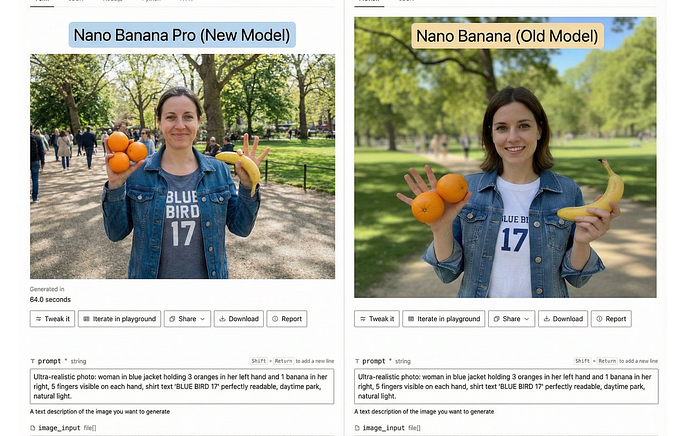
If you have been following the news, you have probably heard about the recent release of Gemini 3, followed just a few days later by the release of Nano Banana Pro. While the former brings many promising advancements, the latter is a true game-changer in every sense of the word.
The Limitations of the Past
The previous version of Nano Banana was already capable of editing existing images with amazing precision. Very few, if any, other models (e.g. seedream 4) could come close to its capabilities. However, even though the technology was impressive, it had one major caveat: it lacked a fundamental understanding of world knowledge and the basic concepts of physics that humans possess.
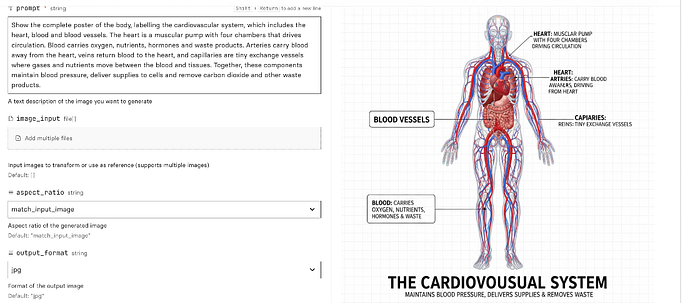
For example, if you asked the old model to create an image of the vascular system, the result might look convincing at a glance, but it was almost never 100% correct. To be precise, it wouldn't pass the scrutiny of any expert in the field. Frankly, it often struggled to even spell words like "cardiovascular" correctly.
Understanding the Physical World
The new model is different. Its results are nearly as precise as the text output of Gemini 3. This means it integrates a core understanding of human anatomy, knowing exactly which vessels exist and where they are located in the body. It is as if someone took the output from the old model and manually corrected all the errors.
Here is one of many impressive results from Nano Banana Pro for that same challenging prompt (draw the cardiovascular system).
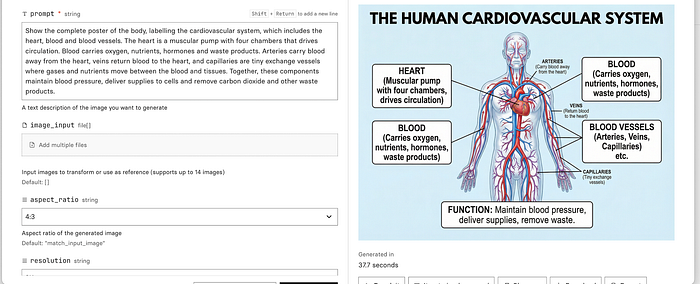
Unlike the previous Nano Banana, which was a standard diffusion model that relied on statistical guesses to mimic what an image should look like, Nano Banana Pro actually understands the subject matter. It moves beyond simple pattern matching and probability to apply a "world knowledge" logic, meaning it constructs the image based on physical laws and facts rather than just blindly predicting where pixels might go based on training data.
Handling Real-World Physics
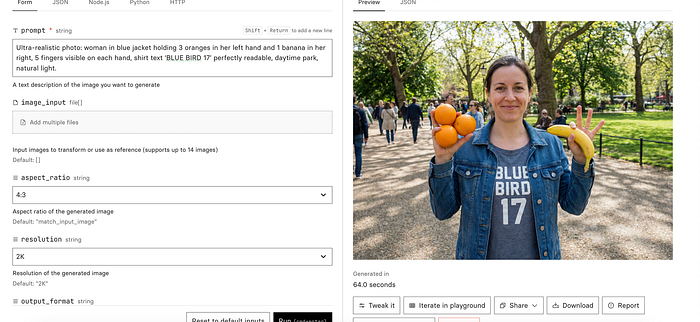
Let's look at another example involving real-world physics. Here is the prompt used:
Prompt: Ultra-realistic photo: woman in blue jacket holding 3 oranges in her left hand and 1 banana in her right, 5 fingers visible on each hand, shirt text 'BLUE BIRD 17' perfectly readable, daytime park, natural light.
With the standard Nano Banana, you might see the girl holding two oranges, but due to the model's poor grasp of gravity, they would likely look as if they were floating or falling rather than being securely held.
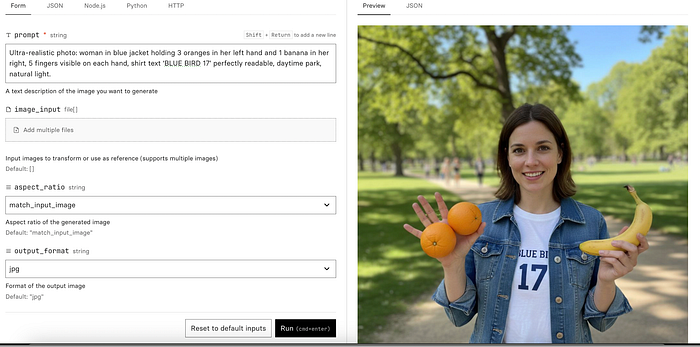
By the way, the feature image for this blog post was created using Nano Bana Pro in approx. 15 seconds.
Honestly, I lacked the imagination to visualize how holding three oranges in one hand would look realistically. Nano Banana Pro, however, shows that it is definitely possible.
Where Can You Try It?
The release is just a couple of days old and is not as publicly available as the "old" model yet. However, there are ways to try it out (and feel free to compare the results yourself).
Nano Banana Pro is currently available only via paid subscription in AI Studio or on replicate.com and probably a few other providers (feel free to check yourself).
The future is brilliant (and scary)
While these scenarios might seem simplistic at a glance, the ability to generate images that adhere to actual world knowledge and physical laws is a significant leap forward. The lack of precision has historically been a limiting factor for using AI in fields like science and education, just as the lack of reliable text generation initially limited its use in commerce.
Now, we are looking at practical applications we couldn't trust AI with before. For example, medical textbooks can be populated with anatomically correct diagrams generated in seconds, rather than requiring expensive medical illustrators.
Physics teachers can visualize complex concepts — like fluid dynamics or gravitational pulls — knowing the AI will represent the reaction correctly rather than just making it "look cool." Even architects could potentially use this to visualize structural loads or material stress in a realistic environment without needing hours of rendering time.
This is great, but we should also discuss the economic impact and risks involved with this new super weapon.
There are, of course, many more possibilities we have likely not yet imagined. However, I also fear this progress will come with the price tag of significant job losses like
- Stock Photographers: The market for generic stock imagery (e.g., "business people shaking hands" or "fruit in a bowl") could collapse. If an AI can generate these scenes with perfect lighting and physics, there is little reason to pay for a studio session.
- Product Illustrators: Companies often hire artists to create realistic mockups of packaging or prototypes. Since Nano Banana Pro understands how light wraps around objects and how materials behave, these roles are at high risk of automation.
- Graphic Designers: Much of the entry-level work involves sourcing assets and creating simple compositions. When a prompt can deliver a finished, high-fidelity asset that doesn't need fixing, the need for junior staff to handle these tasks diminishes.
Beyond the economic impact, the elimination of visual glitches — such as floating objects or incorrect lighting — makes fraud significantly harder to detect. As the traditional "tells" of AI imagery disappear, we can no longer rely on visual inspection alone to spot fakes. This reality underscores the urgent need for strict AI governance and heightened public awareness to ensure we have the tools and frameworks to verify authenticity before misuse becomes a standard.