But in the course of time, I have concluded that most traders spend years without ever understanding how this market works.
I'm no genius myself, but I have spent a ton of time actively studying this market and I can candidly say I know what I'm talking about.
One thing I've noticed is that newbies rarely get the right advice on how to get started trading futures.
I spend quite a considerable amount of time on various crypto focused online forums and since the onset of the bull market that saw the cryptocurrency market soaring throughout 2021, I have come across so many questions about crypto futures and how they work.
If you've stumbled upon such discussions, either on Twitter or Reddit, you'd agree that there's quite a pessimistic view about crypto futures.
Most responses I've seen are always gravitate along the lines of: trading crypto futures is basically gambling and it's something you absolutely should not get involved with under any circumstances.
Quite a bad take, in my view, given that futures trading actually has a lot of potential that can be unlocked by anyone who's willing to put in the work to learn how the market works.
In my opinion, futures trading is the fastest way to make money in crypto. But I'm also alive to the fact that it's also the fastest way to lose money.
So, as a general rule, you should only trade with money you won't fret losing.
Even so, the plan is not to throw money to a furnace and that's where education comes in.
By learning trading strategies, you not only ensure you're making educated trading decisions but also avoid the emotional strain that affects most traders.
In this guide, I'd like us to unpack some of the most common questions about futures trading and how to execute your first trade on Binance, which is my favorite exchange for everything crypto.
The Basics
The very first thing you need to become a successful futures trader is a reputable crypto exchange.
Like I said, Binance Futures has been my go to exchange for derivatives trading.
There are several reasons that make Binance stand out especially as a starting point for beginners.
Some of the advantages that Binance offers include:
- There are more than 100 cryptocurrency trading pairs on Binance Futures. So it's likely that your favorite coin is listed.
- Binance charges low trading fees.
- Access to leverage and high liquidity to perform trades.
- The platform has implemented multiple security features and there is even a $300 million Insurance Fund to ensure that users are protected 24/7.
Now that we know the advantages of trading on Binance Futures, let's go through the steps in setting up your Binance account.
I'd also like to point out that setting your account this way makes you eligible to claim a special welcome bonus of up to $100.
On top of that, you also get a 10% lifetime discount on trading fees when you sign up with this Binance referral code "28082527".
Please note you must use the provided referral code to qualify for the sign-up bonus.
Alternatively, you can sign up for a Binance account via the link provided below. The link is already preloaded with the referral code.
The steps outlined below will get you started quickly and seamlessly on Binance.
- Click the link above to open the Binance sign up page and then enter your email or phone number. Then type a strong password.
- Verify your account. This is a simple KYC verification process. KYC refers to a process that crypto exchanges (and even banks) use to gather identifying data and contact information from clients for the purpose of preventing fraud, money laundering, and other illicit activities. You can either use your Driving License, Government-issued ID or a Passport for the KYC process.
- Enable Two Factor Authentication (either Google Authenticator or SMS Authentication). Binance actually requires you to have 2FA enabled before you can buy crypto on the platform. Without the 2FA code, you cannot complete a transaction. So, ensure you enable it. You can follow this handy guide on setting up two factor authentication.
- Funding your account. If you already hold crypto in another wallet, you can deposit them into your Binance Wallet. Read this guide on how to deposit to your Binance account. Alternatively, you can buy crypto directly using your credit/debit card on the Binance website. This guide will take you through that process. Another way of buying crypto is P2P and it's also the easiest. This allows you to buy crypto from other Binance users without fees. Also before we jump to the next step, I think it is worth mentioning that it's best to buy USD stablecoins (BUSD or USDT) for futures trading purposes but also keep in mind that Binance allows you to trade futures using actual cryptocurrencies as the base asset. These are known as Coin-Margined futures. Crypto futures that use USD stablecoins as the settlement currency are known as USD-margined Futures. I have actually published an article on this topic and you can check it out below.
5. Finally, you need to transfer the funds from your spot wallet to the futures wallet. Open the spot wallet and click Transfer button, then choose the stablecoin coin (BUSD or USDT) that you've just bought and initiate the transfer. With the funds in your futures wallet, you're now set to start day trading.
So, what are crypto futures?
Futures trading, as the name suggests, is traditionally defined as a market where traders buy or sell an asset for delivery on a future date at a specified price.
This concept has evolved over time. In the cryptocurrency ecosystem, the futures market is a place where you can place bets on the direction you think prices of digital assets will move.
Binance offers both perpetual futures contracts and the traditional derivatives that lock in future delivery of a contract at a price set today.
For the purpose of this guide, we will explore the perpetual contracts that have no expiry date.
Though relatively new, perpetual futures allow traders to bet on any direction the market goes.
This, on the other hand, increases the risk of liquidation or what is traditionally known as a margin call.
This simply means that you may lose money if prices move against your trade.
This now introduces the concept of longing and shorting, which is only possible with futures trading.
Being long means you anticipate that an asset, say Bitcoin, will increase in value. On the other hand, being short means you anticipate a drop in the price of the asset.
Being Long on BTC

Being Short on BTC

Due to the volatile nature of cryptocurrencies, you'll soon discover that shorting is an integral feature to have as it allows you to profit off price declines.
Entering a short position can also be an excellent way to manage risk and to hedge existing assets in your spot account during bear markets.
How to make money trading crypto futures
Trading at any level is very emotional.
People tend to get greedy when the market is rising which results in FOMO (Fear of missing out). Also, people often sell their coins due to irrational fear of seeing red candles.
While day trading can make a nice side hustle, you have to study the associated emotional component of the human decision making process which is paramount to understanding how the market works.
Even technical analysis indicators rely heavily on human psychology to get reliable trading signals.
From my own experience, once I started understanding how psychology affects the market, I began to love the thrill of day trading.
In short, to become a consistent trader, you should aim to understand how emotions influence the market.
But before we dive into market analysis, let's go through some of the most common components that you'll be looking at every time you log in to your Binance Futures account.
How to Use Binance Futures Trading Interface
Professional trading interfaces can freak you out as a first time user, but if you start by focusing on the most important areas, everything else evens out quickly.
Binance has a professional, yet a user friendly trading interface combining every important feature that you need to become a winning trader.
When you open your futures account, this is what you'll see:
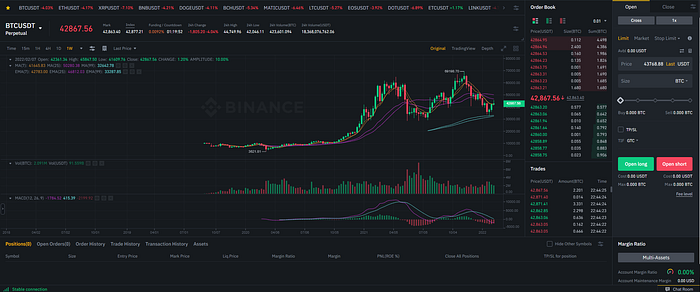
Binance also has a desktop client which is exactly the same as Binance web interface.
Download the Binance Desktop client here for free.
You can also monitor your trades with the Binance mobile app which is available for both Android and iOS. Download the iOS app here and Android app here.
Understanding the data on the chart
When you open a Bitcoin chart or any other token's trading chart, what you see is a trade history or market structure.
Trade history can be partitioned into groups. And each group is used to generate a candlestick.
A candlestick is made up of the open high, low and close price data. These values are also known as OHLC and are used to build each candlestick.
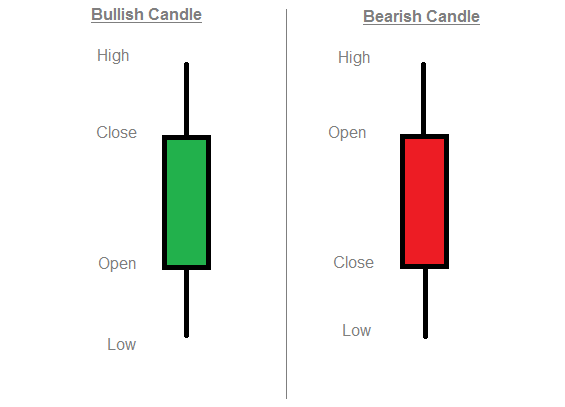
The intervals or periods that determine the size of each candle are arbitrary. You could choose any timeframe, e.g. 4hr or 1 day.
Candlesticks take an arbitrary number of trades in any given period and transform this data into a single candlestick with only four values (OHLC). We lose all the data and information regarding the number and size of trades that occurred in the period.
This is where volume comes in.
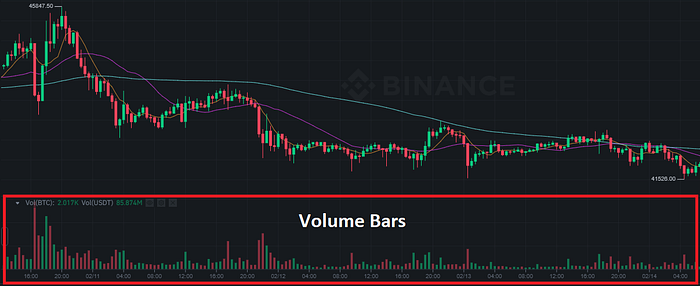
You'll mostly see a volume overlay by default in most candlestick charts.
Whereas price and time values are used to generate candlesticks, the trade size is used to generate volume bars that are usually displayed at the bottom of the chart.
Volume represents the total amount of the asset that was traded in each period.
In summary, it's important to realize that candlesticks give us a visualization of the trade history.
But if you are looking at candlesticks without the volume, a good bit of information is lost.
Adding volume provides a clearer picture of the trade history during each period.
Token Information

As you can see, this section is loaded with a lot of data, but as a beginner what you should keep an eye on is contract-related information — highlighted in red.
The BTCUSDT trading pair is displayed by default on Binance Futures.
You may switch to other trading pairs by clicking on the current contract's name. After which, a dropdown menu will appear to show all listed trading pairs.
Another important information here is the Last price and Mark price of the selected trading pair.
Last Price refers to the latest transaction price the contract was traded at. In other words, the last trade in the trading history defines the Last Price. It's used for calculating your realized PnL (Profit and Loss).
On the other hand, Mark Price is calculated using a combination of funding data and a basket of price data from multiple spot exchanges. Your liquidation prices and unrealized PnL are calculated based on the Mark Price.
How to Place an Order
Before placing your order, there are just two more buttons that you need to acquaint yourself with.
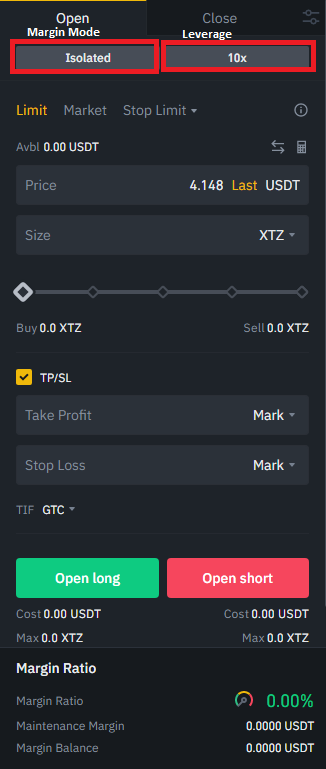
The first button allows you to choose the margin mode. Binance allows you to trade either on isolated margin mode or cross margin mode.
But for the purpose of this guide, go ahead and select the isolated margin mode.
When you open a position in isolated Margin, you only risk the funds allocated to that individual position.
In other words, the allocated margin balance for each position can be individually adjusted.
What makes this setting even more beginner friendly is that if a trade backfires, only the amount that you had allocated to that trade gets liquidated. The remaining margin balance is left untouched.
The other button allows you to set leverage.
As earlier mentioned, the most enticing aspect about perpetual futures is leverage.
Because of the available leverage, futures trading is extremely capital-efficient.
For example, to buy 1 BTC on the spot market, you'd need thousands of dollars — $44,000 at the time of writing — depending on the current market prices.
With a futures contract, you can open a BTC futures position at a fraction of the cost. This is only possible if leverage is used.
The more leverage you have, the less money you need to put into a position. In contrast, leverage is not available in spot trading.
Assume you only have USDT 5,000 in your spot wallet. In this instance, you could only afford USDT 5,000 in Bitcoin.
The best thing about leverage is that it essentially multiplies profits if a trade goes in your favor.
Leverage is also the root cause of liquidations which are very common during periods of extreme price volatility.
How Leverage Works
When you click the leverage button, a leverage meter will pop up. I have been using Binance Futures for quite some time and I'm allowed to access the highest possible leverage.
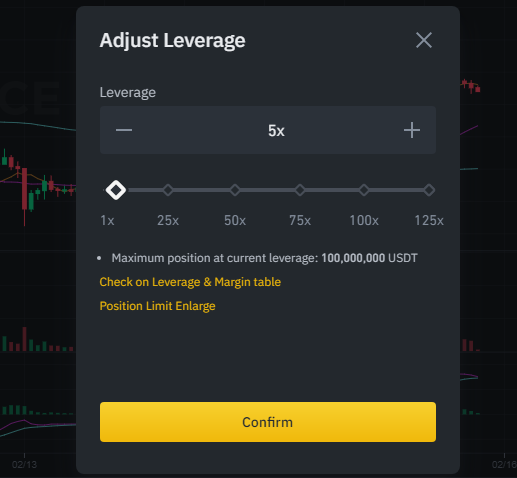
Right now, the leverage you can access as a new user might be restricted. But this is actually a good thing and it's meant to reduce your chances of making costly mistakes.
As a newbie, I'd suggest going with 5x leverage.
So, if you have $100 and 5x leverage, Binance will provide you additional $400 for your trade.
When you close that trade, Binance will take its $400 back and some commissions. And you get what's left.
In the worst case scenario, you will exit the trade at a loss or get liquidated.
This happens when prices move against you especially during volatile markets.
The Basics of Futures Trading
For any trader to turn a nice dollar in crypto, they have to first understand how human psychology affects the market.
As you will soon discover, every technical analysis tool generates signals based on the psychology of the market at any given time.
In addition, when you get used to scanning and interpreting trading charts, you will start noticing even a much deeper relationship between Technical Analysis and price action.
This, therefore, makes human psychology the hallmark of the strategies that we're about to learn.
Binance provides a range of tools that you can use to develop strategies but I think it's better to use a charting platform like TradingView for technical analysis.
The advantage of charting on TradingView is that you can do more with the available tools and it's free.
Support and Resistance
Among all the aspects of technical analysis, perhaps the most important and actionable concepts are support and resistance.
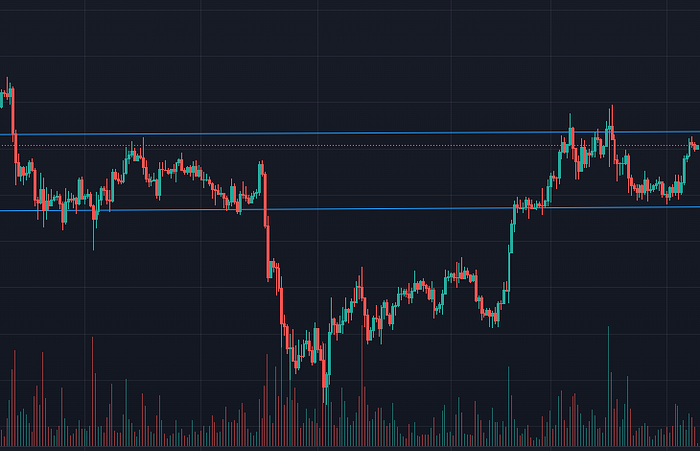
These are simply zones that are plotted on trading charts to map out key psychological levels or the areas where traders have shown interest to buy or sell a commodity.
These levels actually happen across multiple timeframes. But the higher the timeframe, the more relevant the levels become.
To become a profitable trader, you have to learn how to identify support and resistance as they come in handy in giving clues about trade reversals, bounces or breakouts.
Finding support and resistance maybe daunting at first. The easiest way to learn is by practicing regularly.
After opening a chart, start by selecting the 4 hour timeframe. Then draw a line touching at least two areas that have seen a significant turnaround in prices.
Something else to note is that support and resistance levels are only good if the market respects them.
Drawing a line above or below a past event doesn't mean anything.
As earlier mentioned, Technical Analysis is purely psychological. So, there has to be enough players in the market who also identify the level as significant in order for the level to have an effect.
Additionally, levels should be tested at least twice before you can call them support or resistance.
Reversal and Continuation Patterns
As you will soon discover, all traders attach huge significance to different types of patterns that appear on trading charts.
These are the so-called chart patterns and while they are easy to spot, their efficacy in trading cannot be understated.
Patterns appear organically on every timeframe but again, it's advisable to look for them on higher time frames so as to get more solid trends.
Reversal patterns, as the name suggests, provide clues on price turning points while continuation patterns predict where price is likely to continue its course.
Learning and recognizing patterns on price charts can help you make sense of wild crypto price fluctuations. Here are common patterns to get you started.
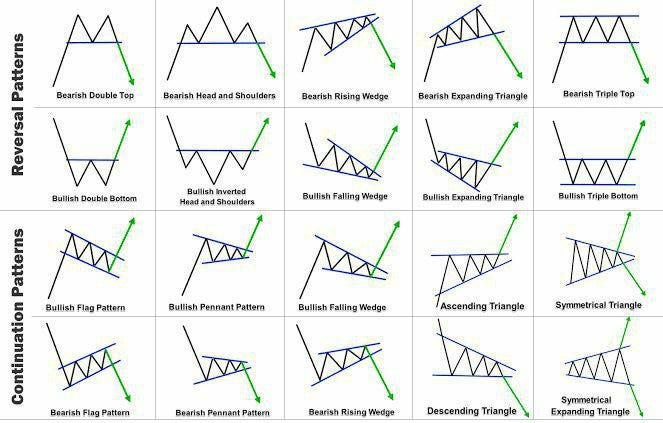
As you can see, the patterns come in different shapes but I would like to point out that actual patterns that you see in your trading chart won't come in perfect shapes.
So, don't get too worried that your patterns aren't lining up perfectly with the shapes shown in the image above.
Indicators
Everyday, new types of technical analysis indicators are introduced in the market. The goal that the creators of these indicators have is one. To try to beat the market.
This simply means indicators play a huge role in determining the winners and there is every reason why you should start using them.
The good news is that the most popular and effective indicators are also the easiest to use.
Among the numerous list of indicators, the basic ones that you should learn are Simple Moving Averages (SMA), Exponential Moving Average (EMA), Relative Strength Index (RSI), Bollinger Bands (BB), Moving Average Convergence Divergence (MACD) and Volume.
Learn more about these indicators here.
Before we dive into learning how to develop trading strategies with indicators, please keep in mind that indicators aren't the silver bullet in trading.
These tools will sometimes give you false signals especially when markets don't present a clear trend.
Price action is king
In its very essence, Price Action Trading is about identifying trading opportunities based on price movements without relying on indicators.
That's why seasoned traders put a lot of emphasis on candles and volume.
But in order to know what the data on the chart is telling you, you need to learn how to interpret prices.
This is where prices prove useful because they simply show all the interactions that are always going on between the buyers and sellers.
Prices not only shape the market but also define the trend direction.
The easiest way to learn how to interpret prices is checking volume.
Volume simply confirms a trend.
Volume at a glance
Volume indicates a buy and sell.
So, it not only matters how much volume but also at what price are people willing to pay. If everyone is buying at the market rate, that will only push the price higher.
Similarly, if everyone is selling at the market rate it will push the price lower. This is a key area of confusion that takes time to understand.
Essentially, 1 volume equals 1 sell and 1 buy. These are always equal, but if no one wants to sell at 100 dollars then the price has to move up and vice versa.
Moving on, strong or increasing volume shows increased interest. In other words, this type of price action interests many traders.
If there is an uptrend with strong volume, that shows more certainty & reliability in the trend.
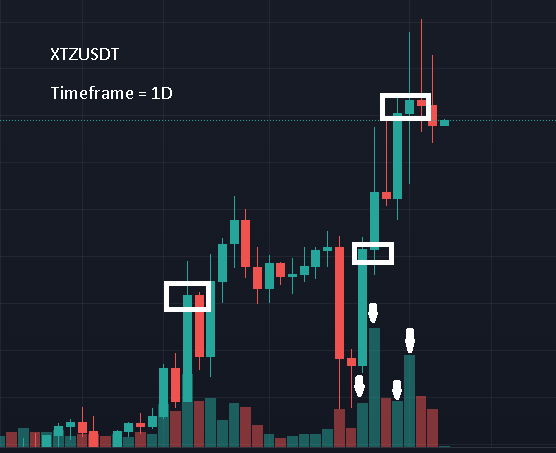
In the above example, volume shows the majority of the market is bullish and enthusiastic. It also adds validity to the breakout.
That is, a large number of traders believed this was a monumental turning point, and likely to believe in further upside.
The move further adds liquidity for larger players to join in, and generally price action is easier to trade.
On the flipside, low volume breakouts signal diminishing confidence. Clearly, not many traders are interested at that point.
In this case, price action will likely be choppy and more likely to fakeout.
Lastly, high volume dumps at the end of strong trends can also be a good sign of a reversal, or at least a good sign of caution.
The reverse is also true. This means high volume pumps at the peaks of super extended moves can also mark the top as well.
Such moves signal imminent liquidations, lots of overenthusiasm, and lots of positions taken at overextended prices leaving a good chance that many traders will get trapped or stopped out suddenly.
The Golden Rules
My experience as a crypto trader has taught me that you can't really beat the market without adopting rules in your strategy.
Even the most seasoned traders have a list of rules that they follow. Some of the rules that you will read here were shared on Twitter by @Nebraskangooner who's one of the most seasoned crypto traders that I look up to. You should actually follow him for some great tips on crypto trading.
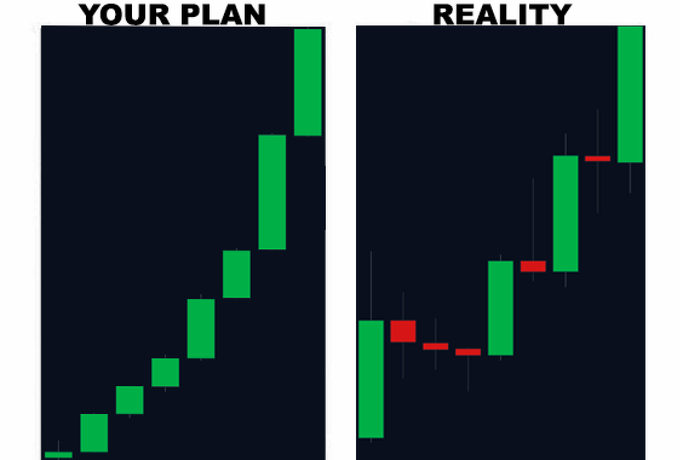
As a first rule, the market doesn't move up or down in a straight line. A lot of times, price action is made of peaks and troughs. So, when you confirm a trend, always give it time to play out.
Another important thing to keep in mind is leverage. As a newbie, never trade with high leverage. Anything above x5 leverage is too high for a beginner. By trading with high leverage, you only increase the probability of liquidation.
Here's a comprehensive list of rules that every trader should adopt.
- Never enter a trade right after opening the chart. Anyone who does this is simply reacting to fear of missing out. Moreover, it's highly unlikely that you'll open the chart at exactly the top or bottom for a perfect entry.
- Zoom out (from low time frame to high time frame e.g. 30 min to 4 hours) and map out key levels on higher time frames before entering trades on lower time frames.
- Plan out what time frame you want to trade on (e.g. 4 hours or 1 day).
- Look at price action then use your indicators to help confirm your directional bias. Indicators are supporting criteria.
- Find counter arguments to your trade. Could you be wrong. Any signs opposing your directional bias?
- Decide what would invalidate your trade idea. This is where you would absolutely close your position or place your stop loss. We must cut our losers somewhere.
- Calculate how much you are willing to risk on this trade. Do not start by calculating how much profit you can make.
- If you do not feel comfortable with how much you are risking then reduce your position size. It's that simple.
- Plan targets using risk:reward ratio.
- Revisit step 3. Do not hold your trade longer than the time frame you're trading. This will often get you stopped out.
- Map out your trade again. Am I shorting resistance? Am I longing support? If yes, proceed
- Be patient and wait for your entry criteria to be met. Don't enter a trade early. This gives u a less favorable risk reward ratio.
- Enter your trade according to your predetermined plan.
- Set your stop loss just past invalidation. NO EXCEPTIONS.
- Don't panic if your trade goes against you a little. This is normal. Most trades do not go immediately in profit and stay in profit the whole time. If you are panicking then you're over exposed!
- Set a take profit.
- Put the chart away.
- Set alerts so you know when key levels are met.
- Steps 17 & 18 keep you from over managing your trade.
- Keeping time frame in mind, it is okay to check your trade after some time has passed but not immediately after entering.
- Remember your counter arguments to your trade. What are the alternate scenarios that can happen to cause your trade to fail?
- At this point you may manage your trade if you see something concerning. Whether you take partial profit/manage stop loss, etc. This is done on the fly.
- If you lost. Review it. Learn from it.
- Don't revenge trade. You don't "have to make the profits all back on the next trade." You don't need to immediately enter another trade. If you're emotionally upset about the loss then you were over exposed. Again, don't revenge trade. Instead, try not to overexpose yourself in the next trade.
- Review your trade. If you win, great, move on. It's over. Don't celebrate your winners too long. Don't enter another trade until you've come down from the high of a big winner. This is when you are susceptible to giving large profits back.
Even in professional football, teams, on average, concede more just after scoring.
Final Thoughts
To be honest, I love the thrill that comes with trading because I see myself as a risk taker. If you have a high risk tolerance, futures trading may just be the right fit for you.
That said, you need to invest a lot of time to learn technical analysis and also develop and test trading strategies.
The best way to get started in crypto futures trading is to start with a small amount of money.
This is not only a nice way to manage risk but you will also get a gist of how everything works.
Above all, ensure you're not overleveraged and always remember to place stop-losses in every trade.
Join Coinmonks Telegram Channel and Youtube Channel learn about crypto trading and investing
Also, Read
- Bookmap Review | 5 Best Crypto Exchanges in the USA
- The Best Crypto Hardware wallet | Bitbns Review
- 10 Best Crypto Exchange in Singapore | Buy AXS
- Red Dog Casino Review | Swyftx Review | CoinGate Review
- Best Crypto to Invest in India | WazirX P2P | Hi Dollar Review
- Best Crypto Trading bots in Canada | KuCoin Review
- Crypto Trading Signals for Huobi | HitBTC Review
- How to trade Futures on FTX Exchange | OKEx vs Binance
- OKEx vs KuCoin | Celsius Alternatives | How to Buy VeChain