A team at the University of Michigan has built a tiny computing device that controls a balancing propeller using about seven millionths of a watt. For comparison, the LED bulb in your kitchen burns through about ten watts. The Michigan device runs the control task on roughly a millionth of that power.
Embedded AI: Launch Updates and Early Access Sign up to receive launch updates for Embedded AI: Intelligence at the Edge, published by No Starch Press. You will be…
That is not a typo. It is the finding of a paper published in ACS Nano in March 2026, and it matters because power is the wall that edge AI keeps running into (or falling off?).
Why Power Is the Whole Game
Most of the interesting AI you read about lives in a data centre. It has a wall socket, a cooling system, and an electricity bill measured in millions. Edge AI is what happens when you try to put that intelligence into a hearing aid, a pacemaker, a drone, a soil sensor, or a pair of smart glasses. You are running off a small battery, or whatever energy you can scavenge from sunlight or vibration.
In that world, every microwatt counts, and there is one component that has been quietly eating the budget for decades: the analog-to-digital converter (ADC). Sensors produce continuous signals, but computers think in ones and zeros. Something has to translate between the two, and that translator is the ADC. It is usually the single biggest line item in a battery-powered device's power budget.
The Michigan team's trick is to skip the translator entirely.
What They Built
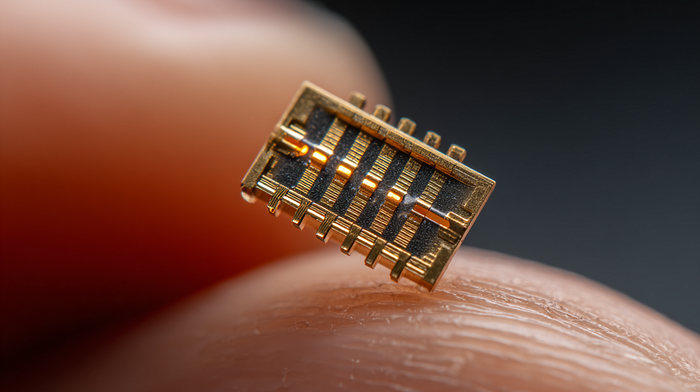
The device is called a memristor. Think of it as a tiny resistor that remembers. Most resistors have one fixed value. This one can be tuned to thousands of different values, and it holds whatever value you set it to, even with the power off, for hours.
The clever bit is what the researchers built out of these memristors. They wired up an array of them and used the array itself as the computer. The sensor signal flows in one side as a continuous voltage, the memristors do the maths, and the answer comes out the other side as a continuous voltage that drives a motor. There is no translation step, and no software loop.
In their demo, that algorithm balanced a propeller-driven lever at exactly 90 degrees. The whole control loop, from sensor to motor command, ran on seven microwatts.
Where This Could Show Up
The temptation with results like this is to leap to the most dramatic application. I want to resist that and talk about the boring ones first, because the boring ones are usually where new technology appears first.
Hearing aids and cochlear implants. Modern hearing aids already do real-time noise cancellation and speech enhancement, and battery life is the constant complaint. A device that runs the signal processing at microwatts rather than milliwatts could mean batteries that last a week instead of a day, or smaller batteries in a smaller device.
Implantable medical devices. Pacemakers, neural stimulators, and continuous glucose monitors all live or die by their power budget. Every replacement surgery carries risk and cost. Pushing the inference work down by three orders of magnitude changes the conversation about how long a device can stay in the body before it needs new batteries.
Always-on environmental sensors. Soil moisture, air quality, structural strain on a bridge, vibration on a wind turbine bearing. These are sensors that need to listen all the time but only act occasionally. Today they spend most of their power budget on the listening, not the acting. A microwatt-class control chip changes which of these products are buildable on a small solar cell or a vibration harvester.
Drones and small robots. Not the big delivery drones. The small ones, the ones the size of a sparrow that have to stay aloft on a battery the size of a coin. Today they cannot afford to do much onboard intelligence, so they either fly dumb or rely on a connection to a bigger computer. A chip that runs flight stabilisation on microwatts means the small machines can think for themselves.
Silicon Reflexes?
There is a less optimistic angle that the press releases tend to skip. The Bi2Se3 device is not a drop-in replacement for the chips in your laptop, your phone, or any AI product you have ever used. It does one thing well: tight sensorimotor control loops, the kind of reflexive responses that animals do without thinking. It is not going to run ChatGPT, or recognise faces. It is not even going to do most of what a current smartwatch does.
What it can do is the layer underneath all of that. The reflexes. The balance, the stabilisation, the gain control, and sensor preprocessing. The work that biological nervous systems do in the spinal cord and brainstem rather than in the cortex.
This is the part of the story that links to the framework I have been developing around how intelligence is layered in biology. The cortex gets the attention because it does language and reasoning, but most of what keeps a living thing alive happens in much older, much faster, much cheaper circuits underneath. The Michigan chip is good news for that layer specifically.
What Has to Happen Next
A research demo is not a product. Three things have to happen before this device shows up in something you can buy.
The fabrication process has to scale. The Michigan team used a deposition technique that is reasonably compatible with existing chip factories, but bismuth selenide is not a material that current factories make at high volume. Either the existing fabs adopt it, or a new generation of fabs grows up around it. Both paths are slow.
The software has to catch up. The current generation of AI development tools assumes you are programming a digital chip with precise, predictable behaviour. An analog device like this one drifts a little with temperature, ages a little over time, and varies a little from chip to chip. The tools to design with that kind of substrate barely exist. Someone has to build them.
The certification frameworks have to adapt. If you want to put this kind of chip into a medical device, an aircraft, or a car, you need to satisfy regulators who are used to deterministic digital silicon where the same input always produces the same output. An analog chip is not deterministic in that sense. The regulatory conversation around that is going to take years.
Watch This Space
The energy cost of putting useful intelligence into something small and battery-powered just dropped by a factor of a thousand for a specific class of problems. That class of problems happens to be exactly the one that matters most for medical implants, environmental sensors, and small autonomous machines.
My first book, Embedded AI, is published later this year by No Starch Press. It includes 25 hands-on hardware projects deploying machine learning on microcontrollers. Sign up for launch updates and bonus material! To support my writing here, please show your appreciation by following me, or subscribe to get an email whenever I publish a new article.
The Godfather of AI Claims a Multi-modal AI had a Subjective Experience The Prism, the Pointing Arm, and What Hinton Got Right (and Wrong).