We've been hearing the same mantra for years now: AI will change everything. And yes, some things will change. But what hasn't changed, and this is what's really interesting, is the old-school political economy that sustains AI: the way its infrastructure is being built, how it's being paid for, and the perverse incentives to make it all happen.
Because when an industry needs obscene amounts of electricity and capital to grow, what we see is not the future, but the same old old story of financial engineering, environmental factors and a geopolitical regulatory free-for-all.
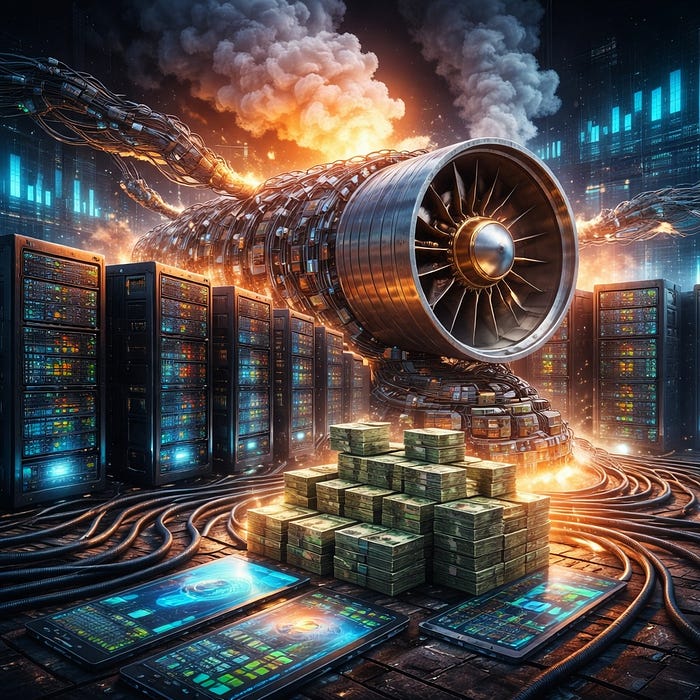
Let's start with the power source. The Financial Times reveals the shocking news that faced with delays of several years to connect to the grid, some data centers are adapting aircraft engines, as well as using diesel and gas generators. Yes, you read that right: the future is being created by burning huge amounts of fossil fuels. And, of course, with the excuse of urgency and competition, there is pressure to "relax" limits on the use of these generators. AI is being sold as innovation, but behind the scenes grids are being overloaded, local communities are paying the cost and our climate continues to worsen.
At the same time, and as usually happens when capex skyrockets, nobody wants to talk about debt. Big Tech and the leading players in the AI ecosystem are moving more than $120 billion of data financing off their balance sheets through special purpose vehicles funded by Wall Street and the private credit market. This is not an accounting technicality: it is a real-time bubble warning. When an industry needs to keep growing to justify its narrative and at the same time needs financial ratios to "look" healthy, it moves the problem elsewhere. And the risk does not disappear: it is redistributed where there is less transparency.
Then there is the geopolitics of control. While we in the West are still caught between lobbying and techno-optimism, China has just published draft rules to tighten oversight of artificial intelligence services designed to simulate human personalities and engage users in emotional interaction.
We can (and should) discuss the framework of freedoms and censorship of the Chinese model, but at least Beijing is acknowledging that these systems can create psychological dependence. In contrast, we're still treating this as some minor side issue that the market can magically self-regulate.
What's emerging is a classic portrait of infrastructure capitalism and get-rich-quick routes for some: rapid growth driven by enormous expectations, financed with increasingly less transparent mechanisms and sustained by energy solutions that clash head-on with a climate emergency that some claim "no longer exists". The investment frenzy in data centers and AI is spreading to India with multibillion-dollar promises, along with with concerns about water, energy, subsidies and jobs.
Meanwhile, Alphabet has bought data center energy specialist Intersect for $4.75 billion to secure electricity supply for its expansion into AI. The message is the same: AI is no longer an app, it is an industrial infrastructure hungry for electricity, land, water and financing. Let the Chinese worry about efficiency.
A few days ago I wrote about the Trump administration's decision cripple offshore wind in the United States under absurd "national security" excuses. In reality, few things better illustrate contemporary strategic stupidity: on the one hand, it's all about the narrative of technological supremacy and leadership in AI, while on the other, scalable sources of energy are sabotaged just when they are most needed. It's the same old incoherence, but magnified: we want data centers everywhere, but we don't want to plan for a bigger grid, renewables, or storage. We want to "win" the technological race, but without accepting the industrial discipline that this demands. We want innovation without assuming costs or limits.
What is worrying here is the logic driving investment. When the dominant discourse is "build it and we'll worry about the consequences later", the result is usually a combination of overcapacity, externalities and covert bailouts. At best, you end up with underutilized infrastructure and misallocated debt. At worst, with a strained energy system, with local communities footing the bill, and with an industry that, when it stops growing at the promised rate, will leave a trail of financial risk packaged in junk products.
In conclusion: AI has valuable uses and is here to stay. But if we really want to separate the wheat from the chaff, we have to ask tough questions: how much energy does this consume and where does it come from? What financial incentives sustain it and what are the risks? Are there rules in place to protect users and society when models are designed to maximize time of use and dependence? The irony is that if AI is going to change our world, we must build it on sustainable foundations. Financing it off-balance sheet and feeding it with jet turbines is not the future. It's little more than steampunk.
(En español, aquí)