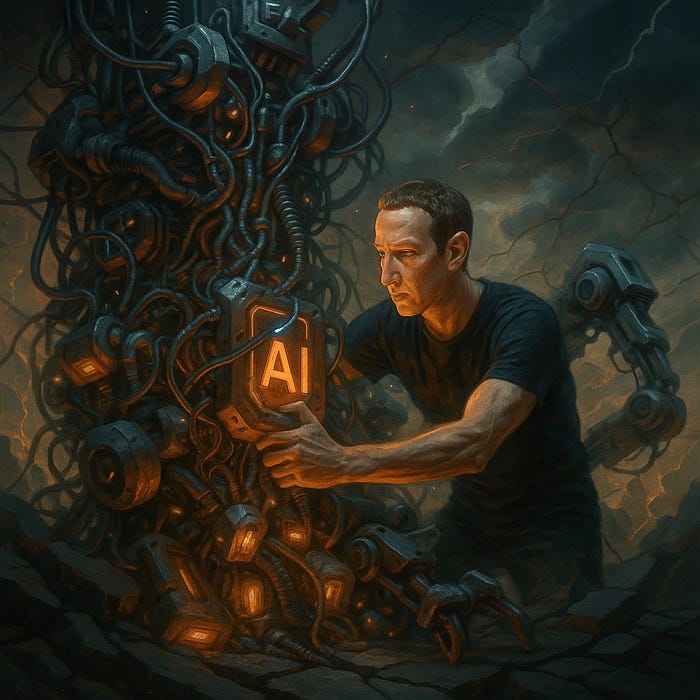
Mark Zuckerberg is clearly losing it. His latest move is Meta Superintelligence Labs, an AI division created by spending millions of dollars on top talent and acquisitions to create a dream team. Rather than vision, he seems to be showing desperation.
What exactly is he up to? In a nutshell: trying to rebuild Meta's AI strategy from the ruins of LlaMA4, its bogus open source model that failed to revolutionize the sector. Faced with yet another setback, Zuckerberg has once again decided that brute force is the answer: hire every recognizable name in the world of AI at any price, compete for talent with OpenAI, Perplexity, Anthropic and evryone else, steal their talent, and even try to buy out whole companies such as Safe Superintelligence and Perplexity. Does that sound like a serious, well-thought-out strategy? It is not.
The core of the new Meta Superintelligence Labs is made up of names with powerful credentials, but together they could generate more friction than synergy. Alexandr Wang, CEO of Scale AI (a company that does not develop models but is dedicated to data labeling), has been appointed Chief AI Officer. Surrounding him are more experienced veterans such as Nat Friedman (former CEO of GitHub) and Daniel Gross (former Apple employee and co-founder of the short-lived Safe Superintelligence), who are now part of an unclear hierarchy in an ecosystem where egos, ambition, and pressure are bound to clash. That Friedman proposed Wang for the position he himself turned down may sound conciliatory, but does not necessarily augur well for lasting harmony.
Added to this are dozens of hires straight from OpenAI, many of them under stratospheric compensation terms, which has crushed morale among Meta's internal teams. What corporate culture can flourish when some are paid ten times more than others and are treated like messianic saviors in an environment with a history of turnover, broken promises, and constant pressure?
Despite having promised to abandon its "move fast and break things," philosophy, in reality Meta is now out of control under a pumped-up, macho-man Zuckerberg. Meta is an environment where everything is improvised, where there is no long-term planning, and where immediate impact is prioritized, even if it leaves ruins in its wake. In such a context, forming a "superstar team" usually ends up as we have seen so many times before: with power struggles, early departures, and a monumental loss of money, focus and reputation.
Leaving aside the chaos and the waste of resources, what is truly disturbing is the question that hangs over all this: what is Zuckerberg's goal here?
It's a deeply disturbing prospect, but the most likely answer is that he wants to position himself as a leader in artificial general intelligence (AGI). We are not talking about a more efficient, more accurate or more useful model, but a system with the ability to reason, plan, learn autonomously and, potentially, surpass our human capabilities. A scenario that many consider inevitable, but few want to be led by someone with Zuckerberg's background.
Because if a psychopath like him manages to develop AGI before anyone else, rather than a scientific breakthrough, we would be facing a huge systemic failure, a patent and extremely dangerous abdication of responsibility. An AGI in the hands of a megalomaniac devoid of any ethical principles, obsessed with control, infinite growth and the algorithmic manipulation of human behavior is not a future: it is a dystopian nightmare.
Zuckerberg knows he is running out of time, and believes his only hope is to buy a short-cut to the future, the same way he previously did with the metaverse. We can only hope that his desperately laid plans come to nothing, otherwise, we're in big trouble.
(En español, aquí)