
Our captain beamed with excitement. "Tomorrow, we will sail the ship into an active volcano."
I leaned forward in my seat. He had my full attention.
"As you can imagine, this is not something we get to do very often in the maritime industry. We do not expect an eruption to occur."
I suddenly realized that Antarctic expeditions require a great deal of trust, and no shortage of luck. There hadn't been seismic activity here for five years, so everything should be fine. Right?
But despite our best laid plans, mother nature almost always wins.
Our destination was Deception Island — a submerged volcano in the South Shetland Islands, 65 nautical miles north of the Antarctic Peninsula, and the first stop for many southbound vessels in these waters. If Antarctica had a front door, the South Shetlands were the welcome mat.
We'd sailed two days from the southern tip of Argentina across the dreaded Drake Passage — one of the most dangerous stretches of water in the world — and after 48 hours of nature's wrath, we were thankful to reach land.

We approached the southeastern corner of the island at dusk and witnessed our first (and most incredible) Antarctic sunset. Several passengers were still sick from crossing the Drake Passage, but nearly everyone stepped out on deck to experience the moment. Many of the ship's crew and expedition guides were right behind us, as giddy as children. No one wanted to miss this.
A thin layer of snow highlighted the craters and ridges along the island's volcanic landscape (it usually appears as bare rock). The snowy peaks contrasted with the deep blue water of the Bransfield Strait which separated us from the Antarctic mainland.

In the west, the horizon was a fiery orange ribbon beneath a lavender mist and an ominous layer of storm clouds. The wind was calm, especially compared to what we'd experienced while crossing the Drake, and stray beams of sunshine appeared through gaps in the rock.
It was a setting right out of a Jules Verne novel; like someone blended the perfect cocktail of A Journey to the Center of Earth, Twenty Thousand Leagues Under the Sea, and The Mysterious Island, and deposited the results right in front of our ship.
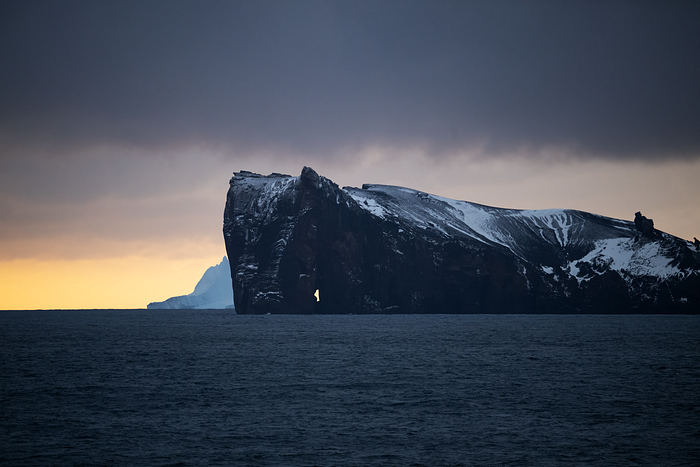
This otherworldly scene lasted just a few moments until the Antarctic weather, true to form, changed in an instant. The dark clouds descended to extinguish the sunset, and as we prepared to enter the island, we were blasted with snow and freezing rain.
Neptune's Bellows
When the American sealer Nathaniel Palmer explored these waters in 1820, he named the island "Deception" because it appeared as a normal island — not the flooded caldera of a volcano. This was but the first of the island's many secrets.
Our ship, like Palmer's, entered the caldera through the single entrance — a narrow channel in the southeast known to sailors as Neptune's Bellows. The channel is 230 meters (755 feet) wide, yet only half this distance is navigable. In the middle of this shallow passage, lurking eight feet beneath the surface, Raven's Rock awaits its next victim. In 1957, a Norwegian whaling vessel wrecked on this rock, and her remains can still be seen beneath the surface.
We squeezed through the Bellows by hugging the cliffs on our starboard side, and as darkness fell, we entered the mysterious waters of Deception Island.

Into the Caldera
Rising nearly 1,400 meters beneath our ship, the volcano extended from the sea floor and we sailed right into its center. Snowy peaks towered above dark shorelines, and steam rose from black beaches as volcanically-heated water filtered through the ash. The ruins of abandoned whaling and research stations dotted the landscape and had been evacuated or destroyed by volcanic eruptions.
Significant eruptions occurred here in 1967 and 1970, with ash-fall and floods destroying the nearby British and Chilean bases. The island experienced more seismic unrest in 1992, 1999, and in 2015. In 2020, Deception Island was designated as a "highly active" volcano.
We later learned that an emergency plan exists if the volcano erupts while a ship is in the caldera. The ship would immediately abandon everyone on shore and exit the island as quickly as possible, since an eruption could potentially collapse Neptune's Bellows and trap the ship inside.
As for the unlucky people who suddenly find themselves stranded on the island, they are expected to hike over the ridges (avoiding eruptions and rivers of volcanic mudflow along the way) until they reach the outer edge of the island where they will await rescue by the ship.
With this comforting bit of knowledge filed away, we dropped anchor in Telefon Bay and attempted our first full night's sleep since leaving Argentina.
I dreamed about raging rivers of lava.
Ashore
The next morning, we journeyed to shore in a Zodiac boat and landed on a steamy black beach. The weather was calm and we hiked up to a ridge that overlooked the site of the last eruptions. The craters of the volcanic landscape were highlighted by the snow, which helped illustrate that Deception Island was very much unlike any other place on the planet. There was no wildlife here, but the views in every direction were incredible.
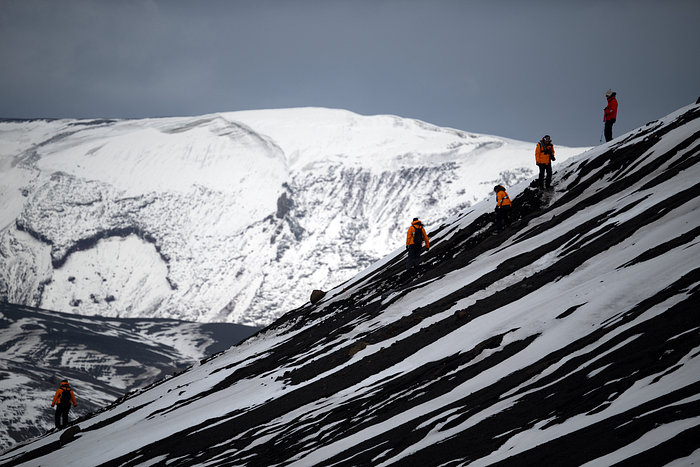
What struck me most, as with virtually every place I would visit in Antarctica, is the absolute silence. In the absence of wind, and when not crunching through slushy snow, rustling synthetic clothing, or breathing heavily after a steep hike, this place was completely silent. I could hear a pin drop across Telefon Bay.

We made our way to Whalers Bay and the ruins of a Norwegian whaling station that operated a century ago. Here stood massive rusty tanks, impromptu graves of some of the men who died here (the original cemetery was destroyed during the 1970 eruption), and whale bones — lots and lots of whale bones.
The station was established in 1912 to extract oil from whales which was then sold for lamp-burning, lubrication, and other purposes. As the whales were boiled, the oil from their bodies was stored in these huge tanks. Hundreds of people worked here during the station's peak years, and at that time, thousands of rotting whale carcasses would have littered the beach. The thoughts of what this beach looked (and smelled) like a century ago conjures a gruesome image — 5,000 whales were processed here in 1912 alone.

Deception Island was also home to the fur-sealing industry in the South Shetlands, and both the local seal and whale populations suffered massive declines. Some animals, including the Antarctic fur seal and the blue whale, were nearly hunted to extinction.
By 1931, the price of whale oil reached a low, and the whaling station on Deception Island was permanently closed. Whaling in Antarctica is now largely banned.

Next came the British, and in 1944, a research station (Base B) was built on this site and many of the original buildings were repurposed. Base B was evacuated and destroyed by a volcanic eruption in 1967. The British quickly returned, but another eruption in 1969 closed the site permanently.
It seemed that mother nature had finally won, and Whalers Bay has been uninhabited by humans ever since.
I walked around the ruins of the site. It was all crumbling, decaying, and slowly being eaten away by nature. We were warned not to approach the buildings too closely, particularly in high winds. I could feel the gaze of the former occupants staring at me through the windows — a ghost town at the end of the world.
The location is now designated as a protected Historic Site under the Antarctic Treaty, and it stands as a grim reminder of the tragic impact that mankind has on the environment when left unchecked.

In the very location where wildlife was nearly decimated to extinction, we met the current occupants of Whalers Bay — a very vocal group of fur seals.
Thanks to conservation efforts, their numbers flourished and the species experienced a significant recovery. Today, the number of Antarctic fur seals in this region is estimated at between two and four million.
They will chase and bite humans if given the opportunity, so I suspect they're still holding a grudge.


Departure
That evening, our ship wedged through Neptune's Bellows into the relative safety of open water and we resumed our southern journey. Instead of spending the next few days casually exploring the scenic Gerlache Strait, a rumor spread around the ship that the captain and expedition team were considering a 330-mile blitz at near-top speed in a bid to cross the Antarctic Circle. Late-summer ice conditions and weather typically make such a trip impossible, but the crew was hopeful that we could make it. We did, and you can read about it here:
As Deception Island dramatically disappeared into the mist behind us, I remembered one of the last images I saw before leaving Whalers Bay: the remains of a grounded wooden boat, abandoned and left to rot on the beach decades ago.
Along with the rusted metal tanks, the crumbling huts, and the countless bits of machinery and scrap metal lining the beach, the old boat was a perfect example of the indelible scar left by mankind on an otherwise pristine and unique landscape.
Sitting on top of the boat, as if it was his personal throne, was a giant fur seal. He stood defiant and watched as yet another group of humans came, and left, his island.
It was a reminder to me that while mankind's creations will eventually decay and be reclaimed by the earth, mother nature will almost always win.

Thanks for reading! If you enjoyed the story and photos, take a look at the video from our trip to Deception Island below!