Note: Please ignore spelling mistakes or grammatical mistakes. That's not the intent. Focus on big ideas. Thanks
Let me tell you something about the last time I scrolled through my phone for 45 minutes before bed instead of picking up the book.
Nothing happened.
I learned that a celebrity I've never heard of wore a dress that people online had very strong opinions about, and I watched 3 videos of dogs failing to catch frisbees.
Was it entertaining? Sure.
Did it do anything for me? Absolutely not.
And yet I do it. You do it. We all do it.
My friend says we're like little digital moths, irresistibly drawn to the screens of our phones, iPads, macbooks, and TVs, burning ourselves up in the warm light.
Meanwhile, there's this thing called a BOOK.
It's been around for roughly 500 years in its printed form and for thousands of years before that in various shapes.
Depending on which one you pick up, it's the life's work of a brilliant human. Their best ideas, their arguments, their vivid stories, all of it compressed into something you can hold in one hand.
And most of us read maybe 3–4 a year.
So what's going on? Why are we collectively ignoring one of the most powerful tools ever invented for making us smarter, calmer, more empathetic, and, I would argue, more interesting at parties? Let's talk about it.
Brain workout
Here's something your gym bro knows that most people don't apply to their mental life.
If you want to get stronger, you have to actually stress the muscle. Pretty basic, right.
You have to make it work in ways that feel, at least initially, a little uncomfortable.
Reading a book is a workout for your brain.
And I don't mean that in the motivational poster sense. I mean it literally, in a physiological way.
When you read, your brain isn't just passively getting info the way it does when you're watching a video. It's actively constructing meaning.
You see a string of symbols on a page, and your brain has to decode them into sounds, then words, then sentences, then ideas, then pictures, then feelings, and so on. Every single paragraph you read is a small part of creation.
Think about what happens when you read a novel and a character walks into a room that's described in detail.
Your visual cortex actually activates. Your brain creates that room. It's yours. No production designer decided what the wallpaper looks like, you did. That's not a passive experience. Its an active activity That's your brain doing real work.
And like any workout, the results compound over time. People who read regularly have been shown to have slower cognitive decline as they age.
Their memories are sharper. Their ability to focus improves. The muscle gets stronger the more you use it.
Meanwhile, doomscrolling, passive video watching, and bouncing between browser tabs are the cognitive equivalent of sitting on the couch eating chips all day.
It's not that they're evil.
It's just that they don't build anything. You finish a 40-minute YouTube rabbit hole, and you don't get with anything except maybe a vague awareness that you were meant to do something else with your evening.
Books can fix your FOCUS problem
Okay, not just you.
We've trained ourselves, over years of algorithmic (based on what you like, dislike) content delivery, to have the attention span of a slightly bored goldfish.
So we've adapted. We've become expert skimmers, yes, that's right, an expert skimmer. We've learned to consume information in tiny, pre-digested chunks because that's what the algo rewards.
The problem is that real thinking, the kind that leads to real understanding, innovative ideas, and actual wisdom, needs attention (for a long time).
It requires sitting with something long enough to let it unfold at its own pace. It needs to take the moments when a book is making a long, complicated argument.
I truly believe books are the only medium left that fundamentally refuses to accommodate your impatience.
A great book will not speed up for you. It won't give you a push notification when it gets to the good part. You either show up and pay attention, or you miss it. That's it.
My Findings
And the beautiful thing, the paradox that takes a while to appreciate, is that the more you practice that kind of long-time intervals attention through reading, the better you get at it in every other area of your life.
Your conversations get better because you can actually listen.
Your work gets better because you can think through hard problems without needing a dopamine hit every 3–5 minutes. You get better at being a human being who is present in their own life.
That sounds dramatic. It is dramatic. It's also true. I am not here to prove to you. I am just sharing what happened to me.
I grew up in a tiny village, and all I can remember is that if the books weren't in my life, I would be doing the same things as the rest of the village. Farming is great, but with my scrawny body, it was the hardest.
You're living ONE life
Books let you live 100s
Here's something nobody tells you when they hand you a list of recommended books.
Reading fiction is not a guilty pleasure. I used to think it was.
It's not a lesser activity than reading non-fiction. It's not what you do when you want to relax instead of doing something productive.
Reading fiction is one of the most powerful empathy building tools.
When you read a novel, you spend hours inside someone else's head.
Not observing them from the outside, the way you do with a movie character, actually inside their skull, feeling what they truly feel, wanting what they want, seeing the world through the particular filter of their consciousness.
And the author has spent months or years crafting that experience to be as true, vivid, and honest as possible.
You want to understand what it feels like to grow up poor?
Read a book!
You want to know what goes through someone's mind in the last few minutes before battle?
Read a book!
You want to understand grief, or addiction, or the specific loneliness of being a stranger in a strange land?
Read a book!
There are books that will take you there more than any documentary, any podcast, or any empathy workshops.
This isn't just a nice philosophical point.
Research consistently shows that people who read literary fiction score higher on tests of empathy and theory of mind, the ability to understand what's going on in someone else's head.
They're better at reading social situations. They're more comfortable with moral complexity. They're less likely to see the world in rigid, cartoon categories of good/bad guys.
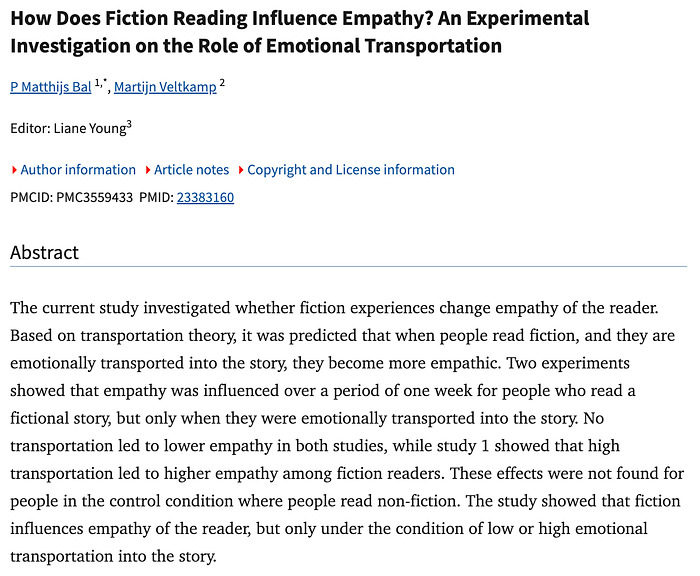
In a cultural moment that seems actively to reward the most reductive, binary, us-versus-them thinking possible, this is worth paying attention to.
Civilization talks
This is the thing that blows my mind a little when I think about it too hard.
Marcus Aurelius wrote his private journal, the book we now call Meditations, around 170 AD.
He was the most powerful man in the world, the emperor of Rome, and he was writing notes to himself about how to be a better person.
How to stay humble.
How to deal with difficult people.
How not to let power corrupt him.
How to face death without losing his mind.
And you can just pick that up.
You can sit with that man's actual thoughts, the real private voice of someone who lived 1,800 years ago, and you will find that his struggles are your struggles.
His anxieties, his hard-won insights, his life as the powerfula nd also the powerless man at the same time.
That's insane. That's really really insane. And we just treat it like it's a normal thing.
Books are how the best humans who ever lived pass their best ideas down through the centuries.
Every intellectual tradition in history, science, philosophy, religion, literature, political theory, exists and evolves primarily through the written word.
The entire project of human civilization is encoded in books.
I'm not saying you need to read Plato.
I'm saying that whatever you're interested in, running, cooking, climate science, jazz history, how to raise children without accidentally traumatizing them, there are books that represent the deepest, most developed thinking on that subject by people who have spent their lives obsessing about it.
And you get to access all of that for roughly $10–30 bucks and a couple of weeks of your evenings.
Remember stuff
Here's one more practical point before I wrap up my thoughts.
You know that thing where you listen to a really interesting podcast on the way to work, nod along the whole time (yes, yes, yes, and so on), feel really stimulated and engaged, and then 2–3 days later you can't remember a single specific thing from it?
Not the name of the guest, not the main argument, not even the topic, really.
That's not a failing. That's the medium, you consumed.
Audio is ephemeral by nature. It moves at the pace the speaker sets, whether or not that's the pace at which your brain is ready to absorb it. The information washes over you and then it's gone.
Reading is different.
When you read something that clicks, when an idea pops up, you can stop.
You can sit with it.
You can re-read the paragraph.
You can put the book down and stare at the wall and think about it for a minute.
You can dog-ear the page, underline the sentence, write a note in the margin. Read the article to improve your retention.
People who read seriously and take notes retain information at dramatically higher rates.
They build actual knowledge, not a vague sense of having been exposed to just ideas, but real, usable, transferable understanding that shows up in how they think and what they can do.
In a world where everyone has access to the same information and the same content, the person who actually knows things, who has absorbed and understood and can apply real knowledge, has a real edge.
That person might as well be you.
So what do you actually do?
Alright. You're convinced, or at least you're curious (the most important part). Now what?
FIRST, stop treating reading like a project you need to optimize.
You don't need a system, at least when you are trying to fall in love with reading.
You don't need a spreadsheet tracking your annual book count.
You don't need to read the books your friends talk about at dinner if those books don't actually interest you.
That kind of performative reading is almost as bad as not reading.
You won't retain it, you won't enjoy it, and you'll use it as evidence that reading is just a chore.
Read what rereally interests you.
Start there
That's it. The habit comes first, the ambition can come later.
SECOND, make it easy. Leave a book somewhere you'll actually see it. On your pillow like me. On the kitchen table. In the bathroom, if that's where you spend a lot of private time, no judgment.
The friction to picking it up should be lower than the friction to reaching for your phone. That's the goal.
THIRD and this is the one I actually believe matters most, give yourself permission to stop reading books you don't like.
Life is too short to read boring books.
There are more great books than you will ever have time to read.
Nobody is giving you credit for finishing something that's boring you. If you hate it, put it down and find something else.
Remember, the goal isn't to read books.
The goal is to become someone who reads.
Those are different things, and only one of them is actually going to change your life.
ONE MORE THING
I know what some of you are thinking.
"I want to read more, I just don't have the time."
I hear you.
Life is busy, kids, work, etc.
Let me share with you, the average person spends somewhere between 3 and 5 hours a day on their phone. Reread, check your screen time now.
Not working on their phone.
Just on their phone. Social media, news, videos, games.
If you took 25–30 minutes of that, just 30 minutes, one episode of a TV show, one doomscroll session before bed, and replaced it with reading, you'd finish roughly 20–25 books a year.
Being an engineer and a math lover, let's quantify, 25 books a year, sustained over a decade, is 250+ books. That's 250+ conversations with the smartest, most interesting people who ever lived, on any topic you care about, at the pace that works for you, on your schedule.
That's not a tiny thing. That's the kind of thing that changes who you are.
Let me know in the comments what your reading habits are, or any questions regarding reading.
Happy reading!
If you want to follow these experiments in real time, including the clear frameworks, systems, and tools I'm creating behind the scenes.
I write about all of it in The Pathway, my newsletter on thinking better, using AI better, and building things better.
Every Tuesday I publish a full framework. Every Saturday, one idea. No BS, no fluff.
Subscribe HERE
If this was useful, share it with one person who needs to start walking. That's the only ask.
Sufyan Maan, M.Eng | Engineer | Systems Thinker | Writer