The day after my C2 German exam was a sunny Sunday. I woke up, decided to go for a walk, and did what I had been waiting to do for months: listen to Taylor Swift.
When you're learning a foreign language without living in the country where that language is spoken, immersion is a big challenge. If you're serious, you need to do everything you can to simulate it.
Living in Italy and working as a language teacher, thus forced to speak Italian and English all day, I had to become creative if I wanted to tackle that exam.
For over a year, my whole internal life was in German: I listened to German podcasts and music while walking through the streets of my small Italian town (hence the strict ban on Taylor Swift and most of my beloved artists); my social media feeds were flooded with German posts and reels; I read articles and novels in German only.
It worked (coupled with about 8 hours of practice a day), but it was exhausting. And after the exam, all I wanted to do was relax.
Unfortunately, the moment you stop practicing, you start forgetting. And I was no exception.
How do you avoid losing the language you've fought so hard to learn?
The myth of the 'native-speaker level'
C2 is the highest CEFR level of proficiency, often referred to as a language level "equivalent to that of native speakers."
Let me be clear: that's bullshit.
First of all, there is no "native-speaker" level. As someone who teaches Italian for a living, my level of Italian is different from my friends', who often make grammar mistakes, as most people do.
It's also different from my twelve-year-old niece's Italian: she uses words I don't know, throws in English words in ways no native English speaker could make sense of, and ignores words I use daily. Yet we understand each other.
My Italian is also different from a writer's, an architect's, or a nurse's. The Italian I use with my students is different from the Italian I use with my grandparents. Purposes, styles, and vocabularies change.
It's not over once you get there
Here's another difference. Should I stop speaking Italian for ten years, I would probably become less spontaneous and suffer from interference from other languages I speak daily, but I wouldn't forget Italian.
On the other hand, I can forget German. I can forget rules and words. It takes sustained effort to maintain the kind of proficiency I reached, and it's still not enough: because, even on my best days, I'm not "perfectly fluent."
The truth is, any exam is just an exam. The speaking part isn't free conversation: it's a rehearsed performance on predictable topics. The listening part happens in a silent room with headphones, not on a crackly phone call in a crowded train. You're 100% focused on words, which never happens in real life.
So no, I don't speak German like a native speaker. Not only do I have to keep working just to avoid losing the language, I also painfully notice how often I am insecure, forget the right word, or still use "textbook-like" language.
So here's what I've been doing after the ultimate language exam in order to:
- Avoid forgetting German, and
- Keep making progress.
These strategies helped me pursue both goals at the same time, without forcing immersion in an unnatural, unsustainable way.
Teaching
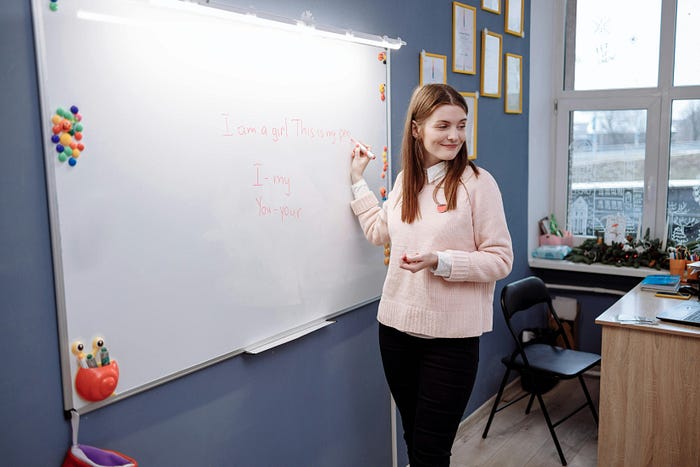
Teaching a language is the best way to never stop learning it. It gives you the chance to review the basics from a new perspective, to refresh forgotten details, to draw comparisons, and ask yourself the tricky questions (because, if you don't, your learners will).
If you're not a teacher and have no interest in becoming one, even preparing a pretend lesson is excellent practice.
How would you explain the difference between "I ate" and "I have eaten"? How would you handle a thirty-minute conversation on a certain topic, let's say, "winter sports" or "beauty standards"?
This exercise helps you give structure and order to your knowledge, uncover hidden gaps, and fill them.
And if you like it, you might make a career out of it…I know I did!
Writing
The first time I tried to write in English, I was humbled. I knew my English was good, yet building sentences on paper was a whole other story.
Writing in a foreign language is an exercise in precision, nuances, and focus. It tightens your grammar, stretches your vocabulary, and even sharpens your speaking. Don't even get me started about punctuation.
What should you write? Whatever you care about. Fiction, essays, blog posts. Start a Substack if you need accountability, or just journal if you don't, but up your game.
Don't just write about your day. Don't settle for anything that doesn't sound exactly like you want it. Pretend to be a novelist or a journalist.
Who knows? You might become one.
Get curious about words
Etymology is a brilliant way to expand your vocabulary and remember new words by understanding where they come from.
We often use words without stopping to think about them, but words actually have a complex life. They come in families, share suffixes and prefixes, are connected across cultures and centuries.
Take "disaster," for instance. It's made up of a prefix, "dis-", that indicates a negative outcome. "Astro" is the Italian word for "star". So a disaster is something that happens under a bad star.
Don't just use words; stop to examine them. Find out where they come from.
Even common words hide interesting stories, albeit not always true. "Sincere" was thought to come from the Latin expression "sine cera", "without wax". Roman sculptors hid cracks in their statues with wax, so a sincere statue was genuine, untainted. This story is not true, but it's still cool.
Don't just memorize words; make them spill their tea.
Improve your pronunciation
I am currently attending an online course for German pronunciation I had no idea I needed.
Because my ear is not trained to listen like a native speaker, I simply couldn't notice certain sound differences. I reached C2 level without knowing that German vowels can be long or short, whereas Italian vowels don't.
I learned to pronounce words by repeating them, and often got them right. But only last week I discovered the reason I can't nail the German r is, I've been putting the tip of my tongue in the wrong place all along.
Working on pronunciation is exhausting because it's physical work. You listen, repeat, and do it again and again. It's no fun. But it opens doors.
My goal is not to get rid of my accent because I am ashamed to have one, but to pronounce words as correctly as possible so that native speakers understand me and don't feel the urge to correct me. So that they focus on what I'm saying instead of trying to guess where I'm from. So that my German doesn't evoke reactions of, "Oh, you're so sweet for trying, now let's switch to English so that we both feel more comfortable."
Working on my pronunciation is not a way to lose myself and my identity, but rather a way to honour the language I've learned to love so much.
Get familiar with sub-languages
Exams and certifications focus on the standard language, but there's no such thing as standard in the real world.
If you want to go deeper, look in the corners.
Read novels or watch movies set in the past to pick up old words that are barely used anymore. Listen to podcasts and webinars about psychology, fitness, or whatever you're interested in to get familiar with specific and technical language. Endure a couple of teen dramas, so you learn new expressions and words you won't find in any textbook.
Medical dramas, true-crime podcasts, blogs on language learning: whatever your passions, there's a whole genre-language to enrich your vocabulary with.
I recently watched a German show called Almania: it's set in a multicultural high school in a disadvantaged neighbourhood. It gave me a whole new perspective on the societal discourse on racism and integration in Germany, much more vividly than any newspaper article.
The obvious one: talk.
I've written before about how I learned German from home. The funny thing is, although I was able to pass the C2 exam without a teacher, I felt the need to have one afterwards.
Not to teach me the language, but to use it. I enrolled in a conversation course because a language is alive after all, and no matter how many tricks I try to find, I need to speak it if I want it to stick.
Pure conversation, unprepared and spontaneous, is the most effective form of training.
Final take
When you speak in your native language, you speak "your" version of the language. There are words that you personally use hundreds of times a week, and others you barely even know. There are words you like the sound of. There are expressions you use with your friends, with your partner, with your parents.
Do the same in your foreign language: make it yours.
Don't settle for the neutral, impeccable textbook language; develop your own style. It's not intentional. It's not something you just decide to do: it's something that grows from a mix of exposure and curiosity.
Reaching C2 means you've done a great job. But it's only just begun, and not preparing for an exam doesn't mean it's going to be easier.
Don't aim to speak like a native speaker. Aim to speak like yourself in your new language. I promise it's worth it.