If there's one thing I've seen in my 20+ years of learning and teaching languages, it's an overemphasis on vocabulary.
Now, don't get me wrong! You definitely need vocabulary to communicate in your new target language. But that's only the first step. There's a lot that needs to come together for you to feel comfortable communicating.
There are even apps like ANKI, out there, designed specifically to help people learn new vocabulary.
Not only is this a waste of time in terms of strategy, because I do believe that vocabulary should only be learned in context (i.e, in reading or during real conversations). But, I also think that when it comes to outputting what you've learned, there's way more to it than regurgitating the words you've memorized.
A lot of times, students get discouraged because they can't understand why they are unable to express themselves properly. They don't get why, after memorizing a whole phrasebook, it's still impossible for them to retrieve the information and spit it out when they need to. And more importantly, they don't know why their speech lacks clarity, coherence, and flow.
So, this is what we're going to do today: We're going to talk about all the things that should be taken into account when speaking.
Pronunciation (what do we say?)
When learning a new language, you need to learn how to pronounce — not only individual words, but also words in use. For example, the word "to" is often pronounced as "tə" in phrases like "I'm going tə London."
In the same way, you'll also need to think about things like connected speech, liaison, etc… For instance, in real day-to-day conversation, "pick it up" sounds more like /pɪkɪtʌp/. So, this is yet another reason not to learn this stuff in isolation.

Pronunciation is just about producing the right sounds. And that usually involves tongue placement. There are 2 things to take into account here:
- Height (low, mid, and high)
- Position (back, central, and front)
You also need to be aware of the movement of your lips. Some sounds heavily rely on lip rounding.
You need to be aware of the sounds that exist in your target language and how they relate to those of your native language.
And even then, you'll need to be careful…
The letter might exist in your native language, but the sound it represents might still be totally different.
For instance, in Spanish, the letters "b" and "v" are part of the alphabet, just like in English. But unlike in English, they are neither a normal plosive (b) nor a fricative (v). The sounds are indistinguishable, and their utterance is closer to a voiced bilabial fricative (β).
So, learning the alphabet of your target language will only get you so far.
Intonation (how do we say it?)
Intonation is the music of your speech — your tone and the melody that conveys your meaning. It's equally important because it helps your listener interpret your intent. A lot of times, intonation is overlooked in language learning, again, due to the overemphasis on vocabulary.

Intonation is an umbrella term that encompasses things like:
- Stress patterns
- Pitch
- Tone
- Accent
- Rhythm
- Inflection, etc…
Stress patterns play an important role in the English language. Sometimes, we develop a less-than-desirable accent in English because we neglect this area. For instance, the word "photographer" is pronounced "Pho¹.TO².gra³.pher⁴." So, we target the second syllable. Putting the stress anywhere else would make it sound weird.
We also have sentence-level stresses. Sometimes, we just need to draw attention to the most important piece of information. And we do that by stressing the most important word. For instance, the sentence:
"MY SISTER went to the supermarket the other day"
…is different from…
"My sister went to the SUPERMARKET the other day."
In the first sentence, you're trying to say that the person who went to the supermarket was your sister. Whereas, in the second sentence, you're trying to point out where your sister went.
Your pitch will help differentiate when you're saying something in the affirmative versus when you're asking a question. For instance, "You're coming home ↗tonight?" with the rising pitch in the end suggests that it's a question and that I'm not giving you an order to come home tonight.
Your tone is equally important. Some people naturally have a dry tone, and it makes it feel like they're always being sarcastic. Your tone will help your listener know if you're actually being serious about what you're saying. The last thing you want is for your tone to express something that you didn't intend.
Another thing that will affect your intonation is your accent. Here is one thing to note…
Everybody has an accent.
Even the version of the language you call "standard" carries a specific accent. For American English, it tends to be the Midwest version. You don't have to emulate 100% of the native accent of your target language, but you should try to move closer and closer every time. Remember! The goal here is to have the target accent as your destination. Don't try to force it. When you're a beginner, your pronunciation and your enunciation matter more than your accent.
Another thing to be aware of is the speed of your speech. Some languages are naturally faster than others. Once you're an intermediate student, start trying to match the speed of the native speakers.
English has a specific rhythm! Notice the dance between the stressed and unstressed syllables in the sentence below:
Could you pass the salt, please? ⬤ — —-◦ — -⬤ —-◦ — ⬤ — ⬤ — —
Inflection is another linguistic tool that speakers use. One of my favorite podcasts is "Let's Read," and I just can't get enough of the voice inflection of the speaker. According to the internet, one of the most annoying voice inflections out there is Valspeak (Valley Girl Speak). It's usually accompanied by a vocal fry at the end. OK! Just hear Kim Kardashian talk and you'll know exactly what I mean.
Enunciation (how clearly do we say it?)
If you've listened to the new subgenre of mumble rap, you'll know exactly what I'm talking about. You have rappers barely opening their mouths. And you know how frustrating it is to listen to.
I mean — just say the word, for Pete's sake!!!

When I'm teaching, I usually tell my students to be bold with the words that they actually know. I remember that scene of Mr. Bean in the church singing, or should I say, pretending to do so while only knowing the word "Hallelujah." He would be quiet for the whole part of the song and yell out the part that sings "Hallelujah."
Now, I don't want you to develop the same habit as Mr. Bean's. But that's the kind of energy that you should have when speaking in your target language.
Say the word like you know how to say it.
Another problem I've noticed is the tendency for students to mumble their words whenever they aren't sure about the pronunciation, hoping to fool their listeners.
Let me tell you something…
You're not fooling anyone — you're just confusing them!
Here are a few things to do:
- Do tongue twisters. They're fun… And since they tend to be difficult, daily conversations become easier and easier as you practice them. Your speech will become way smoother after doing a few of them. My favorite tongue twister website is this one: 50 tongue twisters.
- Roll your lips. Lip rolls are very good, not only for the sake of articulation but also for the health of your throat. If one day, you happen to lose your voice, you can quite literally lip roll your way back to it.
- Do some vocal warm-ups. Vocal warm-ups allow you to work on your pitch, articulation, and help prevent strains when you have to speak for a long time. Go on YouTube — and find some… Actually, my favorite Vocal Warm-ups Channel is Jacobs Vocal Academy.
We do all these things because language learning is primarily a physical/physiological endeavor. And with every single phoneme we try to pronounce come new challenges related to placement, and interaction between the articulators: tongue, lip, and jaw.
Expression (how well does our body amplify what we say?)
Some languages are generally more animated than others. Spanish is one of them. You may also notice that some languages come off as louder than others. Italian would fall under this category. But I'm not sure if the perceived volume is due to some intrinsic characteristics of these languages or if it's a matter of cultural causes.
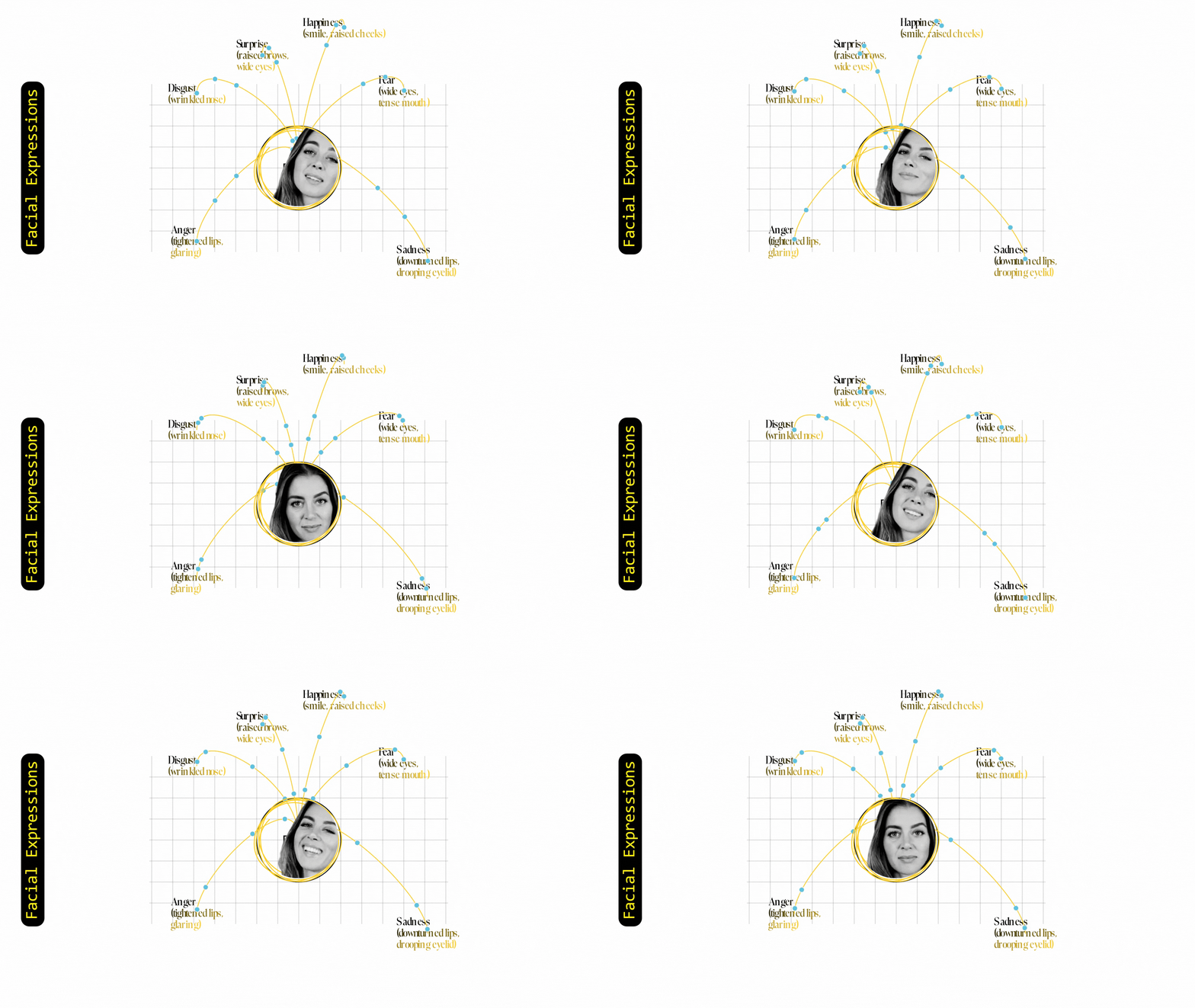
There are universal emotions/facial expressions. Paul Ekman mentions 7 of them:
- Happiness (smile, raised cheeks)
- Sadness (downturned lips, drooping eyelid)
- Anger (tightened lips, glaring)
- Surprise (raised brows, wide eyes)
- Fear (wide eyes, tense mouth)
- Disgust (wrinkled nose)
So, you don't want to have your lips downturned or brows furrowed if the goal is to express happiness.
We also need to talk about gestures and body language. There are cultural differences you need to be aware of. I remember going to the US with some Canadian and American friends, and snapping my fingers at a waiter/waitress. As I did that, my friends slapped my hand down, asking why I was being rude. But, in my mind, I just wanted to get that person's attention. I didn't do it to be condescending or anything of the sort.
Things will vary depending on culture. For instance, the 👌 sign means OK in the US but is an insult in a country like Brazil.
Interaction (whom do we say it to?)
Now, we need to talk about the social aspect of speaking. You've probably heard the term "code — switching," especially when it comes to African Americans having to alter the way they speak to fulfill some unwritten rules in the workplace.
This type of code-switching can be problematic, especially if done explicitly and primarily for the sake of sounding more classy, suggesting that AAVE is primarily ghetto speak. However, code-switching can also be appropriate when it comes to showing politeness, understanding, etc. I mean, you can't speak to your boss the same way you speak to your friends, can you?
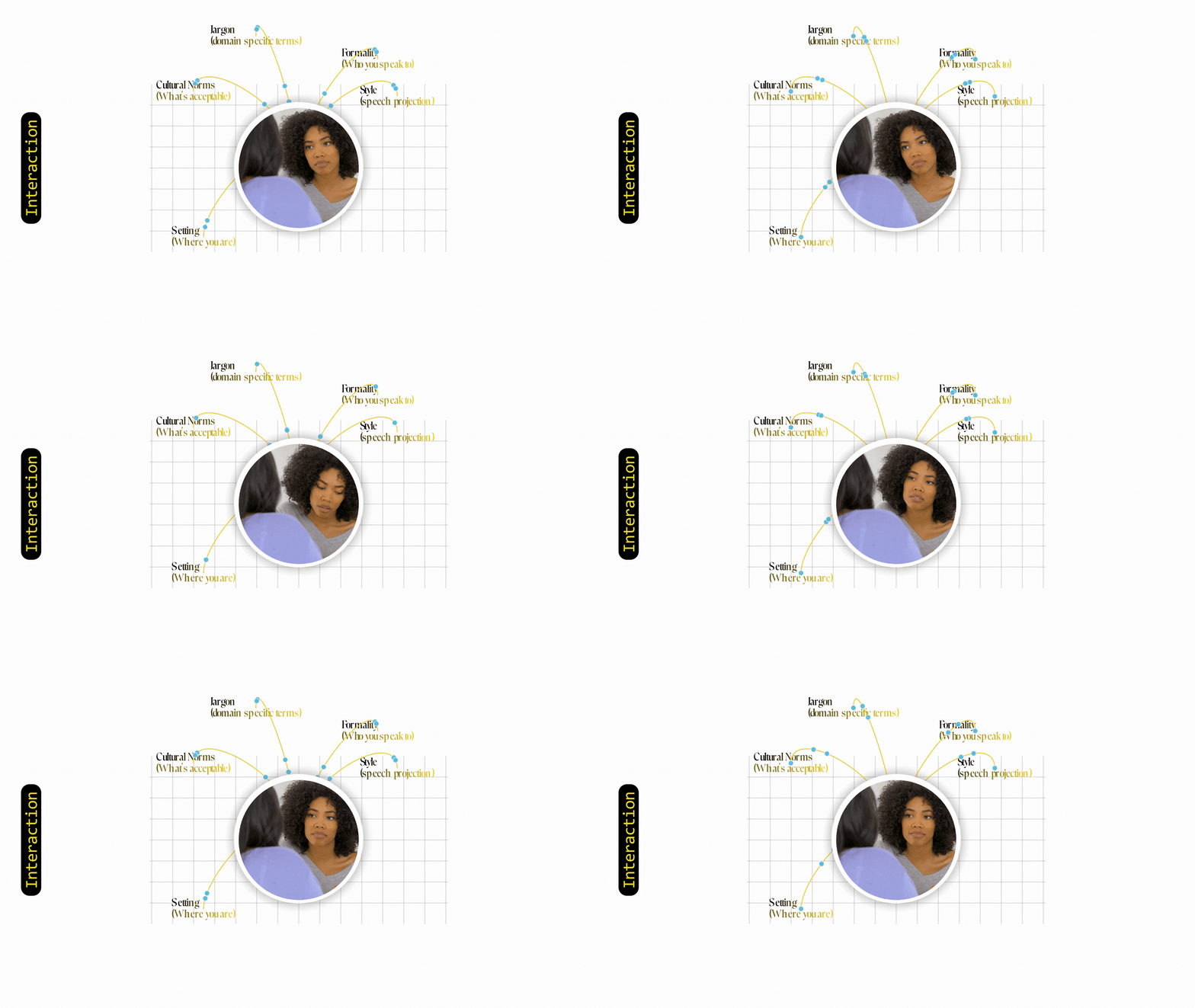
You might have heard of the word "register" as well, which refers to the degree of formality of your speech based on the context you're in.
So you'll need to be aware of:
- Formality (whom you're speaking to)
- Setting (where you are)
- Cultural norms (what is acceptable)
Style would also be relevant here. Talking to someone casually is different than, let's say, giving a TED Talk. The voice projection will be different. Your body language will be different as well. Although I do think that the more natural you sound, the better it is. But that's just a personal preference.
Most domains have their own jargon as well. If you're in a court setting, sometimes it's impossible to understand the topic being discussed because of the terms being hyper-specific. I used to have 2 student pilots, and we would work with ATC-pilot audio conversations. Even as a teacher, it took me a while to grasp what they were saying.
So, yes — speaking is more than learning vocabulary!
Buy me a Ko-fi

My Friend retro games NES SEGA