
You know that moment when you say something in your second language, and everything is technically correct, but somehow the sentence still feels off?
The other person understands you.
That's not the problem.
The problem is that you just said "I have a big hungry" instead of "I'm starving," or "make a humor" instead of "crack a joke," or something equally correct and equally alien, and now there's a polite smile across the table that translates roughly to:
That's not how we say that.
Nothing explodes. No grammar police burst through the wall. The conversation limps forward.
And yet you feel it.
A tiny drop in your stomach.
A little heat in your cheeks.
That awful split second when you realize you were not speaking naturally. You were assembling language like furniture in front of a live audience.
Word.
By word.
I know this feeling intimately.
I teach languages. I have a PhD in applied linguistics. I have spent years studying why learners can know grammar, memorize vocabulary, pass exams, and still sound unnatural in actual conversation.
But the clearest lesson I ever learned about fluency did not come from a research paper.
It came from a dance studio I visited once.
Bright overhead lights. Mirrors on every wall. A floor that smelled faintly of rubber and sweat. Music was already pulsing through the speakers. Around me, people were stretching, chatting, rolling their shoulders as they belonged there.
And me?
Standing in the back, trying to look casual.
Then the music started.
And for the next forty-five minutes, I experienced the full-body horror of what it means to know the pieces but not the pattern.
Everyone around me moved as if the choreography lived inside their bones. Their bodies hit the beat before the beat had even fully arrived. Turn, slide, lift, pause. Smooth. Clean. Effortless.
Meanwhile, I was half a second behind everything.
My arms were late. My feet were confused.
I knew the steps. In theory.
But my body was still translating each movement one instruction at a time.
Hand up. No, other hand. Step left. No, your other left. Turn. Why are we turning. Ah. Too late.
And standing there, flushed and awkward, I had an epiphany about language and fluency.
It's not enough to know words and rules.
You must know what travels together, what comes as one piece.
Because fluent speakers do not build most of what they say from scratch. They do not stand there mentally selecting one word, then another, then a grammar rule, then a preposition, hoping the whole sentence survives the trip out of their mouth.
They pull language in ready-made strings. In chunks. In patterns. In sequences that have been heard and used so many times, they come out whole.
I'm starving.
That makes sense.
You know what I mean.
At the end of the day.
These phrases are not assembled in the moment. They are retrieved as full units.
That is why fluent speech feels fast and flows. And that's why so many learners still feel like they are dragging a bag of loose words into every conversation and trying to build a house before the topic changes.
These ready-made phrases are called formulaic language, and that's what this article is about.
By the end, you will understand why formulaic language makes up such a huge part of natural speech, why your brain loves it, and why grammar plus vocabulary is often not enough to make you sound truly at ease.
You will walk away with 10 concrete strategies to start building this system into your own speech, so talking feels less like emergency sentence engineering and more like stepping into rhythm.
Your First Language Runs on Autopilot (And You Never Noticed)
When someone asks how your morning is going, you don't open a mental grammar book, select a subject, choose an adjective, and assemble a response.
You reach for "not bad, you?" the way you reach for the light switch in a dark room, without looking, without thinking, and with a success rate so high you've forgotten it's even a skill.
That's formulaic language at work.
And the scale of it in your first language would surprise you.
Corpus analyses suggest that 55 to 70% of everything we say, hear, read, and write comes from some form of fixed or semi-fixed expression (Erman & Warren, 2000; Hill, 2000).
Researchers have given these expressions different names, including chunks, collocations, lexical bundles, formulaic sequences, and prefabs (Wood, 2020).
The label doesn't matter.
What matters is that these are word combinations your brain stores and retrieves as single vocabulary items, not strings it builds from grammar every time (Hinkel, 2019, 2020).
You don't say, "I hope this message locates you in a state of wellness."
You say, "I hope this finds you well."
Same meaning. One sounds natural. The other sounds off.
Every hour you spend studying how sentences are constructed word by word, you're perfecting a skill that fluent speakers barely use. You're hand-stitching a shirt while they're pulling one off the rack.
Why Your Brain Is Begging You for Chunks
Speaking in real time is one of the most cognitively expensive things humans do.
While your mouth is producing a sentence, your brain is simultaneously selecting the next words, monitoring grammar, tracking pronunciation, planning what comes after, reading the other person's face, and adjusting your tone to the social situation.
That's six cognitive tasks stacked on top of each other, all at conversational speed.
Formulaic chunks are your brain's compression algorithm.
Joan Bybee describes chunking as a feature of procedural memory, the same system that lets you tie your shoes or navigate your kitchen in the dark (Bybee, 2008).
When word sequences show up together repeatedly, the brain welds them into single units. Over time, retrieving "I'd like to make a reservation" becomes one mental action, not seven.
Look at this diagram.
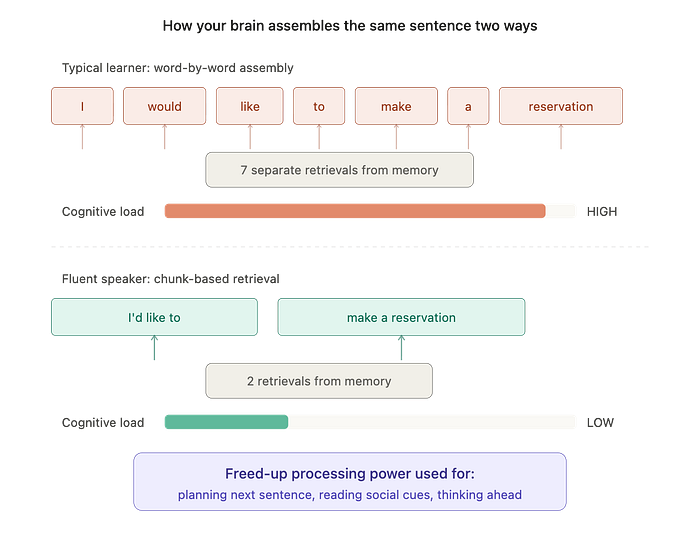
Seven individual retrievals versus two.
Same sentence, a fraction of the cognitive cost. And the brainpower you save doesn't just vanish. It gets redirected to the things that actually make conversation feel like conversation: humor, warmth, timing, wit, reading the room, being you rather than being a translation engine (Wray, 2002).
For proficient speakers, word selection, pronunciation, and grammatical assembly are essentially automatic, and much of their speech comes from predictable, partly formulaic patterns. That automaticity is what lets them sound relaxed while doing something incredibly complex (Lightbown & Spada, 2021).
And Pawley and Syder (1983) named the two specific superpowers that chunks give native speakers.
First, native-like selection: the ability to choose the conventional way to say something out of all the technically grammatical options. (Nobody says, "I desire to ingest a caffeinated beverage." They say, "I need a coffee.")
Second, native-like fluency: speaking at a speed that's physically impossible if every word is retrieved individually.
If you want both of those things, you need chunks.
Grammar and vocabulary alone will never get you there.
Why Nobody Told You About This
Language instruction has operated with two buckets since roughly forever: grammar (rules, conjugations, paradigms) and vocabulary (individual words, flashcards, definitions).
Formulaic language fits in neither bucket.
"Make a mistake" is not a grammar rule. It's not a single vocabulary word. It's a conventional combination that exists because English speakers collectively decided, centuries ago, that mistakes are "made." Not done. Not committed. Not performed. No rule explains why. It just is.
And because these phrases fall between the two buckets, you never learn them.
Without explicit instruction, most learners can't even identify multiword phrases in the language they're hearing, even when those phrases are flying past every few seconds (Hinkel, 2022). You zoom in on individual words and completely miss the larger phrases those words belong to (Boers, 2020).
As a result, you get a flavor of non-native speech that any native speaker recognizes instantly: grammatically correct, individually accurate, subtly wrong in its combinations.
Native speakers don't misunderstand you.
They just would never say it that way. And research shows this pattern persists even at advanced levels, with highly proficient learners using multiword phrases incorrectly more often than correctly (Laufer & Waldman, 2011).
That's not a small detail. That's the reason you can pass a C1 exam and still sound like you're reading from a script.
Not All Chunks Are Built the Same
Before you start collecting phrases, you need to know that they come in different species, and each species needs a different learning approach.
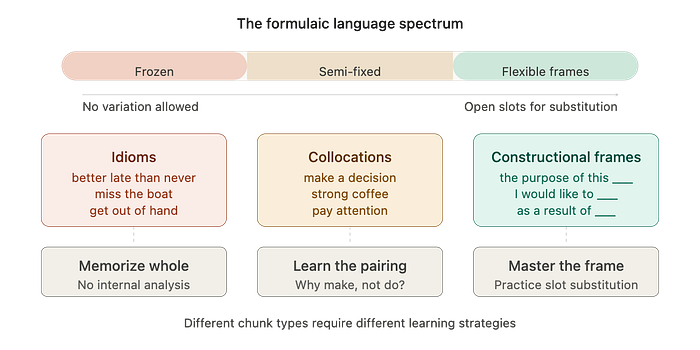
At the rigid end: idioms.
Better late than never. Miss the boat. Get out of hand. Completely fixed, often non-literal, no substitution allowed. You memorize the whole thing.
In the middle: collocations.
Make a decision. Strong coffee. Heavy rain. Pay attention. Words that travel together by convention, not logic. Why "strong" coffee but "heavy" rain? Because that's how it is. No rule. No shortcut. You learn each pairing.
At the flexible end: constructional frames.
"The purpose of this ___." "I would like to ___." "What I mean is ___."
The frame is fixed, but the slot is open (Simpson-Vlach & Ellis, 2010). You master the frame and then practice filling it with different content, and suddenly, one phrase becomes a machine that generates dozens of sentences.
10 Strategies to Build Your Chunk Library
1. Train Your Eyes to See Phrases
Your instinct when you see "take into account" is to look up three separate words. That instinct is the enemy.
- Underline or highlight 2-to-4-word combinations whenever you read or listen
- Log them as single entries in your notes, never broken apart
- Review weekly and notice which phrases you keep overlooking
Without deliberate attention, these phrases remain invisible (Hinkel, 2022).
2. Start Small and Frequent
Two- and three-word chunks are the backbone of natural speech and the easiest to retain (Nation, 2013).
- Begin with: "make sense," "by the way," "it depends on," "for instance," "kind of."
- Add 3 to 5 new short chunks per week
- Graduate to longer phrases once noticing becomes reflexive
3. Harvest From Real Life, Not Word Lists
Context carries information that flashcards can't: register, emotion, social weight, timing.
- Pull phrases from podcasts, series, and books you already enjoy
- Write the full sentence surrounding the phrase, not the phrase alone
- Note the scene: who said it, how formal, how emotional, what they wanted
4. Make Your Flashcards Phrase-Shaped
Stop putting single words on your Anki cards. Phrases are the unit of fluency.
- Front: a communicative situation ("you want to soften a disagreement")
- Back: the full phrase inside a natural sentence
- Add native audio whenever possible so you rehearse the sound, not the spelling
5. Shadow Someone You Want to Sound Like
Shadowing wires phrases as physical mouth routines, not just mental knowledge (Foote & McDonough, 2017).
- Choose one podcast host or YouTuber whose rhythm you admire
- Listen to a 10-second clip, then repeat it aloud, matching their speed and melody
- Ten minutes daily with the same speaker for two weeks
6. Fall in Love With Boring Phrases
The highest-value chunks in any language are not colorful idioms. They're the unglamorous connectors and frames that stitch conversation together (Simpson-Vlach & Ellis, 2010).
- Prioritize: "as a result," "the thing is," "I was wondering if," "on the other hand."
- Deprioritize: "once in a blue moon," "raining cats and dogs."
- Litmus test (a quick reality check): Would you use this phrase at least once a week in real conversation?
7. Organize by What Phrases Do, Not What They Mean
Your brain retrieves language by communicative need, not alphabetical order.
- Build phrase journal sections: disagreeing, hedging, storytelling, buying time, expressing surprise, softening bad news
- File every new phrase by function immediately
- Before a conversation or speaking session, review one functional category
8. Turn One Frame Into Many Sentences
A flexible frame is the highest-leverage chunk you can own.
- Take "lo que me interesa es…" (what interests me is…)
- Produce 5 different completions out loud, back to back
- Do this with one new frame every day
9. Hit 10 Exposures or Forget About It
A single encounter with a phrase deposits almost nothing into long-term memory. Adults need 10 to 15 repetitions (Boers, 2000; Nation, 2013; Webb & Nation, 2017).
- Schedule review: day 1, 3, 7, 14, 30
- Vary the channel: read it, hear it, write it, say it, use it with a real person
- Below 10 encounters, the phrase will not be there when you need it
10. Stop Filling in Blanks
Fill-in-the-blank exercises are the most popular activity in language textbooks and yield the poorest retention of multiword phrases (Boers et al., 2014; Pellicer-Sánchez, 2020).
- Replace with dictogloss: listen to a short passage, then reconstruct it from memory
- Try translation comparison: how does your L1 express the same communicative function?
- Build whole sentences around target phrases instead of slotting single words into gaps
Conclusion
Nobody becomes fluent by learning more grammar or more isolated words. I wish someone had told me that earlier.
You become fluent by needing less time to say what you already know how to say. Every chunk you absorb shaves a microsecond off your processing time, and those microseconds add up. One day, you'll notice that your brain has gotten fast enough that you've stopped catching it in the act.
Give it the chunks. It'll do the rest.
Thanks for reading!
- My deepest work lives on Substack. Join 2100+ passionate language learners at How We Learn Languages and get a free 32-page Language Learning Starter Kit, weekly PDF guides, templates, trackers, and research you won't find anywhere else.
- Want to support me? Buy me a coffee ☕
More recommended stories:
References
Boers, F. (2000). Metaphor awareness and vocabulary retention. Applied Linguistics, 21, 553–571.
Boers, F. (2020). Factors affecting the learning of multiword items. In S. Webb (Ed.), The Routledge handbook of vocabulary studies (pp. 143–157). Routledge.
Boers, F., Demecheleer, M., Coxhead, A., & Webb, S. (2014). Gauging the effects of exercise on verb-noun collocations. Language Teaching Research, 18, 54–74.
Bybee, J. (2008). Usage-based grammar and second language acquisition. In P. Robinson & N. C. Ellis (Eds.), Handbook of cognitive linguistics and second language acquisition (pp. 216–236). Routledge.
Erman, B., & Warren, B. (2000). The idiom principle and the open choice principle. Text, 20, 29–62.
Foote, J. A., & McDonough, K. (2017). Using shadowing with mobile technology to improve L2 pronunciation. Journal of Second Language Pronunciation, 3(2), 167–190.
Grabe, W., & Yamashita, J. (2022). Reading in a second language: Moving from theory to practice. Cambridge University Press.
Hill, J. (2000). Revising priorities: From grammatical failure to collocational success. In M. Lewis (Ed.), Teaching collocation: Further developments in the lexical approach (pp. 47–69). Language Teaching Publications.
Hinkel, E. (2019). Teaching essential units of language: Beyond single-word vocabulary. Routledge.
Hinkel, E. (2020). Teaching academic L2 writing: Practical techniques in vocabulary and grammar (2nd ed.). Routledge.
Hinkel, E. (2022). Teaching and learning multiword expressions. In E. Hinkel (Ed.), Handbook of practical second language teaching and learning (pp. 435–449). Routledge.
Laufer, B., & Waldman, T. (2011). Verb-noun collocations in second language writing: A corpus analysis of learners' English. Language Learning, 61, 647–672.
Lightbown, P. M., & Spada, N. (2021). How languages are learned (5th ed.). Oxford University Press.
Nation, P. (2013). Learning vocabulary in another language (2nd ed.). Cambridge University Press.
Pawley, A., & Syder, F. H. (1983). Two puzzles for linguistic theory: Nativelike selection and nativelike fluency. In J. C. Richards & R. W. Schmidt (Eds.), Language and communication (pp. 191–226). Longman.
Pellicer-Sánchez, A. (2020). Learning words vs. multiword items. In S. Webb (Ed.), Routledge handbook of vocabulary studies (pp. 158–173). Routledge.
Robinson, P., & Ellis, N. C. (Eds.). (2008). Handbook of cognitive linguistics and second language acquisition. Routledge.
Shin, D., & Nation, P. (2008). Beyond single words: The most frequent collocations in spoken English. English Language Teaching Journal, 62, 339–348.
Simpson-Vlach, R., & Ellis, N. (2010). An academic formulas list: New methods in phraseology research. Applied Linguistics, 31, 487–512.
Webb, S., & Nation, I. S. P. (2017). How vocabulary is learned. Oxford University Press.
Wong Fillmore, L. (1979). Individual differences in second language acquisition. In C. J. Fillmore, D. Kempler, & W. S. Y. Wang (Eds.), Individual differences in language ability and language behavior (pp. 203–228). Academic Press.
Wood, D. (2020). Classifying and identifying formulaic language. In S. Webb (Ed.), The Routledge handbook of vocabulary studies (pp. 30–45). Routledge.
Wray, A. (2002). Formulaic language and the lexicon. Cambridge University Press.