
We rarely talk about it.
Most people don't fail at language learning because they're not smart enough, disciplined enough, or hardworking enough.
They fail because the journey isn't truly theirs.
Because they might be chasing or living someone else's story, not their own.
So take a moment and ask yourself:
Are you learning this language because your heart is calling or because you feel you have to?
Is this your dream or someone else's expectation?
My Journey: From 'Should' to 'Want'
When I was a university student, I majored in both English and German. But only one of them truly felt like mine.
English felt alive: a door opening to the world, a key to freedom and self-expression.
German, on the other hand, often felt like a heavy obligation — a "should," not a calling.
I tried to stay disciplined.
I pushed myself to memorize, to prepare, to perform.
But inside, the connection was thin.
Years later, when I started learning Swedish, everything changed.
I wasn't learning to fulfill a requirement. I was learning because I saw a future that mattered to me: building a new life, a new home, a new sense of belonging.
And yet, even then, the dream alone wasn't enough.
Despite eagerly studying for 5–8 hours almost every day, there were still days when Swedish felt overwhelming.
Days when I doubted myself.
Days when progress was so slow.
Yet I kept showing up for the future I couldn't wait to live in.
The future I chose to build every day.
Long story short, I'm now happily living in Sweden — surrounded by wonderful friends and colleagues, enjoying its breathtaking, peaceful nature, and feeling truly at home. I teach this charming, melodic language to students who, just like me, moved to Sweden in search of a fresh start and a better future.

Today, I speak several languages: Russian, Belarusian, English, Swedish, Spanish, Polish, German, and some Italian.
But it didn't happen because I was "supposed to."
It happened because I built a relationship with my Ideal L2 Selves:
- The student dreaming of connecting across cultures
- The young expat seeking to belong in Sweden
- The academic aiming to publish internationally
This obsession eventually led me to earn a PhD in Applied Linguistics, specializing in second language acquisition, multilingualism, language aptitude, and motivation.
Which Future Are You Building?
It wasn't until years later, while studying Applied Linguistics, that I found out there were names for these two different forces:
The Ideal L2 Self — who you dream of becoming.
The Ought-to L2 Self — who you think you're supposed to become.
And understanding the difference can change your approach to learning languages. Hungarian researcher Zoltán Dörnyei developed a model called the L2 Motivational Self System to explain why some language learners persist and thrive and why others burn out.
He points out that motivation isn't just about liking a language.
It's about the future version of yourself you're working toward.
This model has three parts:
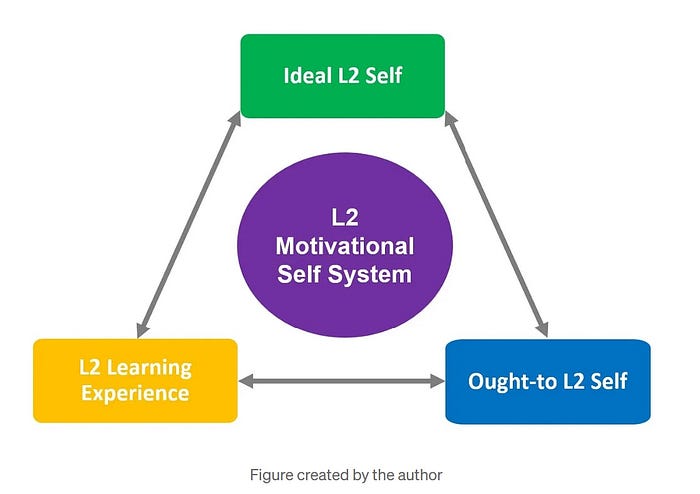
1) Ideal L2 Self
Your dream future self who speaks the language fluently.
It is who you genuinely want to become.
The traveler speaking French on cobbled Parisian streets. The expat making friends in Tokyo. The entrepreneur pitching ideas confidently in English.
2) Ought-to L2 Self
The dutiful version of you that feels pressure — "I must pass the test," "I should get this certification," "I ought to please my boss."
The future you feel you should become, to avoid guilt, shame, or disappointing others.
It has to do with obligations and living up to somebody's expectations.
3) L2 Learning Experience
The day-to-day experiences that either fuel or drain your motivation, like inspiring teachers, supportive classmates, your emotions, or your progress.
When you pursue your Ideal L2 Self, you chase a future that belongs to you.
When you obey your Ought-to Self, you run a race that feels meaningless. And your motivation bleeds out.
The Science Behind It: Why 'Should' Fails You
If you're only studying because someone else expects it, you will probably quit.
Not because you're lazy. Not because you're undisciplined.
But because the fuel you're using burns out fast.
Internal desire?
It's a self-replenishing engine.
The concepts of Ideal L2 Self and Ought-to Self are closely related to the well-known psychological concepts of intrinsic and extrinsic motivation.
And research consistently shows that intrinsic motivation — doing something because it matters to you — leads to:
- Greater persistence
- Deeper engagement
- Higher achievement
- More emotional resilience (Deci & Ryan, 2000)
In contrast, extrinsic motivation (pressure, fear of failure, obligation) often results in:
- Surface-level learning
- Higher dropout rates
- More anxiety and procrastination (Noels, Pelletier, Clément, & Vallerand, 2003)
In fact, one study showed that students driven by external regulation (learning out of guilt or pressure) experienced lower language proficiency and greater emotional exhaustion (Noels et al., 2000).
On the other hand, learners with a strong Ideal L2 Self — a vivid, personal vision of themselves as confident language users — showed higher persistence and motivation, even when things got hard (Papi, 2010).
But here's where it gets interesting.
While these self-guides and personal visions can be powerful, science also warns us: just having a dream isn't always enough.
Some researchers, like Gabriele Oettingen, found that simply daydreaming about success, without linking it to real action, can actually reduce effort.
In her words,
"Positive thinking can be detrimental… if it comes in the form of fantasies" (Oettingen, 2012).
A large review by Hiver and Al-Hoorie (2019) also cautions that while the Ideal Future Self is a compelling idea, its effectiveness depends on how real and connected to action it feels. Mental imagery alone, without emotional engagement and follow-through, often doesn't lead to change.
So what does the research really say?
It says this:
Vision works, but only when it's emotionally meaningful and paired with action.
Just imagining fluency won't get you there.
But imagining the person you want to become, and then showing up for that person every day — that's where transformation happens.
How to Build Your Ideal L2 Self (the Right Way)
Having a vivid dream of your future self is a powerful start.
But if you want real transformation, you need to connect that vision to daily action, emotional engagement, and realistic pathways.
Here's how:
1. Visualize in high definition
Don't just say, "I want to be fluent."
Picture the person you want to become.
Make it detailed. Make it emotional.
- Close your eyes.
- See yourself ordering coffee in Paris.
- Feel the pride.
- Hear your confident accent.
The more sensory details, the stronger your motivation becomes (Markus & Nurius, 1986).

2. Link your dream to daily action
Every day, ask yourself:
What would the future me — the confident, connected version — do today?
Then do one small thing that moves you closer.
Study a phrase. Speak for five minutes. Listen while you cook.
One tiny step. Every day.
3. Plan for obstacles and imagine overcoming them
Don't just picture success.
Picture setbacks and see yourself getting through them.
This is called mental contrasting, and it's been shown to boost motivation far more than fantasies alone.
See the difficulty, and then see yourself persisting anyway.
4. Forgive the bad days
Some days, you'll fall short.
That's normal.
But when your motivation is tied to identity — who you're becoming — you'll always come back.
You don't quit being yourself.

5. Keep your vision emotionally alive
Revisit it often.
Watch a video that reminds you why you care.
Talk to someone who inspires you.
Keep your Ideal Self close.
You're not just learning vocabulary and grammar. You're becoming someone new.
6. Connect daily
Before every study session, remind yourself:
"I'm not just memorizing words. I'm building the future version of myself."
Write affirmations. Create vision boards (if it resonates with you).
Anchor your practice in your Ideal Self, not in "have to" thinking.
7. Personalize your success
Forget what others expect.
What does success look like for you?
Maybe it's:
- Reading your favorite novels in the original
- Watching TV shows without subtitles
- Traveling solo with confidence
- Reading manga in Japanese
Whatever it is, define it.
Own it.
This is your journey.
8. Plan your journey
- Pick learning resources that excite you
- Design your own course syllabus
- Teach yourself or imaginary students (it worked wonders for me!)
- Watch TV shows you love
- Study songs that make your heart beat faster
9. Celebrate small wins
Notice when you understand a conversation, finish a lesson, or use a tricky word correctly.
Closing Words: Your Future Self Is Waiting
Building your Ideal L2 Self isn't about visualization.
It's about building a relationship with your future and then showing up for that future self every single day.
Every choice you make today either brings you closer or pushes you away.
You don't owe fluency to anyone else.
You owe it to yourself.
Dream with open eyes.
Act with an open heart.
And build the future you can't wait to live in.
My best wishes to you on your exciting journey.
Thanks for reading!
If you liked this article, leave a comment and share your experiences. I love reading your comments and I always reply. Follow me and subscribe to be notified about new articles.
References
Deci, E. L., & Ryan, R. M. (2000). The "what" and "why" of goal pursuits: Human needs and the self-determination of behavior. Psychological Inquiry, 11(4), 227–268. https://doi.org/10.1207/S15327965PLI1104_01
Hiver, P., & Al-Hoorie, A. H. (2019). Reexamining the role of vision in second language motivation: A review and a call for research. Language Learning, 69(1), 1–55. https://doi.org/10.1111/lang.12318
Noels, K. A., Pelletier, L. G., Clément, R., & Vallerand, R. J. (2000). Why are you learning a second language? Motivational orientations and self-determination theory. Language Learning, 50(1), 57–85. https://doi.org/10.1111/0023-8333.00111
Noels, K. A., Pelletier, L. G., Clément, R., & Vallerand, R. J. (2003). Intrinsic and extrinsic motivation and second language acquisition: A self-determination theory perspective. In Z. Dörnyei (Ed.), Attitudes, orientations, and motivations in language learning (pp. 33–63). Blackwell.
Oettingen, G. (2012). Future thought and behaviour change. European Review of Social Psychology, 23(1), 1–63. https://doi.org/10.1080/10463283.2011.643698
Oettingen, G., & Mayer, D. (2002). The motivating function of thinking about the future: Expectations versus fantasies. Journal of Personality and Social Psychology, 83(5), 1198–1212. https://doi.org/10.1037/0022-3514.83.5.1198
Papi, M. (2010). The L2 motivational self system, L2 anxiety, and motivated behavior: A structural equation modeling approach. System, 38(3), 467–479. https://doi.org/10.1016/j.system.2010.06.011
My Friend retro games NES SEGA