You understand maybe 30% of a podcast episode.
So you switch to another one. Then a YouTube video. Then a Netflix series with subtitles you half-read, half-ignore. By the end of the week, you have consumed hours of your target language and retained almost nothing.
Your brain has been treading water in an ocean of sound, never touching the bottom.
I know this loop.
Twenty-five years ago, when I started learning English in Belarus, I did exactly the same thing. I recorded songs off the radio, rewound VHS tapes of American movies, and tuned into any broadcast I could find.
I listened to everything and understood almost nothing.
It felt productive (all those hours) and miserable (all that confusion). I had no structure, no system, no idea that the way I organized my listening mattered as much as the listening itself.
It took me years of studying second language acquisition (MA and PhD) to understand what I was doing right and wrong.
Today, I want to share my simple technique called Funnel Listening.
Wide — narrow—deep
Three phases, each one doing something different to your brain, each one useless without the others.
If you stay wide, nothing sticks.
If you skip wide, everything feels overwhelming.
If you never go deep, nothing becomes automatic.
By the end of this article, you will know why unfocused listening keeps you stuck, what cognitive science says about turning passive exposure into real comprehension gains, and exactly how to restructure your listening time so it actually moves the needle.
Subscribe to How We Learn Languages for weekly research-backed deep dives and daily notes (gift inside — 32-page Language Learning Starter Kit)
Your Brain on Random Listening
Every time you press play on a new speaker, a new topic, a new accent, your brain launches into full emergency-room triage.
It has two departments running simultaneously: the sound department (bottom-up processing, which decodes raw audio into words) and the prediction department (top-down processing, which uses everything you already know to guess what comes next) (Burns & Siegel, 2022).
In a fluent listener, these two departments coordinate like a well-rehearsed kitchen brigade. For a second-language listener, they coordinate like two strangers trying to assemble IKEA furniture without the manual.
Now imagine changing kitchens every fifteen minutes.
New stove, new knives, new ingredients.
That is what happens when you hop between sources without ever staying long enough for your brain to adapt. The issue is not variety itself. It is the lack of stability. Your brain needs a few minutes in the same "environment" to start recognizing patterns. When that time is cut short, it resets to zero.
That is what happens when you hop between a true crime podcast, a cooking show, a news broadcast, and a sitcom in a single study session. Your brain never gets comfortable enough with any one "kitchen" to start cooking on autopilot.
Rost and Brown (2022) call this missing ingredient "context effects," the way a listener's brain narrows its expectations and starts predicting what comes next.
When you stay with one source, those expectations sharpen with every minute. When you bounce between ten sources, your brain never builds them. It stays in decoding mode, spending all its energy on the question "what did they just say?" and leaving nothing for the more useful question: "what does it mean?"
This is also why you can "understand" a podcast while listening and remember nothing five minutes later.
Researchers have a wonderfully blunt name for this: "good enough processing" (Ferreira & Patson, 2007).
Your brain grabs the cheapest plausible interpretation, cashes it in, and moves on. It is the cognitive equivalent of skimming a menu, pointing at something, and forgetting what you ordered before the waiter walks away.
What Happens When You Stop Channel-Surfing
Back in 1996, Stephen Krashen proposed an idea: what if, instead of exposing learners to a buffet of different input, you let them eat at the same restaurant over and over?
He called it "narrow listening," and the concept is straightforward.
Pick a topic you care about. Find a few recordings of people talking about it. Listen to them repeatedly, at your own pace, as many times as you want.
The researchers who tested this found something interesting. Rodrigo (2006) and Tsang (2019) both showed that narrow listening helped beginners develop not just comprehension but basic speaking ability in the target language.
When the topic remains constant, vocabulary and grammatical structures naturally recur across recordings, so the input becomes more comprehensible each time without anyone having to simplify it (Renandya & Nguyen, 2022).
Your brain does the simplifying for you. The tenth time you hear "sin embargo" in a political commentary, you stop translating it.
This is the path to automaticity (Anderson, 1990).
Think of it like learning to drive a stick shift.
The first week, every gear change requires your full conscious attention, and you stall at traffic lights while people honk at you (or maybe that was just me). By the third month, you shift gears while arguing with your GPS.
The movements didn't change. Your brain just stopped treating them as problems and started treating them as background operations. Narrow listening does this to sound patterns. Each repeated encounter moves a word, a phrase, an intonation contour one step closer to automatic.
Vandergrift and Goh (2012) found that each listen activates different cognitive layers:
- The first pass grabs the general meaning
- The second catches structures you missed
- Later listening builds the kind of automatic recognition that lets you follow speech without mental subtitles.
Why Wide Still Matters (But Only First)
If narrow listening is so effective, why not skip straight to it?
Because your ear needs chaos before it can handle order.
When you listen to many different speakers and topics at low comprehension, you are training your auditory system to tolerate the sheer messiness of spoken language.
Different accents, different speech rates, the way real conversation chews up and spits out the tidy pronunciation you learned from a textbook. The word "would" inside the phrase "I'd have gone" sounds nothing like "would" on a vocabulary list.
Ellis (2008) found that even fluent native speakers can recognize grammatical function words only about 40% to 50% of the time when those words are clipped from connected speech and played in isolation.
If native speakers can barely hear these tiny words on their own, imagine what your brain is dealing with when they fly past at conversational speed inside a sentence it has never heard before.
A 2025 case study documented a learner who watched roughly 2,500 television episodes in English over several years (Mauludin et al., 2025). The early phase was exactly what you would expect: low comprehension, high frustration, a lot of staring at the screen, wondering if the actors were speaking English or performing some elaborate prank.
But that volume of exposure trained the learner's ear to segment the speech stream, to hear where one word ended and another began. That is not something you can shortcut.
So yes, jumping between sources in a single session can keep your brain stuck in survival mode. But the problem is not listening to many different things. The problem is doing it without structure, without repetition, and without ever staying long enough for your brain to adapt.
Most learners stay wide forever. They keep switching, keep sampling, keep exposing themselves to more input, and wonder why nothing sticks.
The wide phase is about letting your ears absorb the weather patterns of a language before you try to predict the forecast.
But it is only the first phase.
You are not trying to understand everything here. You are not trying to remember vocabulary.
You are training your ear.
The wide phase is not random channel-surfing.
It is controlled exposure.
You listen broadly. You move across sources, but you do not stay lost in them.
Going Deep: Where Your Ear Gets Sharp
The deep phase is where you stop being a sponge.
With your two or three chosen sources, you listen for every word, every phrase, every shift in intonation. You notice that the host always says "o sea" before rephrasing a point (if you are learning Spanish).
You catch the way a guest drops the final "s" in certain words. You start predicting the next sentence before it arrives, because you have heard this speaker enough times that your brain is finally finishing their sentences like an old married couple.
This is Schmidt's (1990) Noticing Hypothesis doing its thing.
His argument was that acquisition requires conscious attention to linguistic forms in the input, not just comprehension of meaning. The catch is that noticing takes bandwidth, and bandwidth is exactly what beginners do not have.
When you are spending 100% of your cognitive energy just keeping up with a speaker, you have 0% left over to notice that they used the subjunctive, or that their sentence structure was different from what you expected.
Deep listening to familiar material solves this.
You already know what they are saying, so now you can pay attention to how they say it. The grammar you never formally studied starts clicking into place, not because you learned a rule, but because you heard the pattern so many times your brain extracted it on its own.
Kurokawa et al. (2025), in a meta-analysis of 49 studies on vocabulary learning through viewing, found that intermediate learners showed particularly strong gains from repeated exposure to the same material.
The likely mechanism?
Familiarity with the content freed up processing capacity for new learning. Your brain stopped spending resources on "what are they talking about?" and redirected them to "what was that word?"
Nation (2013) recommends devoting roughly one-third of extensive listening time to easy, repeated listening.
The deep phase is where you are not struggling to keep up. You are mining material you already half-know for the details your brain skipped the first, second, and third time through.
The Funnel Strategy: 3 Steps to Restructure Your Listening
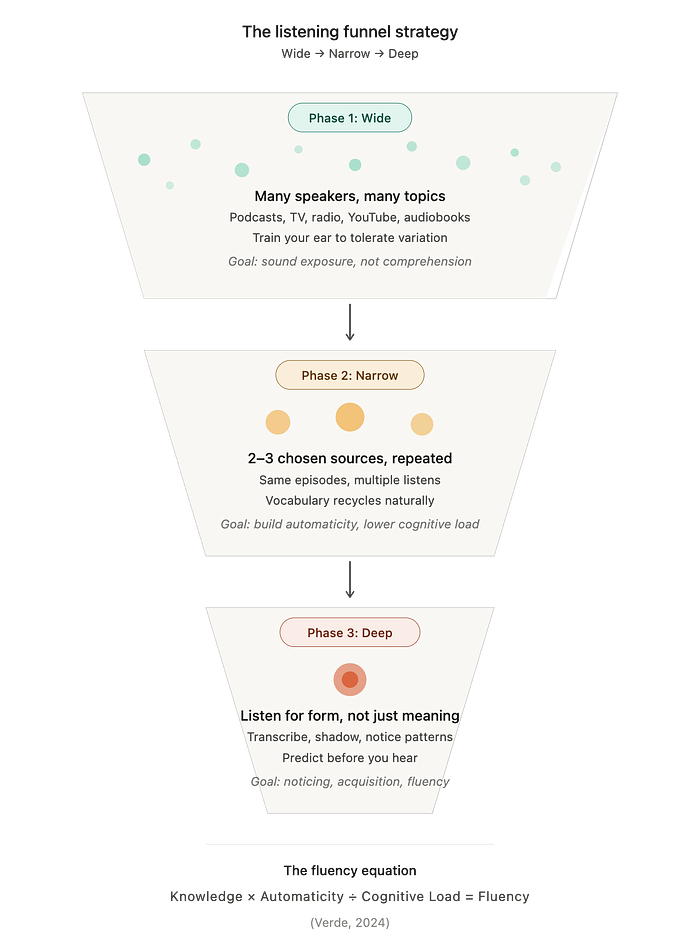
1. Go Wide
Listen to as many different sources as you can find. Podcasts, YouTube channels, radio, audiobooks, TV shows. Do not worry about understanding everything. You are training your ear, not testing your comprehension. Aim for 30 to 60 minutes a day across multiple sources.
- Choose content in your target language on topics you already know well in your first language (this activates top-down processing even when bottom-up decoding fails)
- Vary the speakers: male and female voices, different regions, different ages
- Do not pause, rewind, or look up words. Just let the sound wash over you.
- Keep a running list of sources you enjoy and can follow at least partially
2. Go Narrow
From your wide exposure, pick two to three sources where you understand roughly 60% to 70% and genuinely enjoy the content (Krashen's "compelling input"). These become your core listening sources.
- Listen to the same episodes or segments multiple times before moving to new ones
- Use transcripts or captions on the second or third listen to verify what you heard
- Track recurring vocabulary and phrases in a simple notebook. Do not make flashcards yet. Just notice.
- Stick with these sources. Resist the urge to jump to something new. The repetition is the strategy.
3. Go Deep
With your narrowed sources, shift from listening for meaning to listening for form. This is where you train your ear at the level of individual sounds, word boundaries, and prosodic patterns.
- Listen to a 3-to-5-minute segment and try to transcribe it by hand, then compare with the actual transcript
- Shadow the speaker: play a sentence, pause, repeat it out loud matching their rhythm and intonation
- Identify one grammatical pattern per week that you hear repeatedly. Do not study the rule first. Notice the pattern in context, then look it up.
- Once a segment feels "easy," move to the next one from the same source. You stay narrow, but you go deeper.
Final Thoughts
Your brain needs the ocean first. Then it needs a harbor. Then it needs to learn every current and depth of that harbor until it can sail those waters with its eyes closed.
Most learners get stuck because they stay in one phase. They keep swimming in the ocean. Or they try to build a harbor without ever seeing the ocean.
Listening fluency comes from moving through all three. Wide, narrow, deep. In that order.
That is how listening fluency works. Not by randomly consuming more. By funneling what you consume until the signal becomes unmistakable.
Thank you!
Subscribe to How We Learn Languages for weekly research-backed deep dives and daily notes (gift inside — 32-page Language Learning Starter Kit)
More recommended stories:
References
Anderson, J. R. (1990). Cognitive psychology and its implications (3rd ed.). W.H. Freeman.
Burns, A., & Siegel, J. (2022). Teaching and researching listening in a second language. In E. Hinkel (Ed.), Handbook of practical second language teaching and learning (pp. 226–237). Routledge.
Ellis, N. C. (2008). Usage-based and form-focused language acquisition. In P. Robinson & N. C. Ellis (Eds.), Handbook of cognitive linguistics and second language acquisition (pp. 372–405). Routledge.
Ferreira, F., & Patson, N. D. (2007). The "good enough" approach to language comprehension. Language and Linguistics Compass, 1(1–2), 71–83.
Krashen, S. D. (1996). The case for narrow listening. System, 24(1), 97–100.
Kurokawa, S., et al. (2025). Incidental vocabulary acquisition through captioned viewing: A meta-analysis. Language Learning, 75(1). https://doi.org/10.1111/lang.12697
Mauludin, L. A., et al. (2025). "I can now hear the pauses": The narratives of L2 listening and vocabulary development through extensive viewing. Cogent Arts & Humanities, 12(1). https://doi.org/10.1080/23311983.2024.2448904
Nation, I. S. P. (2013). Learning vocabulary in another language (2nd ed.). Cambridge University Press.
Renandya, W. A., & Nguyen, M. T. T. (2022). Teaching speaking in L2 contexts. In E. Hinkel (Ed.), Handbook of practical second language teaching and learning (pp. 271–279). Routledge.
Rodrigo, V. (2006). The amount of input matters: Incidental acquisition of new words in the written mode. In C. Klee & T. Face (Eds.), Selected proceedings of the 7th conference on the acquisition of Spanish and Portuguese as first and second languages (pp. 180–188). Cascadilla Press.
Rost, M., & Brown, S. (2022). Second language listening. In E. Hinkel (Ed.), Handbook of practical second language teaching and learning (pp. 238–256). Routledge.
Schmidt, R. (1990). The role of consciousness in second language learning. Applied Linguistics, 11(2), 129–158.
Tsang, A. (2019). Narrow listening with authentic materials. ELT Journal, 73(4), 404–413.
Vandergrift, L., & Goh, C. C. M. (2012). Teaching and learning second language listening: Metacognition in action. Routledge.