Neuroscience is one of the most interesting topics nowadays. I completely fell in love with it during my first year as an undergraduate student of Psychology. Since then, I read tons of books to learn more and more about the topic.
Learning neuroscience changed my life, and I'm pretty sure it will change yours!
Here I will recommend the books that completely changed how I think, perceive, and experience life and made me fall in love with neuroscience.
5: The Forgetting Machine by Rodrigo Quian Quiroga
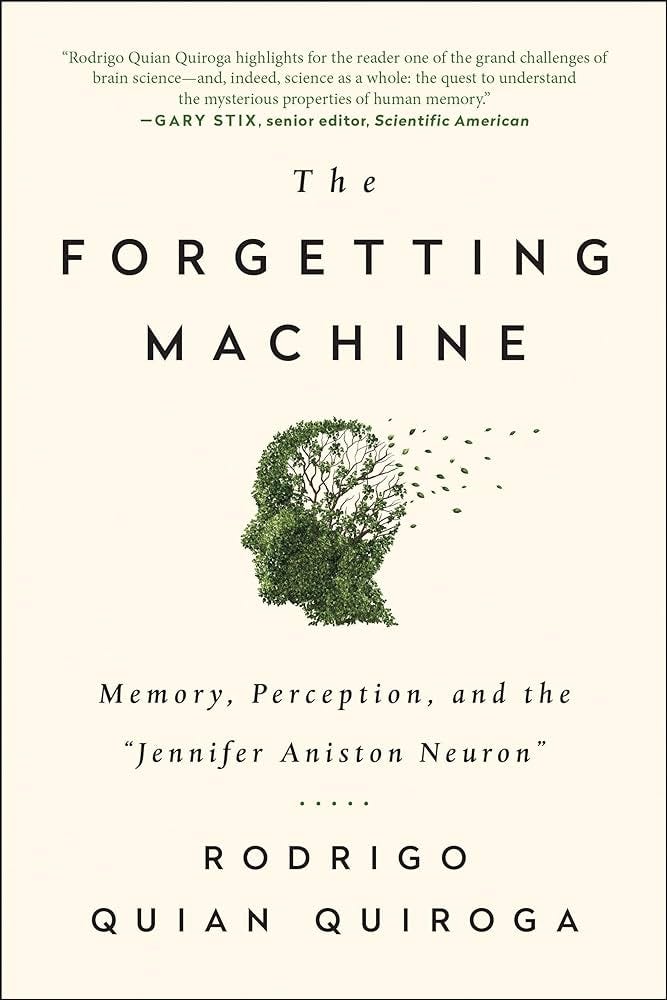
This book is about memory and its myths. Rodrigo Quiroga is a recognized Argentinian neuroscientist known to have discovered the "Jennifer Aniston" neurons, named concept cells. These are neurons that "fire" when a person sees an object that represents a concept. By showing images of famous people, like Jennifer Aniston or Luke Skywalker, they found that some neurons specifically fire when those images are presented to the person (for a review, you can read reference 1).
Rodrigo smoothly writes about the misconception regarding our capacity to retain rich details from our memories. The reality is that the brain doesn't and can't do this! Our brain remembers the context instead of the details because we don't have enough neurons to account for this.
Here's a quote from the author about this:
"The astounding truth that, starting from very little information, the brain generates a reality and a past that make us who we are, despite the fact that this past, this collection of memories, is extremely slippery; despite the fact that the mere act of bringing a memory to our consciousness inevitably changes it; despite the fact that what underlies my awareness of a unique, immutable "self" that makes me who i am is constantly changing"
This book also covers deep questions just as: How do we store memories? How much do we remember? How does the brain represent concepts? Can androids feel?
If you are interested and want to start with the Neuroscience of Memory, this is an excellent beginner option!
4: Your Brain is a Time Machine by Dean Buonomano
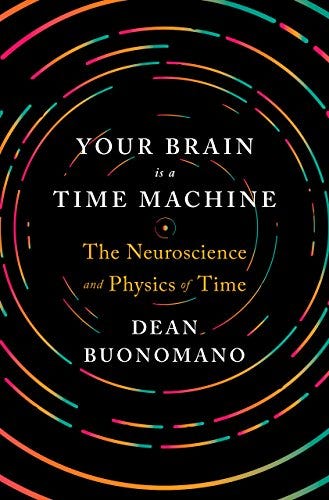
Another great book! This one completely changed my view about time, and I realized how difficult and controversial it is.
Dean Buonamono, another recognized neuroscientist with a Physics background, brought this amazing book about perhaps one of the most mysterious things in the universe: time.
Time is in the top 5 most common nouns used in the English language, remarking the importance of the concept in our lives. Dean takes us on a journey from the philosophy of time (presentism vs eternalism), to circadian rhythms, to the physical and mental nature of time.
In the book, the author argues that our brain is a time machine because:
1. It remembers the past in order to predict the future
2. It tells you the time
3. It is a machine that creates the sense of time
4. It allows us to mentally travel back and forth in time
The most interesting part for me was the intersection of physics and neuroscience. Perhaps time is just an illusion generated by our brain, thus being completely subjective. If this is true, the way we studied time during the centuries was incorrect, and this was something that even Einstein was worried about!
Here's a quote about this:
"A further conflict between physics and neuroscience is that if the flow of time is an illusion created by the mind, then instantaneous slices of the block universe must be able to sustain the phenomenon of consciousness. Yet we are not conscious of instantaneous moments, but rather of chunks of time that capture meaningful and interpretable events — the "specious present". Even more vexing is the question of whether the phenomenon of consciousness itself requires some temporal thickness. Perhaps consciousness is more akin to evolution, an inherently temporal process that cannot be really said to exist within a static frame."
3: Anxious by Joseph LeDoux
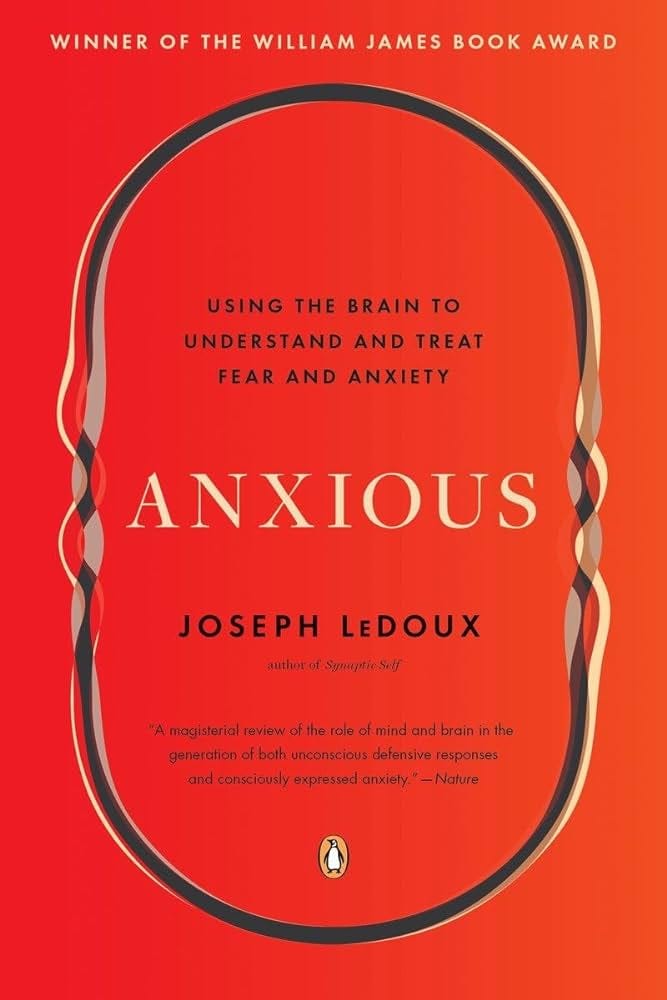
I remember reading this book when I was an undergraduate student in Psychology in my first year. Anxious changed how I perceived anxiety and fear and made me realize that it is present in many other non-human animals.
Joseph LeDoux is a rock star (quite literally because he also has a band called the Amigdoloids) when talking about emotions and fear. In this book, he carries us to the basic neuroscience behind fear and anxiety, the importance of animals in studying these, and also how this research can be implemented in psychological treatments.
In other words, you will learn the neurobiology and philosophy of fear, anxiety, and emotions to the possible implementations in psychological treatments.
Although this book is from 2012, I think that everyone should read it once!
2: Behave: The Biology of Humans at Our Best and Worst by Robert Sapolsky
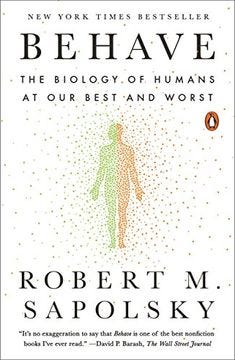
Behave was, without a doubt, the best book I read in 2023. I remember reading it on the train when I was going to work, and I couldn't focus too much as I wanted to read it more and more!
Sapolsky is another prestigious researcher who dedicated decades to studying behavior in humans and non-human animals. He takes us on a journey from the very basics of the brain (anatomy, functionality, etc), to how we end up having wars, peace, and other remarkable human behaviors.
I loved how he structured the book. He started dividing behavior and brain into time lapses: from seconds, hours, days, months, and years. Then, Robert explains all the physiology and behaviors that are related to those time lapses.
The book is quite long: more than 600 pages of pure science! The book even has 3 appendixes for Neuroscience 101, The Basics of Endocrinology, and Protein Basics.
Here's how the book starts in Chapter One:
A behavior has occurred — one that is reprehensible, or wonderful, or floating ambiguously in between. What occurred in the prior second that triggered the behavior? This is the province of the nervous system. What occurred in the prior seconds to minutes that triggered the nervous system to produce that behavior? This is the world of sensory stimuli, much of it sensed unconsciously. What occurred in the prior hours to days to change the sensitivity of the nervous system to such stimuli? Acute actions of hormones. And so on, all the way back to the evolutionary pressures played out over the prior millions of years that started the ball rolling.
Amazing, isn't it? If you're looking to learn more about behavior, seriously, you MUST read this book.
1: Being You: a New Science of Consciousness by Anil Seth
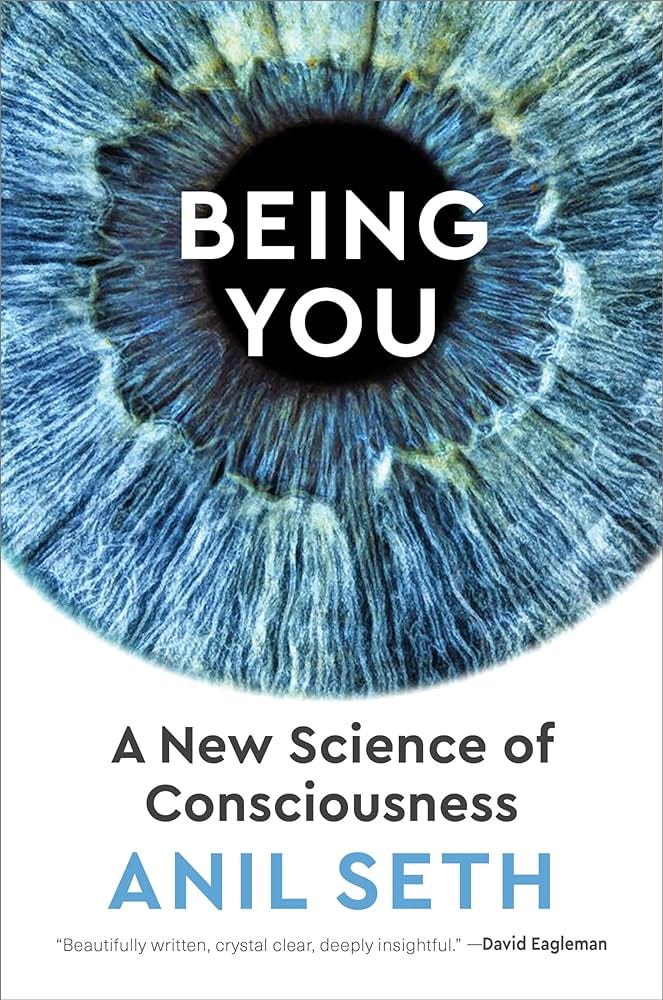
In the top 1 I have my favorite Neuroscience book: Being You by Anil Seth. Since I was a kid, I've been very interested in how we experience the world.
I often extend these thoughts to other animals: do they perceive the world like us? Are they conscious?
Being you takes you from the philosophical debate of consciousness to the core of how we have experiences. Particularly, Seth uses examples from optical illusions, showing us that it is the brain that generates consciousness. For example, the classic dress image (is it black and blue or white and gold?) gets multiple experiences, and the truth behind this is that they are all true.

Seth then uses the analogy of the "Bayesian Brain", beautifully arguing that the brain is like a Bayesian machine, making the best inferences from the information it has at that moment.
Finally, he argues about other types of consciousness, and he talks about it not in singular, but in plural: there may be consciousnesses out there, in several non-human animals. He puts the case about what is it like to be an octopus, an incredible example from the animal kingdom.
Importantly, he argues about a misconception of consciousness in several academics and people: consciousness and intelligence ARE NOT the same thing.
Being intelligent doesn't mean consciousness, and Seth argues that this is the reason Machines are not conscious, perhaps intelligent.
Here's one of my favorite quotes from the book:
"Looking out across the wild diversity of life on Earth, we may value more — and take for granted less — the richness of subjective experience in all its variations and distinctiveness, in ourselves and in other animals too. And we may also find renewed motivation to minimize suffering wherever, and however, it might appear."
If you're interested in animal consciousness, I wrote (and I will write way more!) something about it:
Conclusion
These books changed my life and the way I see and experience the world. I hope they can motivate you as well!
Comment below if you have an additional recommendation!
Have you read these books? What's your opinion about them?
If you liked the post, please react, comment, and follow me for more neuroscience articles!
Let's connect on LinkedIn!
Cheers!
📚 References
1. Quiroga, R. Concept cells: the building blocks of declarative memory functions. Nat Rev Neurosci 13, 587–597 (2012). https://doi.org/10.1038/nrn3251
My Friend retro games NES SEGA