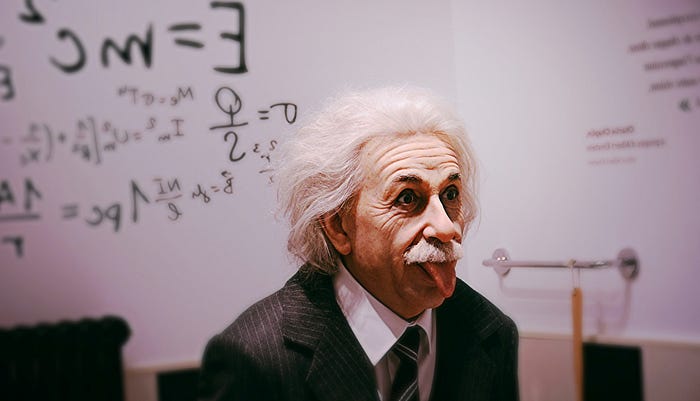
Einstein rejected the personal God. But there's more. His views were nothing like yours. He called belief in an afterlife "ridiculous egotism." What does that even mean? Einstein wasn't religious. He didn't pray. Or follow ritual. He didn't believe in a God who intervened in our affairs, answered prayers, or kept score. He was absolutely clear on this. "I cannot imagine a God who rewards and punishes the objects of his creation," he wrote, "whose purposes are modeled after our own — a God, in short, who is but a reflection of human frailty."
It's a direct rejection of almost every mainstream religious tradition.
But it's not the end of it.
There's more.
Einstein wasn't an atheist. Not even close. He found militant atheism just as intellectually arrogant as fundamentalist religion. "I do not share the crusading spirit of the professional atheist," he wrote, "whose fervor is mostly due to a painful act of liberation from the fetters of religious indoctrination received in youth."
Wow.
In other words, calm down.
The angry atheist is just reacting. Einstein wanted something more than what religious institutions teach. When Einstein used the word God, he meant something no one else means by it: the structure of the universe itself. The laws. The patterns. The breathtaking, mind-blowing fact that the cosmos is comprehensible at all. That a human brain, this fragile, evolutionary accident of a brain, can sit down with a pencil and paper and describe the motion of galaxies.
That, to Einstein, was the miracle.
It had nothing to do with the resurrections. Or the stories I've read in the Bible. The fact that mathematics works. "My religion consists of a humble admiration of the illimitable superior spirit who reveals himself in the slight details we are able to perceive with our frail and feeble mind."
Read that slowly, please.
He's not describing a deity with intentions. He's describing a feeling, the feeling you get when you get something true about the universe and realise, immediately, how much you don't know. Or understand. The details. And a feeble mind. The Focus here is entirely on limitation, not on revelation. That's not faith in the traditional sense.
It's the opposite.
The permanent awareness of how little you know.
But there's this one quote by Einstein that sounds like he's endorsing Buddhism. "If there is any religion that could respond to the needs of modern science, it would be Buddhism." He rarely endorsed anything religious. But he was pointing at one, in its philosophical rather than devotional form. It doesn't demand belief in the supernatural. But a direct observation of experience. On the impermanence of all things, the dissolution of a fixed, permanent self. It's less a religion in the Western sense.
And more of a practice of radical attention.
Buddhism resonated with Einstein because it teaches what physics kept telling him. The universe doesn't have a fixed centre. Time isn't what we think it is. The observer and the observed are not completely separate. What you assume to be permanent almost certainly isn't. He thought what Buddhism teaches (how it approaches knowledge, uncertainty, and the nature of self) sits more comfortably alongside modern physics than, say, a literal reading of Genesis does. It's a precise and limited observation.
Einstein also thought ethics didn't need God.
Most traditions build ethics on divine command. Be good because God said so. Avoid cruelty: punishment awaits if you don't. Love your neighbour: that's how you get rewarded. The entire architecture of moral life, in this view, depends on a divine judge keeping records of our deeds, good and bad. Einstein thought this was unnecessary.
"A man's ethical behaviour should be based effectually on sympathy, education, and social ties and needs; no religious basis is necessary. Man would indeed be in a poor way if he had to be restrained by fear of punishment and hope of reward after death." He's saying if your motivation for being kind is avoiding hell, you're not kind.
You're just well-incentivised.
For Einstein, true ethics came from something far more ordinary and demanding: empathy, connection, understanding why other people's suffering matters. You don't have to be told by a book to be good. Or kind to others. Fear doesn't have to be the reason you are good. Just be good. Einstein is asking you to build your moral framework without a safety net. Most people find that uncomfortable, which is probably why most people don't do it.
What did Einstein mean when he said:
"Science without religion is lame, religion without science is blind."
Religious people love the first half. Atheists try to contextualise it away. Both are missing the point. When Einstein said "religion", he didn't mean institutional religion, doctrine or scripture. He meant a sense of what matters, what you're trying to do, what values and principles you use for your big question inquiry.
Science without that is lame in the most literal sense: it can move, technically, but it has no direction. It can build and destroy. Pure scientific process without values is just power without wisdom. And religion without science is also blind: it claims to describe reality while refusing to look at it objectively. It mistakes metaphor for fact. And passed on experiences as the only truth. Together, though, a reverence for truth combined with rigorous methods for finding it changes everything.
That's what Einstein was trying to say his whole life, without ever finding a tradition that teaches both. The one thing he kept coming back to was intellectual humility. The specific, disciplined recognition that what you don't understand exceeds what you do. "What I see in Nature is a magnificent structure that we can comprehend only very imperfectly, and that must fill a thinking person with a feeling of humility. This is a genuinely religious feeling that has nothing to do with mysticism," he said. He's making a clear distinction between mysticism, the claim to special access, hidden knowledge, and revelation beyond reason. And what he felt was awe at the limits of reason itself.
"I prefer an attitude of humility corresponding to the weakness of our intellectual understanding of nature and of our own being," he said.
You don't need mysticism to be humbled by the universe.
You need to understand enough physics to know how little physics has explained. The more you learn, the bigger the unknown gets. Einstein knew this. He was the most famous scientist alive, and he spent his final thirty years failing to unify gravity with electromagnetism. The universe didn't cooperate with his intuitions. It rarely does with anyone's. It didn't shake his reverence for all things he couldn't comprehend. Einstein's position on God, religion and spirituality forces you to ask yourself.
Do you hold your beliefs, religious, atheist, spiritual or whatever, because you know it to be the only truth? Or were they handed them young and never got around to checking them against reality? Einstein was suspicious of both the religious and secular. He saw the same psychological pattern in both. Certainty adopted to relieve anxiety, rather than conclusions reached through inquiry, or knowledge acquisition. He was willingness to sit with the awe of the universe without needing to resolve it into doctrine.
A capacity to say "I don't know what this means" without it being a personal crisis. He had his own blind spots. He was sometimes arrogant about his intuitions. A complicated human being if you ask me.
But on this particular question.
What it means to live with reverence for reality without pretending you understand it. He was onto something most religious traditions have not caught up with. Einstein had a sustained, disciplined, humble attention to a universe that never stopped being astonishing. And the courage to admit, right to the end, that he still didn't fully understand it.
Most of us never manage that.
"As a human being, one has been endowed with just enough intelligence to be able to see clearly how utterly inadequate that intelligence is when confronted with what exists." — Einstein (1932)
This quote sums up everything I know, or don't:
"We are in the position of a little child, entering a huge library whose walls are covered to the ceiling with books in many different tongues. The child knows that someone must have written those books. It does not know who or how. It does not understand the languages in which they are written. The child notes a definite plan in the arrangement of the books, a mysterious order, which it does not comprehend, but only dimly suspects. That, it seems to me, is the attitude of the human mind, even the greatest and most cultured, toward God. We see a universe marvelously arranged, obeying certain laws, but we understand the laws only dimly. Our limited minds cannot grasp the mysterious force that sways the constellations."― Albert Einstein
The universe is like an ancient library. There is order here. There is pattern. Books don't lie randomly on the floor. They're shelved by some logic. Did someone arrange this? Physics gave us some answers. Mathematics gave us more. We can follow certain arguments. And trace certain laws across the shelves. And every translation we manage reveals ten more volumes we hadn't noticed before, in books we've never seen.
There are more questions than answers.
Einstein never got all the answers he wanted.
I wouldn't pick one book in library and say it's the key to all the others. And stopping looking. I can't stop at one book. I'm staying in the library. Keeping my eyes open. Admitting that the mysterious order is beyond me. This is what Einstein meant by humility with ambition. You push as far as your mind can go. You go further than almost anyone before you. And then you stand at the new edge and acknowledge: there's more in this library. Einstein suspected a plan. The arrangement couldn't not be random. He marvelled at the order. But he never claimed to have found the librarian. Never claimed to understand the cataloguing system.
He didn't pretend his translations were anything other than partial and subjective. Einstein knew so much about our universe. But he stood in the library, until the end, looking up. Still a child.
Still wondering.