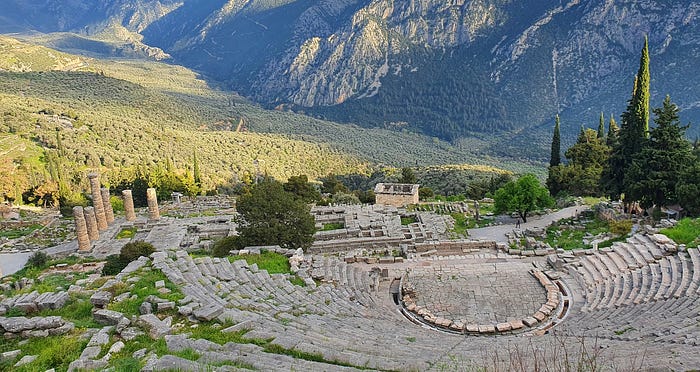
Socrates taught Plato. And Plato taught Aristotle. But Socrates left no written works of his own. Everything from him was written by Plato. The Oracle at Delphi back then said Socrates was "the wisest man in Athens." But he tried to prove the Oracle wrong. He went around the city questioning politicians, poets, and craftsmen. Anyone with a reputation for wisdom. He found something consistent: these people believed they knew things they didn't actually know. And they were confident about it. Now, Socrates realised his only advantage was knowing the boundary of his own knowledge. He could see where his understanding ends. Everyone else couldn't. That was his "specific" leverage.
Socrates confessed, "I know that I know nothing." That short wisdom has been passed on for over 2,400 years. He also said, "The only true wisdom is in knowing you know nothing."
People with low competence in any domain don't just make mistakes. They don't have the ability to recognise their mistakes. They rate their own performance significantly higher than it is. The reverse is also true. As people become genuinely expert, they become more uncertain, not less. They understand their areas of expertise well enough to see how many unsolved problems exist. And how many assumptions are untested?
Experts hedge.
Beginners speak with certainty.
Richard Feynman, one of the smartest minds of the 20th century, built his entire intellectual reputation around this. He said the first principle of science is that you must not fool yourself. And you are the easiest person to fool. He wasn't kidding. He kept a mental inventory of things he didn't understand. He thought confusion was better than false clarity.
"I would rather have questions that can't be answered than answers that can't be questioned," he said. Einstein also said, "The more I learn, the more I realize how much I don't know."
The unfortunate reality is that intelligent people can become less curious as they get more credentialed. It's a strange thing. Isn't it? The degree, the title, and the track record can all become traps? They stop you from becoming a free thinker. There's a concept in Zen called shoshin: beginner's mind. Experts have few possibilities available to them. But beginners have many. They still ask the beautiful questions. Carol Dweck's research on mindset confirms this. People who believe their intelligence is fixed. A thing they have, take the path of least resistance, avoid challenges, deflect criticism, and plateau. But those who believe intelligence is a process stay open longer and upgrade their mindsets faster.
The fixed mindset is a defence mechanism.
The growth mindset is a confession: I'm not done yet.
Socrates applied the growth mindset 2,000 years before Dweck had a name for it. Premature closure is doing more harm to most careers than knowledge ever will. Deciding you know before you've verified is a trap Socrates tried to avoid. I've been more wrong about what I thought I knew about people than I can count. Even in our arguments, when you think you are completely certain. Or understand what the other person means, chances are you wrong. Every wrong about their intent or feeling.
Certainty closes you off. You stop listening. You think you already knew where the conversation is going. Even in our financial decisions, overconfidence is the most costly cognitive bias. More than loss aversion, more than anchoring. If you think you might be wrong, you build in a margin for error.
Socrates' confession opens doors.
It makes you stop defending a position. And start testing it. You stop asking questions and hoping the answers confirm what you already believe. There's a term for the space between knowing and not knowing: aporia. Socrates deliberately put people in aporia. He'd ask a question, get an answer, ask another, and quickly the person would realise their original answer didn't hold up. That's why he said, "I cannot teach anybody anything. I can only make them think." Most people found his "productive discomfort" annoying. Some were even furious with him for doing it. But the discomfort was the point.
The Socratic method is his confession in action.
Socrates built a whole technique around "I know nothing." He asked questions he didn't have answers to. He followed the logic wherever it led, even when it got him into trouble. He treated every conversation as an investigation, not a debate to win. His confession is the starting point for an intellectual upgrade. You admit you don't know, then you do something with that admission. You ask better questions. You pressure-test assumptions. You let the conversation go somewhere you didn't plan.
Socrates's method as a way of thinking only works if you genuinely believe you might be wrong. And do something about it. Aporia makes practical learning become possible. Einstein was right. "Imagination is more important than knowledge. For knowledge is limited to all we now know and understand, while imagination embraces the entire world, and all there ever will be to know and understand."
When someone disagrees with you, your first instinct should be curiosity, not defence. Sometimes they're wrong. But if you start from a beginner's mindset, you'll know the difference. Before you make a major decision, list out the things you don't know. Where are the gaps? What's your uncertainty based on? What are you assuming? Seek out people who make you feel dumb. People who know things you don't. Those who push the edges of what you understand. Those conversations are uncomfortable. They're also where you grow fastest. It's amazing how rare "I don't know" is in most professional settings. People would rather say more, even things they are not sure about, than ask better questions.
"We can easily forgive a child who is afraid of the dark; the real tragedy of life is when men are afraid of the light," notes Socrates.
Admitting you might be wrong about anything is the hardest thing for our minds. We're wired to protect the ego. You can't just "question" everything you've believed to be true for all those years. Even in social experiences (at work, in families and online), certainty is rewarded. It looks like confidence. And it gets attention. But you risk stagnation. "Confidence is what you have before you understand the problem," says Woody Allen. In fact, intellectual humility is so hard, Socrates died for it. The Athenians put him on trial partly because he kept exposing how little the people in charge understood justice, virtue, and politics. He made the powerful feel small and confused. They couldn't take that. Or let it go.
Most of us don't face the kind of resistance Socrates had in his time. But there's still a cost. "I might be wrong" is not encouraged. No one wants to be that "vulnerable." But absolute certainty is even worse. It's a trap. Once you're stuck, you're just rearranging existing knowledge.
Aim to put any process to the test. Making life work is a flame. Something alive that needs air and fuel. You only grow by staying open. The more you know, the more there is to burn. Be confident in your ability to keep asking, keep revising, keep learning.
You don't need to have the answer to trust that you're the kind of person who'll keep looking for it. It's a better approach to life than absolute certainty. Curiosity will do more for your life than trusting in "one" truth. The "democratic" process at the time found Socrates irritating. But he was onto to something. The Socratic method has changed lives. There's something to learn from "I know that I know nothing." Start there.
"It is impossible for a man to learn what he thinks he already knows." — Epictetus, Discourses