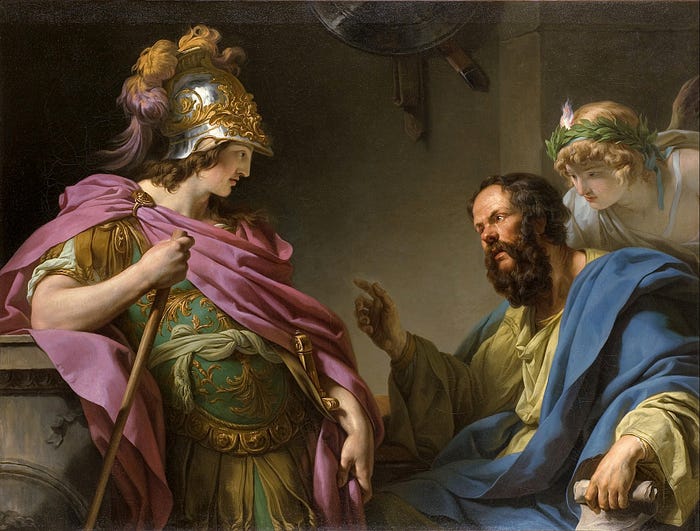
For every philosopher, Socrates (469-399 B.C.) is a model. He is the one who is considered to have given birth to the discipline that we know today as philosophy.
Of course, there were thinkers before Socrates, what we call the pre-Socratic philosophers. They made important contributions to metaphysics, cosmology, and epistemology. However, Socrates made a crucial shift by grounding philosophical inquiry in a broader way. His approach redefined the role of philosophy in public discourse and shaped its trajectory in ways that profoundly influenced later thinkers such as Plato and Aristotle. Thus, there is a before and an after Socrates in the sense that we can say that without Socrates there would be no philosophy as we know it.
But Socrates is largely a mythical figure. He is also one of a few rare cases in history where a philosopher did not write anything. This can be confusing since his name often appears on the cover of books. At your local bookstore, if you find a piece of text with "Socrates" as the author's name, you can safely assume that someone — a publisher, an author, or someone else — is trying to lure you in.
Everything we know about Socrates has been told to us by someone else. Our best teacher about Socrates is the famous Plato (429?-347 B.C.). Because of this, we only have secondhand accounts of Socrates' teachings and only a small portion at that.
In Plato's writings, Socrates seems to be the main protagonist; the archetypal figure of what a philosopher is, or at least what a philosopher was thought to be for a very long time.
In this article, I would like to introduce you to the man, the myth, and the model that Socrates represents. I will begin with a brief overview of what we know about him. I will introduce you to what specialists call "the Socratic problem." Then I will present an important episode in his life, both as a man and as a philosopher: his trial and death sentence.
Socrates: The Man
Socrates is believed to have been a legendarily ugly man. Of course, there is some debate on this point, but at least he did not look like the Greek statues we see in museums. It is not relevant to his philosophy, but it may be useful to understand the character that Plato portrayed in his writings. This can be easily found even in contemporary introductions such as the Stanford Encyclopedia of Philosophy:
The extant sources agree that Socrates was profoundly ugly, resembling a satyr more than a man — and resembling not at all the statues that turned up later in ancient times and now grace Internet sites and the covers of books. He had wide-set, bulging eyes that darted sideways and enabled him, like a crab, to see not only what was straight ahead, but what was beside him as well; a flat, upturned nose with flaring nostrils; and large fleshy lips like an ass. Socrates let his hair grow long, Spartan-style (even while Athens and Sparta were at war), and went about barefoot and unwashed, carrying a stick and looking arrogant. He didn't change his clothes but efficiently wore in the daytime what he covered himself with at night. Something was peculiar about his gait as well, sometimes described as a swagger so intimidating that enemy soldiers kept their distance. He was impervious to the effects of alcohol and cold weather, but this made him an object of suspicion to his fellow soldiers on campaign. We can safely assume an average height (since no one mentions it at all), and a strong build, given the active life he appears to have led. ("Socrates")
The Greeks of that time were people who valued social status, wealth, education, and so on. What we know about Socrates leads us to believe that he didn't meet these standards. He didn't work for a living. He didn't even try to make a living from his teachings. He preferred to embrace poverty — at least according to many commentators — and spend time with the young people of the city, some of whom followed his example.
However, he was known to be very active in public places such as the marketplace, conversing with people of different genders, ages, and social statuses (including slaves and foreigners). He conversed not to teach people what he personally took for granted, but to discuss the presuppositions of his interlocutors. This was what philosophizing meant to him: arguing with anyone, educated or not, who wanted to discuss matters that could not be settled without resorting to the art of reasoning.
Socrates is the archetype of the public philosopher.
Socrates: The Myth
However, there are severe limitations to what we know for certain about Socrates. Of course, with any famous philosopher, it is never easy to distinguish between what history or sources teach us for certain and what is a mere construction. However, the case of Socrates presents a unique problem: history and sources tell us very little and seem to contradict each other. This is what specialists call the "Socratic problem."
The "Socratic problem" refers to the historical and methodological problem that historians confront when they attempt to reconstruct the philosophical doctrines of the historical Socrates. ("The Rise and Fall of the Socratic Problem," p. 1)
The "Socratic problem" refers to the scholarly difficulties faced by historians and philologists in reconstructing both the life and philosophical views of the historical Socrates. This problem seems insoluble, as Louis-André Dorion suggests:
Socrates, as we know, wrote nothing. His life and ideas are known to us through direct accounts — writings either by contemporaries (Aristophanes) or disciples (Plato and Xenophon) — and through indirect accounts, the most important of which is the one written by Aristotle, who was born fifteen years after Socrates' death (399). Because these accounts vary greatly from one another, the question arises as to whether it is possible to reconstruct the life and — more importantly — the ideas of the historical Socrates on the basis of one, several, or all of these accounts. ("The Rise and Fall of the Socratic Problem," p. 1)
This is an old problem. Earlier philosophers, such as Hegel, had already raised concerns about the historical Socrates versus the literary Socrates. But the one who is credited with having made an important contribution to posing this question is not Hegel, but Friedrich Schleiermacher with his 1818 paper entitled "The Worth of Socrates as a Philosopher." And although some philosophers, such as Karl Popper, have approached the Socratic problem, most specialists today consider it to have no definitive solution.
Socrates remains an enigmatic figure — his life and thought are accessible to us only through interpretive reconstructions, making him a paradoxical case: a historical figure whose heritage takes on the character of myth.
Socrates: The Model
Much of our fascination with Socrates is due to the way he has been portrayed and his thought transmitted by Plato. However, an important part of the image we have of him comes from a specific element of his life: his trial and death sentence.
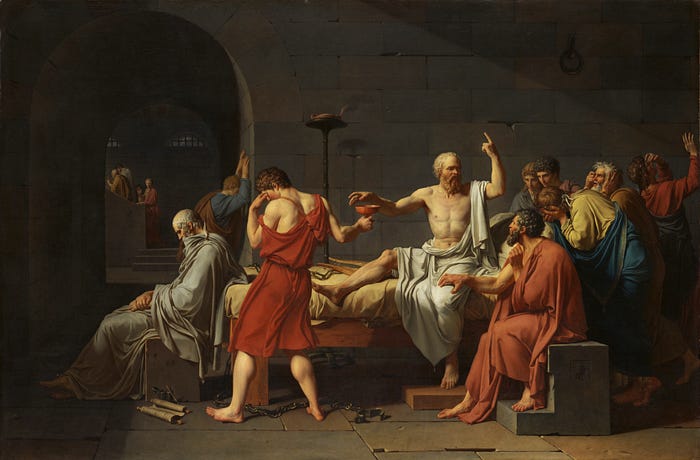
The trial and execution of Socrates in 399 B.C. were a defining moment in the history of Athens and the history of philosophy. Socrates was accused of impiety — not honoring the gods of Athens and introducing new deities — and of corrupting the youth with his teachings.
This singular event has been examined and reexamined ever since. There are other accounts, but it is Plato's that has become philosophy's founding myth and that has immortalized Socrates in the popular imagination as a man of profound moral strength and intelligence — though also as a uniquely peculiar and inscrutable individual. When brought to trial, Socrates was 70 years old, married, the father of three sons ranging in age from 1 to 17, and poor (…). ("The Trial and Death of Socrates," p. 5)
According to Plato, during his trial, Socrates defended himself by saying that he was on a divine mission to encourage moral reflection and intellectual inquiry. Instead of asking for mercy, he said he had done nothing wrong and even ironically suggested that he deserved a reward. This attitude probably irritated the jury, who found him guilty by a narrow margin.
Some scholars have also argued that the trial likely had political motivations related to the instability in Athens after the Peloponnesian War. When it came to sentencing, Socrates refused to suggest a punishment that implied guilt. This led the jury to sentence him to death by drinking hemlock.
A day or two before the end, Socrates's childhood friend Crito tried to persuade Socrates to escape. (…) Socrates could not point to a harm that would outweigh the harm he would be inflicting on the city if he now exiled himself unlawfully when he could earlier have done so lawfully (Crito 52c); such lawbreaking would have confirmed the jury's judgment that he was a corrupter of the young (Crito 53b–c) and brought shame on his family and friends. ("Socrates")
Final Remarks
Obviously, this story is essential to understanding the popularity of Socrates among philosophers. Another dimension is the fact that he was more than open to discussion and that he avoided dogmatic or doctrinal teaching. He was less a teacher in the common sense of what a teacher is than a questioner, and good questioning became the ideal of philosophical inquiry.
He was a philosopher open to putting his ideas out in public, raising questions concerning many topics such as politics, metaphysics, science, art, poetry and, among others, ethics. He was also an example of a humble man who, despite his talents, accepted at least a relative poverty.
We are used to thinking of philosophers as people who teach at famous universities, sell books, and travel — and many professional philosophers (whatever that term means) travel more frequently than most people.
But if we were to meet a person on the street — a man or a woman — talking to people, spreading what seems to most people to be a strange way of thinking, would we really be able to understand that this person could have a multi-millennial influence on human culture.
Don't judge a book by its cover.
For Further Reading
- Debra Nails, "The Trial and Death of Socrates," in Sara Ahbel-Rappe and Rachana Kamtekar (eds.), A Companion to Socrates, Malden, Wiley-Blackwell, 2006.
- Nails, Debra and S. Sara Monoson, "Socrates," The Stanford Encyclopedia of Philosophy (Summer 2022 Edition).
- Louis-André Dorion, "The Rise and Fall of the Socratic Problem," in Donald R. Morrison (ed.), The Cambridge Companion to Socrates, New York, Cambridge University Press, 2011.
- Christopher Charles Whiston Taylor, Socrates. A Very Short Introduction, Oxford, Oxford University Press, 1998.