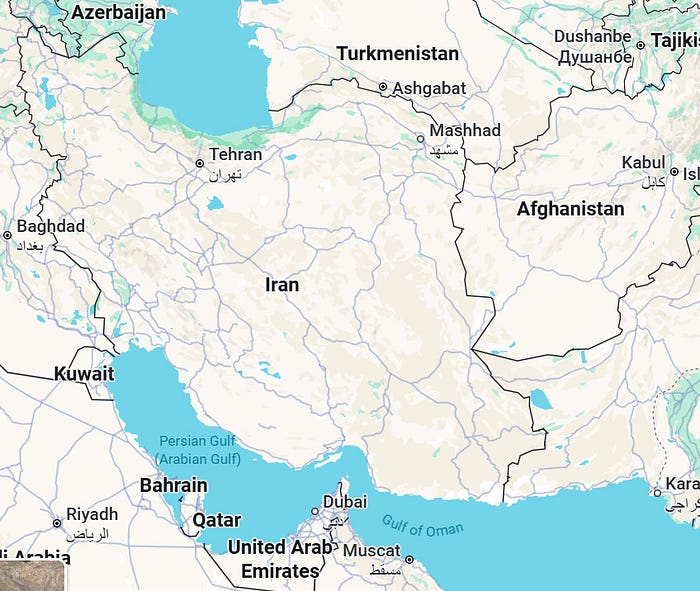
The American and Israeli governments launched a deeply unpopular war on Iran a couple weeks ago, and it has gone as any even lightly educated person would have expected — horribly. Proof of this is in the fact that the Israeli and certain Gulf Cooperation Council (GCC) governments have criminalized sharing footage of damage online, along with the torrent of lies coming from the American government.
If you're wondering how this all might end, read on. This analysis is not based in any preference for one side over the other — all parties involved have blood on their hands, are untrustworthy and, no matter the outcome, innocent civilians just trying to live their lives will suffer the most (as usual). Nevertheless, based on what we do know, we can read between the lines of censorship and misinformation to discern the probable resolution.
Iran won't — can't — quit
Let's put to bed the idea that Iran can be bombed into submission. It won't happen for two simple reasons — 1) wars are rarely, if ever, won by airpower alone, and 2) the Iranians believe, perhaps rightfully, that they are fighting for their very survival. Israeli Prime Minister Benjamin Netanyahu's comments give credence to this belief:
This combination of forces enables us to do what I have longed to do for 40 years — to strike the terrorist regime with a crushing blow. That is what I promised — and that is what we will do.
The conduct of the American and Israeli militaries provides further evidence that the complete destruction of Iran is the goal. They have bombed elementary schools and hospitals, carpet bombed the capital, Tehran, among other cities, hit at least one desalination plant, and targeted and assassinated the Ayatollah Khamenei, the spiritual and political leader of the country, along with other senior leaders. These are all war crimes, by the way.
Ayatollah Khamenei was a controversial figure, even among his own people. When selected to become supreme leader, many balked at the choice because Khamenei lacked the rank of grand ayatollah. Nevertheless, he acquired significant political influence during his stint as president (1981–1989) and had a strong relationship with the Islamic Revolutionary Guard Corps (IRGC), an organization he helped form.
Despite his ostensible unpopularity among many in the populace, killing him was unquestionably a mistake. In addition to Supreme Leader of Iran, Khamenei was the spiritual leader of Shia Muslims, some 200 million people in and outside of Iran.
In an official statement, China said the killing was "a serious violation of Iran's sovereignty and security, a trampling on the aims and principles of the UN Charter and the basic norms of international relations." Hamas called it "blatant aggression and [a] heinous crime against the sovereignty of the Islamic Republic of Iran." Houthi political leaders said much the same. Iran's deputy foreign minister Kazem Gharibabadi summed up the feelings many hold about the ayatollah's assassination: the enemies "must pay the price" for killing him.
Media in Iran interviewed numerous people on the streets of Tehran. Here's what they had to say when asked whether they wanted their government to sign a ceasefire:
Man (30–40 y/o): Sir, don't even speak of it. Even our dead bodies won't surrender to them. Even our corpses won't accept this. For God's sake, don't even talk about it.
Man (perhaps in his 60s): If we truly are followers of our dear leader, he will always be 100% against such compromise.
Man (about mid-20s): We will fight and resist until Israel is destroyed… we must resist like Aba Abdillah.* We must resist even if it takes our own blood.
Woman (maybe 25–40): Didn't this same Israel attack you 6 months ago? Are they going to attack again in 6 months? We do not talk about negotiations. There is no negotiation anymore.
Woman (early 20s): Anyone who says we should negotiate now, seeing these conditions, is truly an idiot.
**Aba Abdillah is a title given to the grandson of the Holy Prophet, Imam Husayn.
Khamenei was near death, at 86 years old and stricken with cancer, which made targeting him even more foolish. Instead of letting a sick old man die on his own, the Americans and Israelis made him a martyr to hundreds of millions of people.
Recall that the CIA and Mi6 helped solidify Shah Pahlavi's power in 1953 by orchestrating a coup to oust duly elected Prime Minister Mohammad Mosaddegh. Dr. Masumeh Bolurchi, of the National Council of Resistance of Iran, has characterized the coup as "one of the most defining and tragic events in Iran's modern history… [and] the start of a systematic campaign to destroy Iran's democratic movement." A key reason the West wanted Mosaddegh out was because he nationalized Iran's oil industry, which threatened to diminish the profits of western oil companies.
The 1979 revolution that established Ayatollah Khomeini as supreme leader was as much a rejection of American (and British) meddling as it was a deposing of the shah and his brutal regime. Thus, killing his successor, Khamenei, only bolstered the long-held belief in Iran that western powers seek to subjugate or outright destroy the country, its culture, and its right to democratically govern itself.
Moreover, regardless if dissension existed among the people prior to the American and Israeli assault, the indiscriminate killing of civilians — especially children — has done more to unify the country than anything. It is akin to the principle that I can fight with my siblings all the time, but the moment an outsider tries, we drop our quibbles and team up against that outsider.
What about a ground war?
Officials in the United States have hinted at putting 'boots on the ground' in Iran. While it is certainly a possibility they will do it, such a decision would be a tragic, catastrophic mistake.
First, the US does not have the troop levels necessary to succeed at a ground war. Estimates put the total number of combat-ready ground troops between 630,000 and 660,000. For perspective, Russia has lost over 700,000 troops to Ukraine since 2022, according to former US Secretary of Defense Lloyd Austin. Casualties from a large-scale invasion of Iran are expected to be far worse and, without a draft, the Americans would not be able to replace their depleting forces (more on the implications of instituting a draft below).
Second, American troops wouldn't just be facing the Iranian military, itself estimated to comprise 960,000 soldiers. They would also be up against a vast network of proxy militias that occupy the country's border regions — the same areas most US soldiers would need to use to gain entry. This would mean skirmishing with potentially hundreds of thousands of enemy fighters, who also have missiles, drones, and other range weaponry, before ever facing Iranian regulars. And it's hard to predict how many of the country's 90 million citizens would take up arms against invaders.
Third, the United States lacks the manufacturing capacity for a sustained ground war. Joe Costa, director of the Forward Defense program of the Scowcroft Center for Strategy and Security at the Atlantic Council, notes that "the Iran war is (already) degrading US military readiness for homeland defense and China." This is highlighted by Trump asking Ukraine — of all countries! — for help:
Facing shortages, the United States has turned, of all places, to the Ukrainian government that Trump has frequently criticized. In a series of social media posts on Thursday, Ukrainian President Volodymyr Zelenskiy revealed that he had "received a request from the United States for specific support in defending against 'shaheds' in the Middle East."
Furthermore, the asymmetry between Iran and the US is a strategic and tactical advantage for Iran. Every cruise missile costs the equivalent of about 2,300 shahed drones. Those drones have proven remarkably effective and can be produced far faster than missiles, which suggests Iran would constantly possess more munitions than the Americans, at least until the United States made substantial changes to its approach.
Fourth, Iran's geographic composition presents a formidable problem. For one thing, the country is three times the size of Iraq; larger than Germany, France, and Spain combined; or about 2.4 times larger than Texas. Its terrain is similar to that of Afghanistan (which is about the size of Texas), where the US military failed miserably against a far less sophisticated opponent. Much of Iran's military infrastructure is located underground and, based on the relative ineffectiveness of the air strikes against it so far (evidenced by Iran's continued successes at striking American and Israeli assets), it seems the US has limited intelligence on specific locations. Soldiers would be marching blindly into an enormous death trap.
Fifth, while there is scant political will in the US for a ground invasion, the populace's apathy will turn to violent protest should Trump attempt to institute a draft — which, as noted, is the only way the military will ever reach enough manpower to engage in a competitive ground war. But parents are not going to sit idly by as their kids are forcibly shipped to the Middle East to fight an illegal war that most believe is nothing but the fulfillment of an Israeli wet dream. Put simply, a draft might very well mark the end of the Trump presidency.
So, if Iran won't quit, and the US can't invade (or shouldn't, anyway), how does this end?
Iran already has the upper hand
This war seems to have been launched without any strategic planning — by the Americans, anyway. (The Israelis appear solely interested in causing damage and chaos, and they are accomplishing both.) For example, Trump officials apparently "did not plan for the possibility of Iran closing the strait [of Hormuz] in response to strikes." **It should be noted Iran claims the strait is not fully closed, it is only closed to American and Israeli vessels and anyone allied with them (see near the 5-minute mark).
In any case, the failure to predict a disruption to one of the world's most important waterways is a stunning portrayal of incompetence.
To illustrate the gameshow buffoonery of American leadership further, here's what the American Secretary of Defense, Pete Hegseth, has said in the last day or so:
it's definitely not a regional war, definitely not a… a world war going on here. Everything is fine. We're condensing it and uh bringing it all together…
Iran's leadership is in no better shape. Desperate and hiding, they've gone underground, cowering. That's what rats do.
On the former claim, numerous countries have been involved, including Iraq, Saudi Arabia, Kuwait, UAE, Jordan, Israel, Oman, Bahrain, Azerbaijan, Lebanon, Qatar, and Cyprus. Sounds pretty regional.
Russia is purportedly supplying intelligence about the locations of American military assets. China is buying the only oil currently flowing through the Strait of Hormuz — from Iran. The US Navy sank an unarmed Iranian ship (also a war crime) in the Indian Ocean. And, as I am writing this, the head of the National Security Commission of the Iranian Parliament, Ebrahim Azizi, announced Iran might target Ukraine for providing drone assistance to its enemies. Sounds increasingly global.
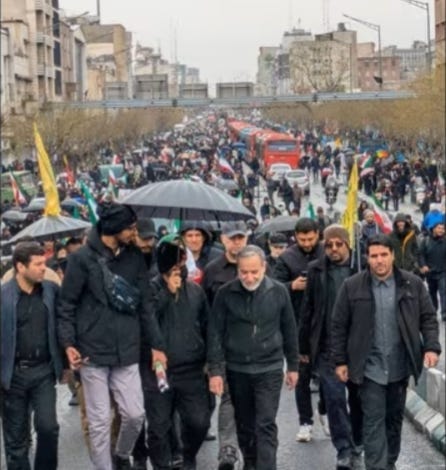
On the same day as Hegseth's gibbering, Iranian leaders literally marched through the streets of Tehran, on video, laughing and mocking the US. The Chief Justice of Iran, Gholam-Hossein Mohseni-Eje'i, gave a speech on the street as bombs fell in the background. He didn't even flinch (see around 17:30). Meanwhile, Bibi Netanyahu and his brother have, by many accounts, disappeared. Like rats, I guess.
In a Truth Social post, Trump recently wrote, "we have already destroyed 100% of Iran's military capability," but then immediately added that Iran could "send a drone or two, drop a mine, or deliver a close range missile" into the Strait of Hormuz. He concluded by begging "China, France, Japan, South Korea, the UK, and others" to send warships to secure the strait.
Uh… what?
What is really happening is European countries are negotiating with Iran directly to gain permission to traverse the strait, bypassing American diplomats entirely. And, obviously, nothing has been destroyed "100%."
The point here is simply: regardless if you like, hate or just don't trust the Iranian leaders, American officials are clearly full of shit and definitely should not be trusted.
Anyway, such a catastrophic oversight (regarding the Strait of Hormuz) has already given Iran a leg up in the conflict. With 20% of the world's oil moving through the strait, its closure will have a profound effect on the global economy. Indeed, gasoline prices in the United States have skyrocketed by as much as sixty cents per gallon since last month. Oil is on the cusp of breaking $100 per barrel, a more than 50% increase over pre-war prices.

But such surges won't stay confined to the pump — the oil market affects every other sector, which means the price of everything is going up. Inflation is expected to exceed 4% in the coming month or two, higher if the conflict rages on. Some speculate it could reach COVID levels within just a few months.
Iran is also using its control of the strait to benefit its economy and enhance its soft power. It has sent its own ships through to transport oil to China. At the same time, it is attacking ships under other flags that attempt to pass without its permission, at least 16 so far. And as Adel Bakawan, the director of the European Institute for Studies on the Middle East and North Africa, stated, "Neither France, the United States, an international coalition or anybody is in a position to secure the strait of Hormuz."
The damage to the global economy is only just beginning.
Another blow from the closure of the strait involves liquified natural gas (LNG) and fertilizer. Products used in fertilizer, such as ammonia, urea, sulfur, and phosphates, all travel through the strait. Around 50% of global urea and sulfur exports originate in areas that utilize the strait. America imports the majority of its phosphates from Saudi Arabia — again now completely shut off by the closure of the strait. LNG also supports farming, among other things, and 20% of the world's supply is essentially gone because its biggest producer — Qatar — has stopped production.
Prepare for serious pain in the grocery store.
To further gut the American (and world) economy, Iran has threatened to target companies in the AI sector, such as Nvidia, Microsoft, Amazon, and others (it has already hit at least two Amazon centers). The circular trading among companies in that sector might be the only thing keeping the US out of a recession. A sudden tanking of their stock from missiles or drones pummeling their datacenters in Dubai, Bahrain, and other places within the range of Iranian munitions could thrust the US and others into recession or even a depression, especially on the heels of exploding inflation.
America and Israel defeated?
It is hard to see any other outcome than Iran achieving a profound victory. But what does that victory look like? First, and foremost, Iran is not going to cease hostilities until Israel is either wholly destroyed or, at least, so diminished in power as to no longer pose a threat to anyone in the region, including Gaza and Lebanon. They will also probably demand that Israeli leaders, including Bibi, should he survive, stand trial for war crimes.
Likewise, Iran will almost certainly demand considerable concessions from the United States. A significant hurdle to Iran's development has been sanctions imposed upon it for decades by the US. Iranian officials insist those have to go and they want reparations for all the damage caused by the indiscriminate bombing. But Iranian leaders will probably pursue more than that.
American politicians have flooded the airwaves and interwebs for years with commentary about Iran as a 'terrorist' organization or supporter. Regardless whether such assertions are true (and it is worth noting that many around the world accuse the US of being the same), when Iran has its enemies in a vice, those claims will be used as leverage in any negotiations with the US.
The problem, however, is that Iran may decline to negotiate with the US if Trump is still in power. His administration has — twice — attacked the country in the middle of negotiations, before anything was decided or dismissed, in just the last year. No rational leader would bother taking a third chance. (Fool me once, shame on you. Fool me — you can't get fooled again). Put bluntly, this conflict may not end as long as Trump remains president. Kazem Gharibabadi has said:
Even if they [US and Israel] request a ceasefire, this has to be put forward when Iran is certain they will not attack again, and they have accepted responsibility for their actions. They cannot just come to us and say ceasefire, and we say OK.
How will the Iranians ever feel certain the US will not attack them again when they have been duped twice by Trump?
Despite the demand for accountability, do not expect a direct attack on the US. Although some commentators have warned about Iranian "sleeper cells" coming to life to commit terrorism in the US or military attacks on the West Coast, this would actually go against the Iranian strategy (and sounds suspiciously like fearmongering to set up a 'false flag' event).
Trump is widely detested both domestically and abroad, so what would be the point of potentially uniting the American populace behind him, when some two-thirds currently oppose this war (or are 'unsure')? In fact, many Americans believe their leaders were tricked into participating in this conflict, as reflected by a common refrain shared on social media:
This is Israel's war. This is not the United States' war.
Others believe Trump was bribed. For this reason, many are calling it 'the Epstein War' or 'Operation Epstein Distraction' or 'Operation Epstein Fury.'
Contrary to the claims of chronic liars Pete Hegseth and Scott Bessent, the United States is quickly losing whatever hold it had on the Middle East. Soon-to-be former allies like Saudi Arabia, the UAE, and Kuwait feel abandoned and are, therefore, parleying with Iran to work out a security arrangement. Iranian officials have made it clear that any deal must include the expulsion of American military forces and business interests from their countries. China is mediating this process, which will only enhance that country's prestige in the region and further erode American soft power.
Reconciliation between Middle Eastern states and Iran, and expulsion of the US, will almost certainly happen because the US has proved it cannot or will not protect its alleged allies' interests.
There is other grave news… news that few in mainstream media have discussed.
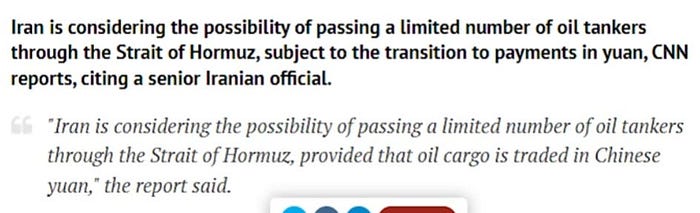
The above screenshot shows, in the view of some financial experts, the greatest threat to the United States from Iran. This issue is best explained in the European Business Magazine:
What makes the Iranian proposal structurally significant is not simply that it challenges the dollar — de-dollarisation rhetoric has circulated for years without materialising into meaningful change. What is different here is the mechanism. Tehran is not merely proposing that some bilateral trade occur in yuan. It is proposing that access to the world's most critical energy chokepoint be conditional on currency denomination.
The practical consequence, if even partially adopted, would be a bifurcated global oil market: yuan-denominated barrels flowing through Hormuz for those willing to pay in China's currency, dollar-denominated barrels rerouted at significant additional cost and time for those who are not. The war premium that Western energy importers are already absorbing would become structural rather than temporary…
What the Hormuz crisis does represent… is the most operationally specific challenge to dollar energy dominance since the system was established.
Russia is sure to benefit as well, as the might of the US military is rapidly being proven to be a fiction. Expect further advances into Ukraine and other parts of Europe, funded by the backpedaling of sanctions on Russian oil (a desperate, but failed attempt to keep prices down at American gas pumps). As Iranian and Russian oil flows more freely, the prospect of an alliance forming among Russia, Iran, India, China, Türkiye, and most of the Middle East grows by the day.
What we are witnessing in real time is the acute reordering of global power — political, military, and economic. And the United States and Israel are finding themselves sidelined. Even if the US quietly steps away from the conflict, the wheels of this realignment are already turning and will not stop absent some profound and unexpected event.
Donald Trump is the most unpopular American president in at least a century. His regime coddles the rich while assaulting the middle and poor socioeconomic classes. Jackboots operating under the guise of federal authorities have attacked American cities, particularly those Trump doesn't like for spurious reasons. Evidence strongly suggests he was directly involved in a sex trafficking ring that included children. Courts have adjudicated him guilty of rape and felony fraud. He ignores the law, courts, and Constitution as a matter of routine.
As the war in the Middle East drags on and sinks the American (and eventually global) economy, a violent uprising against Trump's failed government, particularly in a country where the populace is better armed than many of the globe's standing armies, seems increasingly possible.
Coda
The American empire has been on the decline since the Reagan administration. Trump has not caused it, but he has certainly accelerated it, or perhaps even harkened its final collapse. The damage his ill-considered war has caused, however, will take decades to repair. Some consequences may not be reversible at all. Chief among them is the loss of America's political capital.
Rest assured, Middle Eastern countries will no longer ally with the US, at least not in any way that potentially endangers them or presents an imbalance of power. Others may follow suit, including allies, especially in the context of Trump's ridiculous tariffs and threats. Look at America's neighbor and once closest ally, Canada, as an example. It is investing $40 billion into a military build-up of the Arctic in response to Trump's threats against Greenland and others. Electing a new president isn't going to suddenly convince anyone America got better.
Also, prepare for the dollar to lose preeminence. Governments around the world are not going to stake their economic security on a currency controlled by a rogue government headed by a slow-witted lunatic, whether this one or the next. This will be exacerbated by the currency chokehold Iran seems poised to impose upon oil moving through the Strait of Hormuz. American markets are going to pay a heavy price for years, possibly decades, to come.
Citizens of the United States stand at a crossroads. They can continue down this path of clinging to the delusional belief of their moral, technological, and political superiority and watch their country wither away ever further and faster. Or, they can do what their own founders declared is their right, their obligation:
Whenever any Form of Government becomes destructive of these ends, it is the Right of the People to alter or to abolish it, and to institute new Government, laying its foundation on such principles and organizing its powers in such form, as to them shall seem most likely to effect their Safety and Happiness.
Post script — on nukes
Chatter on the internet and in political circles indicates there are people concerned about the US or Israel resorting to nuclear weapons. I do not expect the United States to do this. Trump is notoriously a coward, and opening that Pandora's box is a step too far for him, if for no other reason than his fear of reprisal. Such reprisal could be in the form of a reciprocal strike or, more likely, in strenuous unified calls for his removal and prosecution.
Trump knows the moment he is out of office he is going to jail for his myriad crimes. It is why he has repeatedly hinted at cancelling, or at least interfering with, America's 2026 midterm elections. He is coasting, for now, on his rock-bottom approval rating by continuously creating a litany of distractions (of which the Iran war is but one) in the hopes that he will — somehow—find a way to (illegally) carve himself out a third term. But, as dumb as he is, he is aware that going nuclear ends all that. At least, I hope so.
Israeli leadership, on the other hand, expresses signs of psychopathy. Nothing should be put past them. They've shown no hesitancy at committing genocide and other crimes against humanity and yet they have the overwhelming support of their citizens. Using a nuke would be a stupid move, of course, because it would likely invite the country's absolute destruction, but psychos tend not to worry over such things.