I realized something was wrong the night I cried over a hand-drawn map of my body.
It was winter in Vienna. My then partner, later husband, now trusted friend, sat on the couch; I lay half-dead on the herringbone parquet floor, facing a piece of paper.
I had sketched a stick-figure of my body and circled the parts that hurt: my left shoulder, my throat, my nose, swollen with what must have been the eighth cold of the year.
Staring at the paper, half-joking and half-desperate, I said, "I just want to feel healthy. I should cut off my head so it stops hurting."
At the time, I was convinced something was wrong with me, my body failing, my mind undisciplined. I blamed myself.
I hadn't yet learned that complex problems are riddles life wants you to solve. With the right support, resources, systems, and mindset, you can solve almost anything.
This is the article I wish I could have read to my younger self five years ago, on that winter floor.
The Trap of Misplaced Individualistic Discipline
I inhaled books like Atomic Habits and The Power of Discipline. While valuable, these books established an impossible standard for a twenty-something lacking critical distance.
I concluded that if the advice failed, I was the problem. If I couldn't be energetic and fit rather than sick and miserable, I had failed.
I didn't realize how many other forces shape life.
I didn't see how wealth, networks, time, and safety nets underpinned the routines of the productivity gurus I admired. I didn't know that many self-help books reveal only a fraction of the author's experience to fit a narrative.
I missed that middle-aged white American men wrote all the advice I read. I hadn't yet found bell hooks, Gabor Maté, adrienne maree brown, or Tricia Hersey — role models with experiences closer to mine. I didn't know how the menstrual cycle affects energy, or how the mental load of teaching middle school — money worries, commuting, lesson planning — consumed the cognitive bandwidth I needed for change.
And yet, I had more than many. A partner who stayed present even when I was falling apart. A teaching salary that was modest but stable. A body that, however much it hurt, was not chronically ill in ways that foreclosed options. The floor I was crying on was in a warm apartment in one of the world's safest cities.
Enter Systems Thinking
This cycle of sickness and self-blame continued for a year. Then, as I shifted from teacher to education systems researcher and started reading Donella Meadows, I realised I was asking the wrong question.
Instead of asking, "Why do I keep getting sick? I must have a weak immune system." (blaming the element in the system), I started asking, "Which parameters, feedback loops, and everyday rules in my life are combining to produce this pattern of sickness?" (a question about system structure and feedback).
My life's draining riddle remained unsolvable as long as I framed it as a character defect ("I am broken"). It became solvable when I saw it as a logical outcome of my system ("My current structure and inputs are perfectly designed for the results I'm getting").
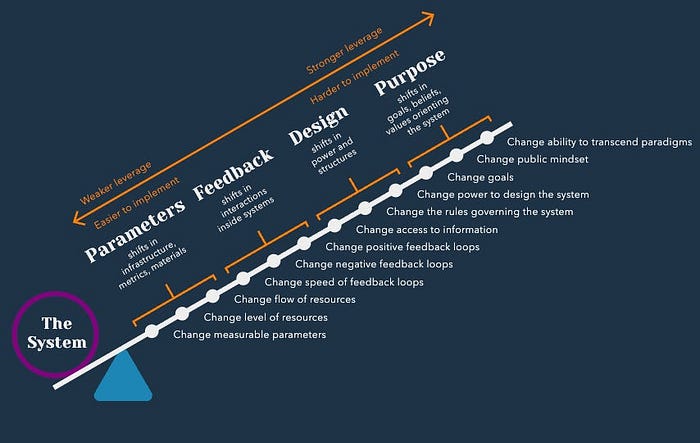
Around the same time, I was working on A New Education Story. One visual we used — an adaptation of Meadows' "places to intervene in a system," showed how tweaking parameters is far less powerful than changing structures or mindsets.
Systems thinking is usually applied to governments and economies, but looking at that graph, I realised I'd misapplied it to myself. I was obsessing over parameters — supplements, hacks, yet another protocol — while ignoring the underlying architecture of my life.
How I Changed My System From Always Sick to Never Sick
As much as I'd love to, I can't give you a James Clear–style 5-step action plan. Complex riddles don't work that way. They require sitting with the questions rather than rushing to quick, low-leverage fixes.
Advice I didn't follow in the beginning.
I chased the cure. I searched YouTube for "how to release shoulder pain" and ordered a hilariously expensive black foam roller ($65 — a fortune on my $1,900 teacher's salary). I went to three different doctors. An osteopath. A physician who recommended acupuncture I couldn't afford. Everyone offered short-term relief: a cortisol shot, a pressure point release, a pill.
I was intervening at the level of parameters — trying to numb the feedback loop rather than listening to it.
But I was 29, and I wasn't ready to accept that pain was just my new normal. So I promised myself I wouldn't stop asking questions until I solved the riddle.
Then came the first surprising answer, from a direction I didn't expect. I mentioned my shoulder pain to my mentor (not a doctor, not a therapist, just someone I trusted) and he said: "You need to build more muscle in your upper back. The pain will go away."
I avoided the gym because of the pain and my always-returning colds, not realizing the gym might be part of the cure.
Around the same time, my physician, after I told him acupuncture was too expensive, said I should humidify my rooms. Dry winter air was making my respiratory system vulnerable. So I got a vaporizer and put wet towels on the heaters.
Neither change felt like the solution, but the sinusitis subsided. With fewer sick weeks, I went to the gym more consistently.
Yet I remained sluggish.
My mentor asked non-judgmental questions about my lifestyle. At the time, I spent most weekends in the club until the lights came on. I was curious to see how my sleep was impacting my recovery and got a WHOOP to see what was actually happening to my body.
But those were the small interventions — parameter adjustments, in Meadows' language. The structural changes came later and were harder to name as such, because they looked less like optimization and more like my life falling apart.
I left teaching; despite loving it, the physical and mental demands sickened me. My ex-husband ended our marriage — a loving but unsustainable relationship. I ended friendships with those who crossed boundaries or avoided conflict. I said no to more things and spent more time in nature and community.
I must acknowledge what made these moves possible: savings, a powerful passport, no children, a self-sufficient ex-husband, and a flexible professional network. Unearned privileges underwrote every structural intervention. Systems thinking without this acknowledgment is just individualism with better vocabulary.
Slowly, I rested on tired days and trained hard on healthy ones. I haven't been sick in two years. The shoulder pain vanished. I have the body and energy I dreamed of — not because I became disciplined, but because I understood my system. I treated my problems with compassion rather than blame.
Solving Your Riddle
If I could sit down next to my younger self on that herringbone floor, I wouldn't hand her a framework. Frameworks were part of what broke her.
I'd point at her little stick-figure drawing — all those circles around the parts that hurt — and I'd say: That map is more useful than you think. But you're reading it wrong.
You're circling the symptoms. Circle inputs instead.
The shoulder and your recurring colds aren't the problem. The relentless job, the sleep debt, the draining relationships — those are the system. The pain is helpful feedback to guide you towards a more sustainable path.
Your riddle likely isn't shoulder pain and your feedback loop might not be physical. Dysfunction doesn't always look like sickness — sometimes it looks like procrastination, stagnation, or dread. Maybe it's the language learning plan you keep abandoning. The writing habit that won't stick. The skill you've started three times.
Before you blame your discipline, ask: What is my current system perfectly designed to produce?
If your writing habit keeps failing, the problem might not be your writing. It might be your energy. Trying to write at 9pm after a full day of decisions is like trying to sprint on a sprained ankle. The first step isn't "write 500 words" — it might be "write before I open my inbox."
If you keep abandoning a language, the problem might not be your motivation. It might be your method. Duolingo can feel and look productive but doesn't build the muscle of actually speaking.
A riddle feels impossible right up until the moment one new piece of information makes everything click — and systems work the same way.
You might not need a hand-drawn map of your body on a parquet floor. But if you're willing to circle your inputs instead of your flaws, you'll start to see your own riddles as solvable.