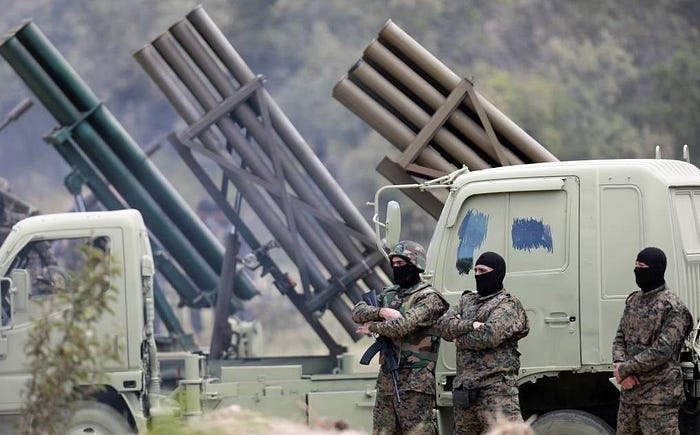
Here, we take a deep dive into the group known as Hezbollah. Who are they? How did they form? And what do they want?
Lebanon's largest city (also its capital), Beirut, has existed for around 5,000 years and was once a magnificent place. Alas, over the last half-century it has been reduced to an almost fictional dystopia.
After World War I, Lebanon was placed under the Mandate for Syria and Lebanon (mandat pour la Syrie et le Liban), a part of the dismantling of the Ottoman Empire.¹ Lebanon became independent during the second World War (in 1943). When the war ended, investment from Europe helped mold the country into a "regional intellectual capital… a major tourist destination and a banking haven," with Beirut at the center. Then, civil war broke out in 1975.² That internal conflict lasted 15 years, turning the once illustrious capital into a tragic wasteland.
As the civil war raged on, Israel invaded in 1982. The following year, the infamous barracks bombing occurred, an event that killed American soldiers and Lebanese civilians. At the same time, another attacker bombed the French Multinational Force headquarters. In total, the bombings left 307 people dead.
Those attacks were Hezbollah's first salvo.³
Formation
Hezbollah (Persian), or Hizbullah (Arabic), means "party of God." Consisting of Shia Muslims, it first formed as a loose collection of militias made up of the rural poor in southern Lebanon. Many who joined the ranks were inspired by Iran's 1979 revolution. That usurpation gave the Lebanese hope of ousting foreigners from their own country, specifically the Israelis, Europeans, and Americans.
When Ayatollah Ruhollah Khomeini seized power, he publicly cut ties with Israel over its efforts to advance western interests in the Middle East. Trita Parsi, executive vice president of the Quincy Institute for Responsible Statecraft, stated:
To overcome both the Arab-Persian divide and the Sunni-Shia divide, Iran adopted a much more aggressive position on the Palestinian issue to brandish its leadership credentials in the Islamic world and to put Arab regimes allied with the United States on the defensive.
As part of this 'more aggressive position,' Iran began building alliances with entities who opposed the west. Several of those entities would later become Hezbollah. Iran — specifically, the Iranian Revolutionary Guard (IRGC) — was instrumental in turning them from a disparate collection of like-minded militias into an organized entity.
Lebanon's militias converged into Hezbollah as a unified front against the murder or dispossession of Lebanese people. The entity's ire was primarily targeted at Israel because its "Peace for Galilee" operation — a part of its broader 'Operation Litani' — in 1982, drove 80% of the population from their homes, instantly turning them into refugees in crisis.
Israel invaded Lebanon in 1982 because Ariel Sharon (future Israeli PM, but defense minister at the time) wanted, among other things, to destroy the PLO (Palestine Liberation Organization), which was headquartered in Lebanon. It was claimed that Palestinian special forces had continuously attacked Israeli interests since the 1970s, operating primarily from Lebanon.⁴
Notably, Henry Kissinger and Richard Nixon lumped Palestine in with other supposed 'Soviet proxies' and, thus, backed Israel on the issue. Jimmy Carter furthered this support through his 'Carter doctrine,' whose primary purpose was to more strongly project US power in the Middle East.
In the time leading up to the 1982 invasion, it was apparent Israel intended to annex lands in the West Bank and Gaza Strip. In April 1981, for instance, Israeli Army spokesman Brigadier General Yaakov Even said:
We are on the offensive. We are the aggressors. We are penetrating the so-called border of the so-called sovereign state of Lebanon and we go after them wherever they hide.⁵
His use of 'so-called' clearly illustrates his view of the sovereignty of Lebanon and, arguably, of any land he wanted to acquire.
When Israeli forces reached Beirut, they bombed the Palestinian refugee camp Shatila (among other areas). After the bombing, someone assassinated the leader of the Phalange, Israel's proxy militia in Lebanon.⁶ In response, Phalange troops entered the refugee camps Sabra and Shatila and "murdered as many as 3,500 people, mostly Palestinians but also some Lebanese, most of them women, children, and the elderly."
An Israeli commission chartered with investigating the incident found "indirect responsibility" for the massacre among certain officials, such as Prime Minister Menachem Begin, Sharon, and IDF Chief of Staff Raful Eitan. Sharon lost his post as defense minister following the investigation, but remained in the Israeli cabinet.
Two decades later, the highest court in Belgium ruled criminal charges against Sharon and others involved in the massacre could proceed. Elie Hobeika, the leader of the Phalange's assault on the camp, was prepared to testify against Sharon in those proceedings, but was killed at his home by a bomb before the trial.
No one faced any real justice for the massacre. Some, like Sharon, lost their position temporarily, but nothing more.
Philosophical declaration and development
Nathan William Swanson, in his 2008 Master's thesis for Iowa State University, theorized the success of Hezbollah — compared to other militant Muslim groups — was based in the character of its leader, Hassan Nasrallah. Across the Middle East, Swanson wrote, one can find Nasrallah's image posted everywhere, and around him had formed a sort of 'cult of personality.' This turned him into a key political figure in the region. (Dr. Swanson is now professor of political and cultural geography at Perdue).
Nasrallah produced an 'Open Letter' on February 16, 1985, which laid out the broader philosophy and intent of Hezbollah. In it, he declared the men of Hezbollah — the sons of the umma (Muslim community), as he called them — operate under the rule of Ayatollah Khomeini. Rather than an "organized and closed party," they are a group "linked to the Muslims of the whole world by the solid doctrinal and religious connection of Islam, whose message God wanted to be fulfilled by the Seal of the Prophets, i.e., Muhammad" (p. 2).
Benedetta Berti, a research fellow at the Institute for National Security Studies (INSS), noted the letter generally held that Hezbollah wanted "all foreign presence" out of Lebanon, and that the Muslim community at large be left alone (p. 93).
While Nasrallah frequently mentioned the West, most of the 1985 letter focused its ire on Israel. To illustrate, one passage said:
We see in Israel the vanguard of the United States in our Islamic world. It is the hated enemy that must be fought until the hated ones get what they deserve. This enemy is the greatest danger to our future generations and to the destiny of our lands, particularly as it glorifies the ideas of settlement and expansion, initiated in Palestine, and yearning outward to the extension of the Great Israel, from the Euphrates to the Nile (p. 7).
The massacre by the Phalange served as acute motivation and indicated why Hezbollah lumped western powers into its target matrix:
In a single night the Israelis and the Phalangists executed thousands of our sons, women and children in Sabra and Shatila. No international organization protested or denounced this ferocious massacre in an effective manner, a massacre perpetrated with the tacit accord of America's European allies, which had retreated a few days, maybe even a few hours earlier, from the Palestinian camps (p. 3).
In November 2009, Hezbollah issued its manifesto, the only other written rendition of its political doctrine. Berti characterized this second piece as "adopt[ing] and develop[ing] these same concepts, showing, however, a greater degree of political sophistication" (p. 93). For example, while the content was quite similar to the Open Letter, the terminology used in the manifesto appealed to "antiglobalists" and "leftists."
From 1985 to his death, Nasrallah turned Hezbollah into both a military and political force. Internally, he developed a complex hierarchy upon which he occupied the top role (aside from the Ayatollah). He headed the seven-member Shura Council and its five sub-councils: the political assembly, the jihad assembly (military body), the parliamentary assembly, the executive assembly, and the judicial assembly. Iran's Supreme Leader serves as the deciding vote when the Shura Council cannot agree on a decision.
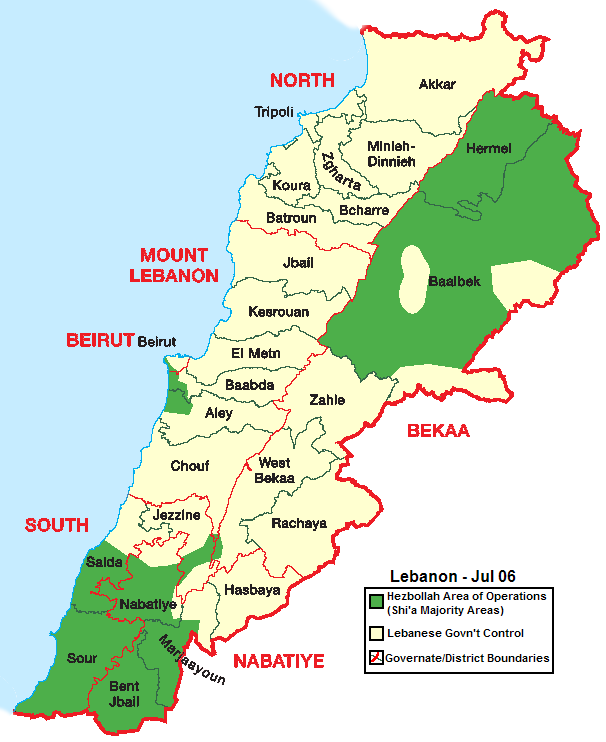
Hezbollah is also a political party in Lebanon's central government, first elected into parliament in 1992. It has held seats in the cabinet since 2005. In areas where its authority is unchallenged, it operates both military and social infrastructure, such as health-care facilities, schools, and youth programs. In those regions, it effectively functions as a government. Its military is estimated to consist of around 50,000 soldiers with hundreds of thousands of rockets, missiles, and other munitions.
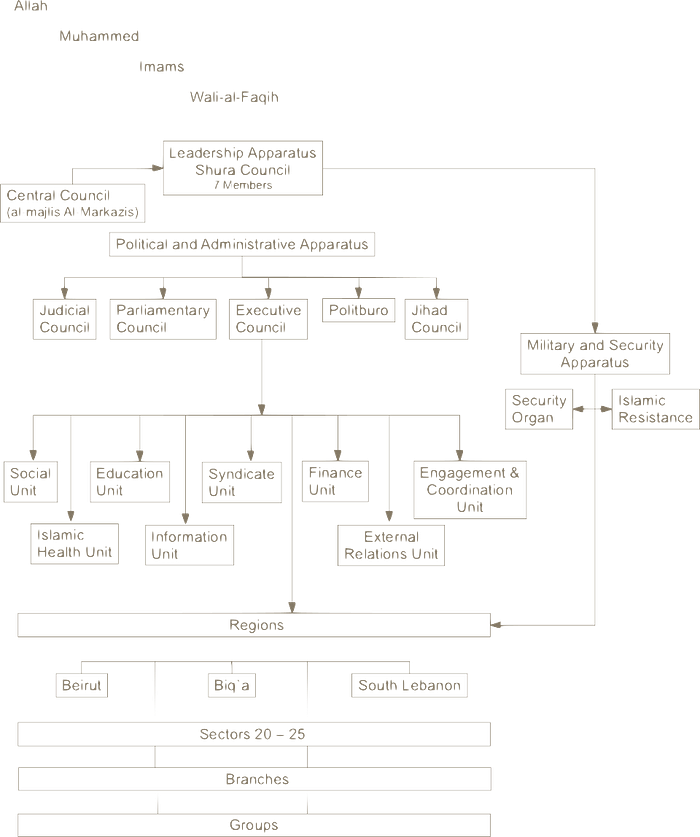
Nasrallah served as Hezbollah's leader until September 2024, when he was killed by an Israeli airstrike. Today, the organization's structure and leadership are less clear in light of recent military exchanges with Israel that led to the deaths of many of Hezbollah's leadership. (Naim Qassem succeeded Nasrallah, though he is in his seventies and appears to be in hiding, according to some reports).
Both the letter and manifesto further outlined the need to engage in what has been classified as 'terrorism,' a tactic upon which Hezbollah routinely relies. As many groups understand it, terrorism is merely an element of asymmetric warfare, characterized in such a way as to impugn the weaker side.
Asymmetric warfare or terrorism?
The American government's definition of terrorism is:
The unlawful use of force or violence against persons or property to intimidate or coerce a Government, the civilian population, or any segment thereof, in furtherance of political or social objectives.
Asymmetric warfare is generally defined as an imbalance of "power, means, methods, organization, values, and time" between or among conflicted entities.
Alexander Treiblmaier, from the University of Vienna, notes:
This asymmetry of conflict is mostly expressed in the areas of manpower, equipment, and the level of technological expertise of the armed forces or combatants. A terrorist group is thus clearly inferior to a conventional armed force in terms of troop strength, armament, mobility, and protection. This forces such groups to avoid conventional confrontation and to use "irregular" procedures. Therefore, from a historical point of view, asymmetry in warfare is the rule and symmetry is the exception.
As Toni Pfanner points out, asymmetrical capabilities are reflected both militarily and legally. In other words, the weaker one side is militarily, the lower its chances are of justifying its actions before legal bodies, such as the UN Security Council. This typically leads weaker parties to resort to religious or moral defenses that appeal to the public rather than political sphere. He adds, "the idea that it is the sovereign's prerogative (only) to wage war still pervades almost all international treaties concerned with war."
When states fight non-state parties, however, the non-state actor is often treated as "illegitimate," irrespective of its motive for fighting or the tactics used against it by the opposing state. This often leads state politicians to apply labels to non-state actors, such as "criminals" or "terrorists," while their own armies engage in the equally atrocious, such as slaughtering noncombatants or targeting civilian infrastructure.
Hezbollah falls into a curious gray area. It is, in some ways, a state in and of itself, yet it is not legally recognized as such. Nevertheless, it obviously has military capability, associates itself with a specific geographic area, and oversees very state-like functions such as healthcare and education. In fact, Hezbollah's hostilities toward Israel and, less recently, the US and European powers, arise from assaults against that area and the people who reside within it.
Do not misinterpret any of this as an argument in favor of Hezbollah's tactics. Lobbing missiles or exploding bombs in civilian areas — something Hezbollah has admitted to doing — is no more morally or legally justified than the Americans and Israelis targeting hospitals and schools in Lebanon or Iran. Yet, that's also precisely the point. If all the entities involved target civilians and civilian infrastructure, how is only one of them a terrorist organization?
Going forward
Hezbollah does not appear to be going away. Despite its repeated violent exchanges with Israel over the past several decades, the organization has proved to be quite resilient. The current war the United States and Israel launched on Iran and Lebanon has exhibited Hezbollah's continued military capabilities.
Iran's stance in its tenuous peace negotiations with the United States is clear: unless it is compelled to capitulate by force (a scenario that looks less probable by the day), Iran will persist in demanding that Israel not only cease its attacks against Hezbollah, but also pull out of Lebanon completely. It seems to me that would be the best prospect to achieve actual peace in the Middle East, but Israel will certainly reject such a concession unless it is somehow compelled.
For now, the world is resigned to waiting and seeing. In the meantime, people everywhere will increasingly suffer as the shockwaves from the sudden loss of roughly 10% of the world's energy supply reverberate across the oceans. While global citizens suffer from these depravations, the people of the Middle East face all the horrors of an ongoing, brutal war.
If you find my work informative and care to offer a little something in support, feel free to buy me a coffee. See below for additional sources consulted for this essay and the footnotes.
Additional sources:
Bodansky, Yossaf. The High Cost of Peace; How Washington's Middle East Policy Left America Vulnerable to Terrorism. Forum. (2002).
Byrne, Malcolm. "Critical Oral History: A new approach to examining the United States' role in the war," in The Iran-Iraq War: New International Perspectives. Routledge. (2013).
Jaber, Hala. Hezbollah; Born with a Vengeance. Columbia University Press. (1997).
Krämer, Gudrun. A History of Palestine; From the Ottoman Conquest to the Founding of the State of Israel. Princeton University Press. (2008).
Norton, Augustus R. Hezbollah; A Short History. Princeton University Press. (2014).
Pappe, Ilan. A Very Short History of the Israel-Palestine Conflict. Oneworld Publications. (2024).
Ze'ev Schiff and Ehud Ya'ari. Israel's Lebanon War, Simon and Schuster. (1985).
Footnotes:
1 — Myers, Denys P. (January 1, 1921). "The Mandate System of the League of Nations," The Annals of the American Academy of Political and Social Science. Vol. 96, pp. 74–77.
2 — There are differing views over the cause of the Lebanese civil war. To read some first-hand perspectives, visit here.
3 — Some scholars argue these events were conducted by a loose coalition of actors and thus do not constitute the origin of Hezbollah. Regardless of the specific inaugural event, most agree that by 1985 the entity Hezbollah firmly existed and was engaging in attacks.
4 — The Palestinian view has long held that Israel was illegally granted Palestinian land, and then the Israelis continued to procure more (also illegally). When Arab states lost wars against Israel in 1948 and 1956 over this very issue, asymmetric conflict (often called terrorism) became the go-to method of resistance.
5— Ryan, Sheila. "Israel's Invasion of Lebanon: Background to the Crisis," Journal of Palestine Studies, Vol. 11/12, Vol. 11, no. 4 — Vol. 12, no. 1, Special Issue: The War in Lebanon (1982), pp. 23–37.
6 — Bashir, the Lebanese Phalange leader, was killed by a bomb placed in the apartment above his. Who planted the explosive remains unknown. Rumors spread among the Lebanese that the Israelis killed him to provide a pretext to invade. These rumors were grounded in the fact that many Lebanese believed Bashir did not intend to allow the Phalange to serve as a "front" for Israel. Members of the US State Department did not think this was true or that an Israeli killed Bashir, but they did agree Israel used the killing as a predicate to invade. See the account by Robert Dillon, Ambassador to Lebanon, 1981–1983, here.